Get your free personalized podcast brief
We scan new podcasts and send you the top 5 insights daily.
An anecdote about a "wonky" BindCraft design with disconnected beta sheets, which experts predicted would fail, highlights a key trend. The resulting binder was one of the best ever produced, suggesting AI models are extracting structural principles that go beyond traditional human "protein literacy" and intuition.

Related Insights
Unlike generative tools that always produce an output, BindCraft sometimes yields no passing designs. This "failure" is a valuable feature, acting as a strong negative predictor that saves researchers months of wasted lab effort on low-probability targets. This builds user confidence in the designs that do pass.
Bolts Gen's protein design model simplifies its task by predicting only the final 3D atomic structure. Because different amino acids have unique atomic compositions, the model's placement of atoms implicitly determines the protein's sequence, elegantly merging two traditionally separate prediction tasks.

An AI model analyzing drug delivery peptides discovered that adding a flexible amino acid before the active end group significantly improved cell entry. This was not a commonplace understanding in the field. Initially questioned by chemists, the insight was experimentally validated, showing how AI can augment human expertise by revealing novel scientific mechanisms.

The design tool isn't a passive executor. Its multi-component loss function, optimizing for properties like foldedness, can override a user's chosen binding site if it's suboptimal. This "AI agency" is a key feature that contributes to its high success rate in the lab.
Instead of screening billions of nature's existing proteins (a search problem), AI-powered de novo design creates entirely new proteins for specific functions from scratch. This moves the paradigm from hoping to find a match to intentionally engineering the desired molecule.

John Jumper uses an analogy to explain the leap in complexity from prediction to design. Predicting a protein's structure is like recognizing a bicycle's parts. Designing a new, functional protein is like building a working bicycle—requiring every detail to be correct.

Generate Biomedicines' AI learns the fundamental rules of protein structure and function, much like a language's grammar. This allows it to design entirely new proteins by generating novel "sentences" (sequences) that are biologically coherent and functional, rather than just mimicking existing ones found in nature.

The pipeline's high success rate stems from its final filter, which uses an AlphaFold model trained only on single proteins (monomers) to predict a protein complex. The rationale is that if a model naive to complexes can still predict the interaction, the interface must be exceptionally strong and well-defined.
Generative AI alone designs proteins that look correct on paper but often fail in the lab. DenovAI adds a physics layer to simulate molecular dynamics—the "jiggling and wiggling"—which weeds out false positives by modeling how proteins actually interact in the real world.
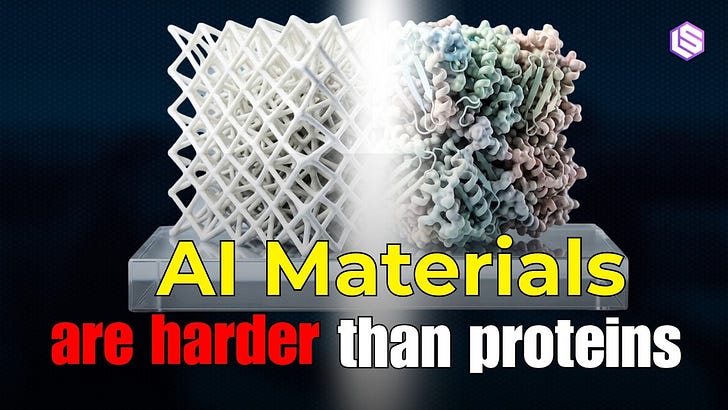
AI models can screen vast material spaces to identify novel solutions that defy conventional chemical intuition. Heather Kulik's group used AI to discover a quantum mechanical phenomenon that made a polymer four times tougher, a design experimentalists admitted they would never have conceived on their own.