Get your free personalized podcast brief
We scan new podcasts and send you the top 5 insights daily.
Atlassian discovered that having cross-functional teams exclusively write code with AI initially accelerated output, but quickly stalled progress. Without dedicated product and design leaders steering strategy and unblocking decisions, development velocity degenerates into aimless spinning.

Related Insights
Speeding up just the coding phase with AI doesn't increase overall project delivery speed. It merely shifts the bottleneck to other parts of the Software Development Life Cycle (SDLC) like design, review, or deployment. To achieve real throughput gains, the entire end-to-end workflow must be optimized.
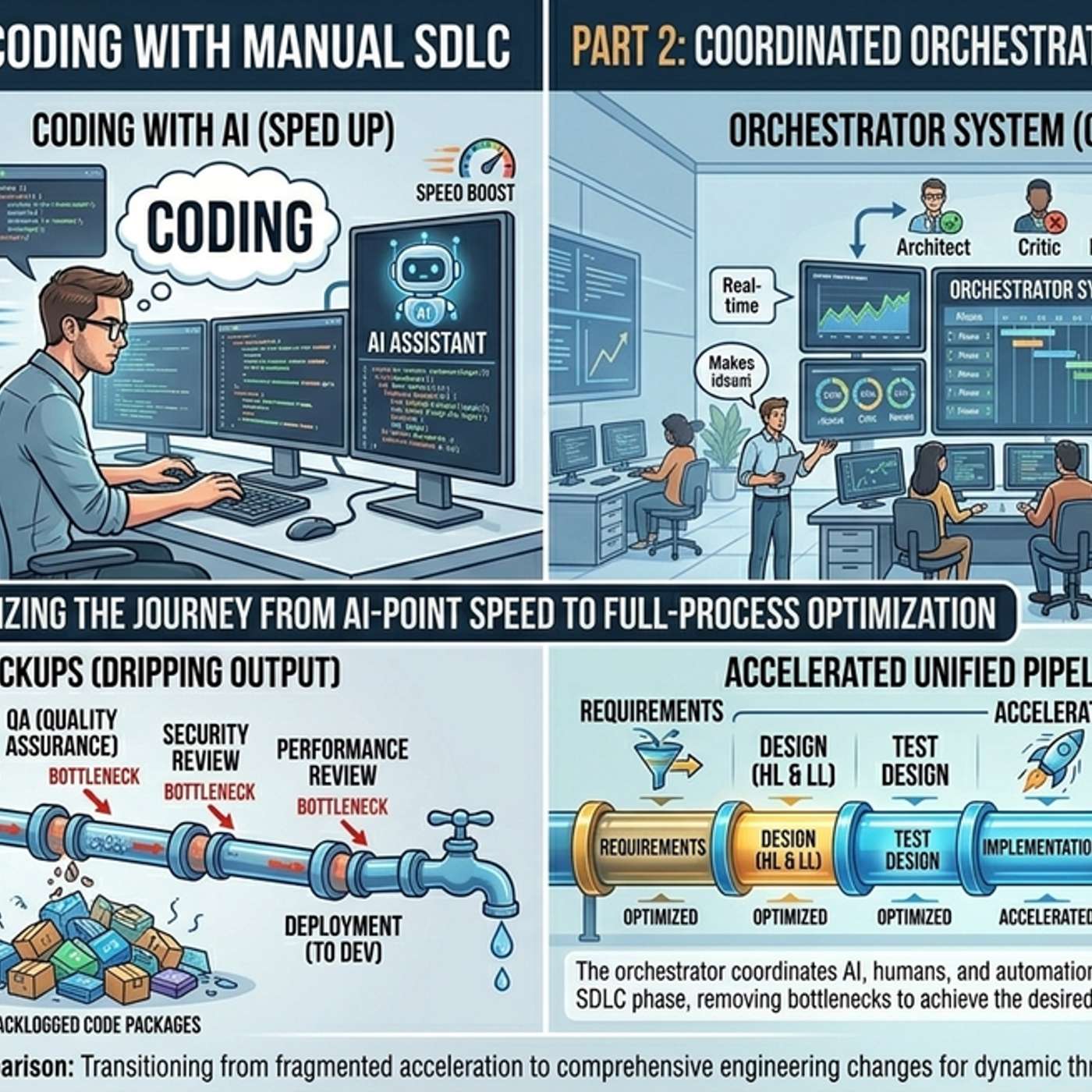
Paychex found that initially using AI to accelerate coding only created a backlog for product and design teams. This reveals that a holistic process change across the entire software development lifecycle is needed, rather than optimizing a single function in isolation.

AI coding assistants can make engineers so hyper-productive that they mistakenly believe they can handle the entire product lifecycle alone. This leads them to ignore critical inputs like design, customer briefs, and collaboration, resulting in technically functional but ultimately useless products.
AI tools are rapidly increasing developer output. If product managers don't adopt similar AI-native tools to accelerate their own workflows—like product judgment, research, and planning—they will become the primary constraint on the entire development lifecycle.

AI has compressed development cycles from weeks to days, but it hasn't equally accelerated human coordination. The new bottleneck is getting stakeholders aligned on strategy, planning user communication, and managing the "fuzzy" aspects of a launch. While coding saw a 100x speed-up, these coordination problems remain.

AI tools dramatically speed up code implementation, making engineering velocity less of a constraint. The new challenge becomes the slower, more considered process of deciding *what* to build, placing a premium on strategic design thinking and choosing when to be deliberate.

An engineering org was effective at using AI for delegating and assessing code, but failed to tackle large problems. The missing piece was a dedicated 'planning phase' to scaffold significant work before execution. Without it, their AI-driven compounding of learnings was limited to small, incremental gains.
While AI dramatically increases development speed, it's a double-edged sword. Without a solid product foundation, user understanding, and clear principles, teams will simply accelerate the shipment of low-value features. AI amplifies both good and bad practices.

Without a strong foundation in customer problem definition, AI tools simply accelerate bad practices. Teams that habitually jump to solutions without a clear "why" will find themselves building rudderless products at an even faster pace. AI makes foundational product discipline more critical, not less.

As AI tools dramatically increase engineering leverage (2-3x), the traditional 5-engineer, 1-PM, 1-designer team structure breaks. The PM and designer become bottlenecks, struggling to manage what is effectively a 15-20 person engineering team's output, forcing a rethink of team ratios and roles.