Get your free personalized podcast brief
We scan new podcasts and send you the top 5 insights daily.
Paychex found that initially using AI to accelerate coding only created a backlog for product and design teams. This reveals that a holistic process change across the entire software development lifecycle is needed, rather than optimizing a single function in isolation.

Related Insights
Speeding up just the coding phase with AI doesn't increase overall project delivery speed. It merely shifts the bottleneck to other parts of the Software Development Life Cycle (SDLC) like design, review, or deployment. To achieve real throughput gains, the entire end-to-end workflow must be optimized.
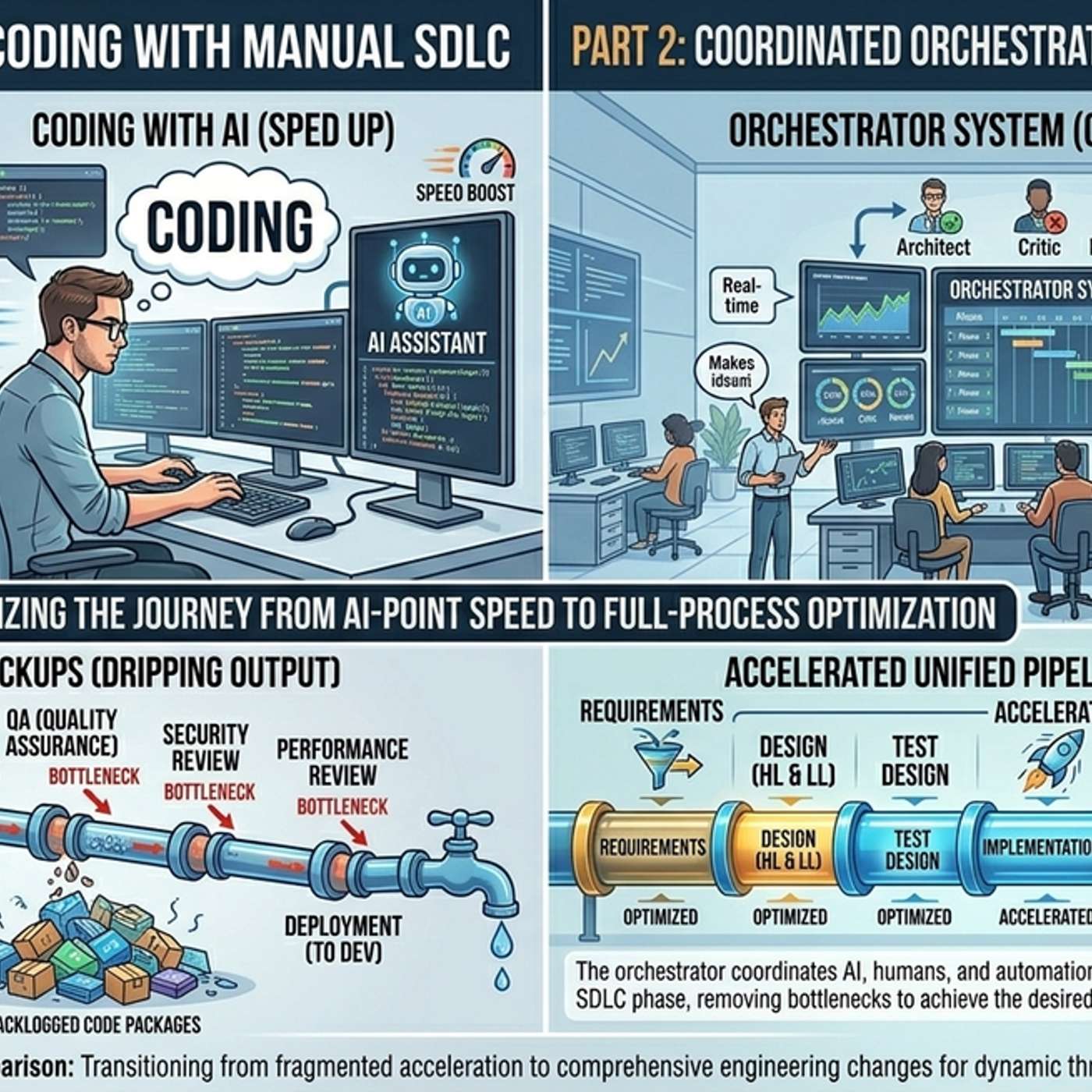
The most significant productivity gains come from applying AI to every stage of development, including research, planning, product marketing, and status updates. Limiting AI to just code generation misses the larger opportunity to automate the entire engineering process.

With AI making code generation cheap, the limiting factors for development velocity are now defining what to build (product) and ensuring its quality (review). Engineers will increasingly focus on high-level systems architecture rather than typing code.

AI tools dramatically speed up code implementation, making engineering velocity less of a constraint. The new challenge becomes the slower, more considered process of deciding *what* to build, placing a premium on strategic design thinking and choosing when to be deliberate.

As AI coding agents make engineers more productive, the development bottleneck eases. The new constraint becomes product management—understanding user needs and business impact. This shift will necessitate a higher ratio of product managers to engineers to effectively guide the accelerated development cycle.

With AI accelerating development, the key challenge is no longer building faster; it's getting completed features through legal, marketing, and other operational hurdles. Organizations must now re-engineer these internal processes to match the new pace of creation.

As AI tools dramatically increase engineering leverage (2-3x), the traditional 5-engineer, 1-PM, 1-designer team structure breaks. The PM and designer become bottlenecks, struggling to manage what is effectively a 15-20 person engineering team's output, forcing a rethink of team ratios and roles.

The feeling of being overwhelmed by AI stems from applying new technology to old structures like quarterly roadmaps and PRDs. The real solution isn't just faster work, but re-architecting the entire product development process to natively leverage AI, much like building superhighways for cars instead of using old horse trails.

The proliferation of AI has dramatically reduced development time, shifting the primary constraint in product delivery from engineering capacity to the customer's ability to learn and integrate new features into their workflow. More output no longer guarantees more value.

While AI tools have massively accelerated developer velocity by up to 10x, design tool acceleration has lagged at only 1.5-2x. This imbalance makes the design phase a new critical bottleneck in the product development lifecycle.
