Get your free personalized podcast brief
We scan new podcasts and send you the top 5 insights daily.
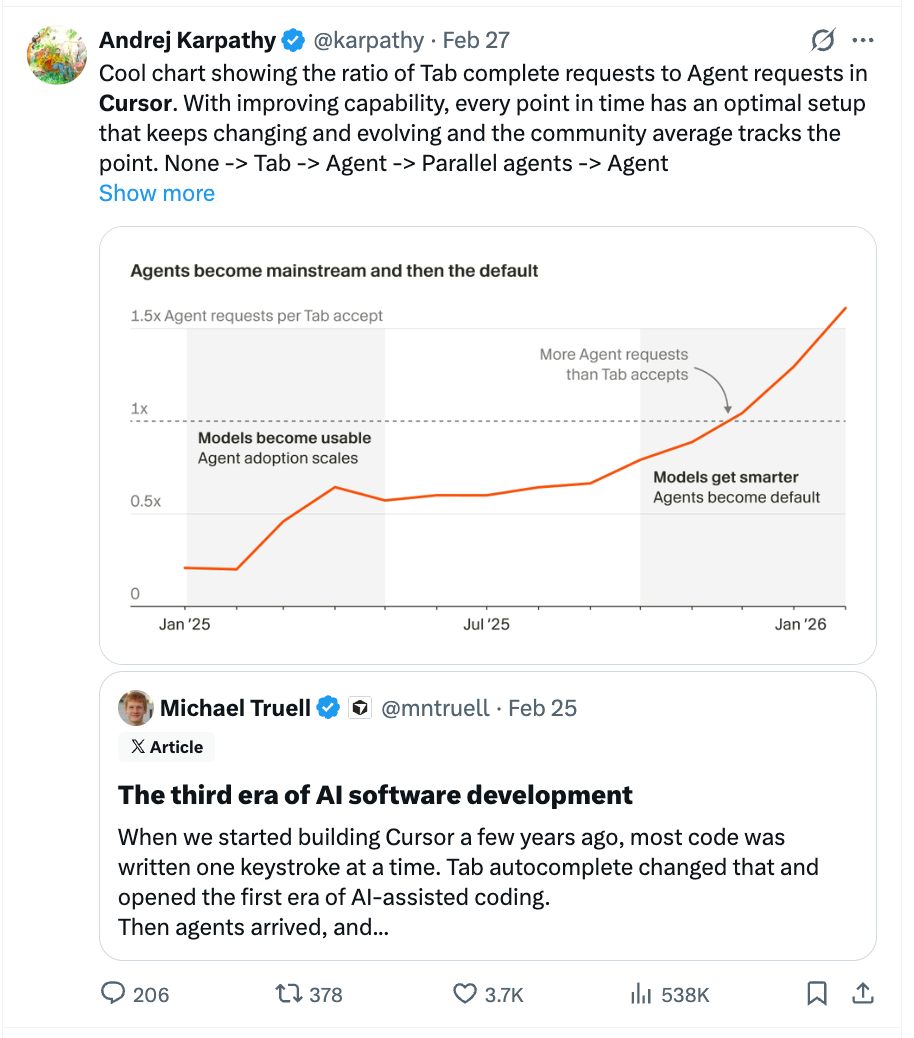
To encourage a shift in user behavior, Cursor "unshipped" a file editor from its web UI. By restricting the ability to make small manual tweaks, they push users to delegate changes to the AI agent, reinforcing the new pattern of high-level instruction over low-level "hand coding."
Related Insights
The interaction model with AI coding agents, particularly those with sub-agent capabilities, mirrors the workflow of a Product Manager. Users define tasks, delegate them to AI 'engineers,' and manage the resulting outputs. This shift emphasizes specification and management skills over direct execution.

An internal OpenAI team maintains a codebase written entirely by AI. By removing the "escape hatch" of manual coding, they are forced to solve fundamental problems in providing better context and documentation to the AI, thus uncovering best practices for agent interaction.

Cursor discovered that agents need more than just code access. Providing a full VM environment—a "brain in a box" where they can see pixels, run code, and use dev tools like a human—was the step-change needed to tackle entire features, not just minor edits.
The emerging paradigm is a central coding agent with multiple specialized input tools. A canvas tool (like Paper) will be for visual prompting, an IDE (like Cursor) will be for code refinement, and a text prompt will be for direct commands, all interoperating with the same agent to build software.
At Cursor, development is increasingly happening in Slack channels. Team members collectively kick off and redirect a cloud agent in a thread, turning development into a collaborative discussion. The IDE becomes a secondary tool, while communication platforms become the primary surface.
In this software paradigm, user actions (like button clicks) trigger prompts to a core AI agent rather than executing pre-written code. The application's behavior is emergent and flexible, defined by the agent's capabilities, not rigid, hard-coded rules.

Instead of writing Python or TypeScript to prototype an AI agent, PM Dennis Yang writes a "super MVP" using plain English instructions directly in Cursor. He leverages Cursor's built-in agentic capabilities, model switching, and tool-calling to test the agent's logic and flow without writing a single line of code.

Instead of prompting for code line-by-line, "Plan Mode" has the AI agent generate a detailed plan in a markdown file first. The user reviews and modifies this plan like a spec document, elevating their role from coder to architect before the AI executes the build.

Cursor's visual editor allows designers to make minor adjustments to UI elements like padding and spacing directly, bypassing the need for constant AI prompting. This speeds up experimentation but doesn't replace dedicated design tools like Figma.
Historically, developer tools adapted to a company's codebase. The productivity gains from AI agents are so significant that the dynamic has flipped: for the first time, companies are proactively changing their code, logging, and tooling to be more 'agent-friendly,' rather than the other way around.
