Get your free personalized podcast brief
We scan new podcasts and send you the top 5 insights daily.
The narrative of 'AI eating SaaS' is overblown, according to Robinhood's CFO. Foundational 'tools of record' like Workday remain essential. He argues engineering talent is better spent on customer-facing AI products than on rebuilding mature internal enterprise software.

Related Insights
SaaS companies are not equally vulnerable to AI. Some (like Zendesk) tie seats to work AI can replace. Others (like Workday) use seats as a proxy for company size and are safer. Markets are currently failing to differentiate, creating a valuation gap worth understanding.

Contrary to fears of AI making SaaS obsolete, the reality is that most enterprise software is deeply flawed. A contrarian view is that AI will provide the tools to finally rebuild these systems better, creating a massive new wave of demand for software development and product design.
Investor Mitchell Green argues that the fear of AI "vibe coding" away SaaS businesses is overblown. Incumbents like Workday spent decades building trust and deep enterprise integrations, a moat that can't be easily replicated with code alone, regardless of AI's power.

While replacing complex systems like Workday with AI is impractical, the real opportunity is in extensibility. AI allows users to build small, custom apps on top of existing platforms, solving specific needs and making the core SaaS product even stickier and more valuable.
The 'SaaS-pocalypse' narrative is flawed because IT/SaaS is only 8-12% of enterprise spend. Companies will use powerful AI models to create value in the other 90% of their business—like operations and sales—rather than just rebuilding core software like ERPs or CRMs where the financial upside is limited.
SaaS value lies in its encoded business processes, not its underlying code. AI's primary impact will be forcing SaaS companies to adopt natural language and conversational interfaces to meet new user expectations. The backend complexity remains essential and is not the point of disruption.
The market has overreacted to AI's threat to SaaS giants like Salesforce and Adobe. While AI can replicate code, it cannot easily replace the years of deep integration into client billing, customer service, and employee training. These high switching costs are being ignored, making their stocks undervalued.

The idea that AI will eliminate SaaS is overblown because it incorrectly projects small startup behavior onto large enterprises. Fortune 100s face immense change management, security, and maintenance challenges, making replacing established vendors with internal AI-coded tools impractical.
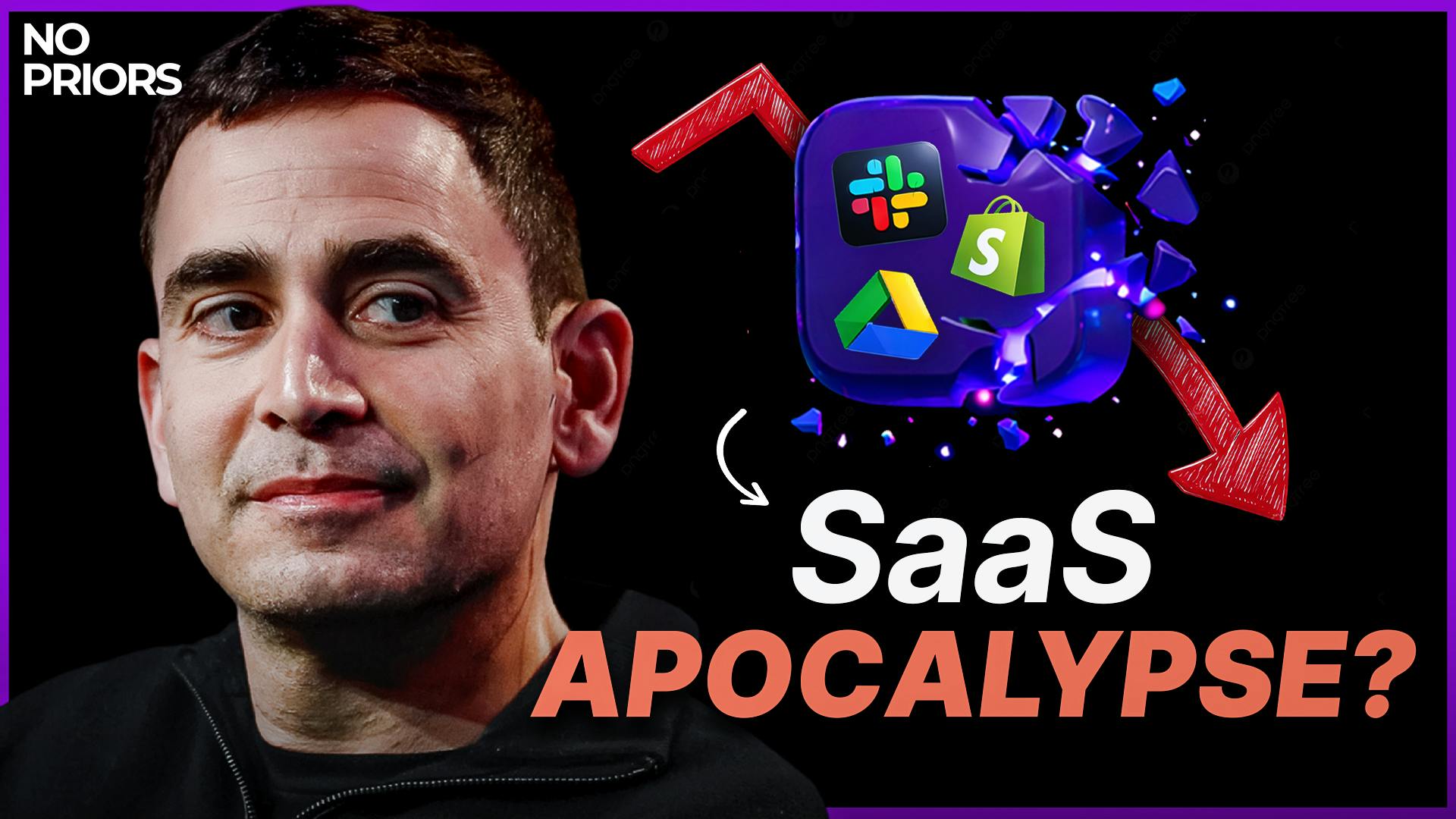
The threat of AI to SaaS is overstated for companies that own either a deep relationship with the user or a critical system of record. "Glue layer" SaaS companies without these moats are most at risk, while those like Salesforce (owning the customer relationship) are more durable.
Contrary to the 'SaaSpocalypse' narrative, Jensen Huang believes AI agents will use existing SaaS tools rather than replace them. This will increase demand for best-in-class software like databases, as it's more efficient for an agent to leverage an existing tool than to build one from scratch.