Get your free personalized podcast brief
We scan new podcasts and send you the top 5 insights daily.
The landscape of AI tools and tactics changes rapidly. Instead of chasing the latest setup guides, focus on understanding the underlying design and engineering philosophies. This knowledge is more durable and allows you to adapt to new tools as they emerge.

Related Insights
The most effective users of AI tools don't treat them as black boxes. They succeed by using AI to go deeper, understand the process, question outputs, and iterate. In contrast, those who get stuck use AI to distance themselves from the work, avoiding the need to learn or challenge the results.

Overly structured, workflow-based systems that work with today's models will become bottlenecks tomorrow. Engineers must be prepared to shed abstractions and rebuild simpler, more general systems to capture the gains from exponentially improving models.

Newcomers to AI development often fall into 'analysis paralysis,' endlessly comparing low-code tools instead of starting a project. The specific tool is less important than the hands-on learning gained from building. The key is to pick one and start, as the real learning happens only through action.

Vercel designer Pranati Perry advises viewing AI models as interns. This mindset shifts the focus from blindly accepting output to actively guiding the AI and reviewing its work. This collaborative approach helps designers build deeper technical understanding rather than just shipping code they don't comprehend.

Instead of asking an AI to directly build something, the more effective approach is to instruct it on *how* to solve the problem: gather references, identify best-in-class libraries, and create a framework before implementation. This means working one level of abstraction higher than the code itself.

Building an AI application is becoming trivial and fast ("under 10 minutes"). The true differentiator and the most difficult part is embedding deep domain knowledge into the prompts. The AI needs to be taught *what* to look for, which requires human expertise in that specific field.
When developing AI-powered tools, don't be constrained by current model limitations. Given the exponential improvement curve, design your product for the capabilities you anticipate models will have in six months. This ensures your product is perfectly timed to shine when the underlying tech catches up.

The key technical skill for an AI PM is not deep knowledge of model architecture but a higher-level understanding of how to orchestrate AI components. Knowing what AI can do and how systems connect is more valuable than knowing the specifics of fine-tuning or RAG implementation.
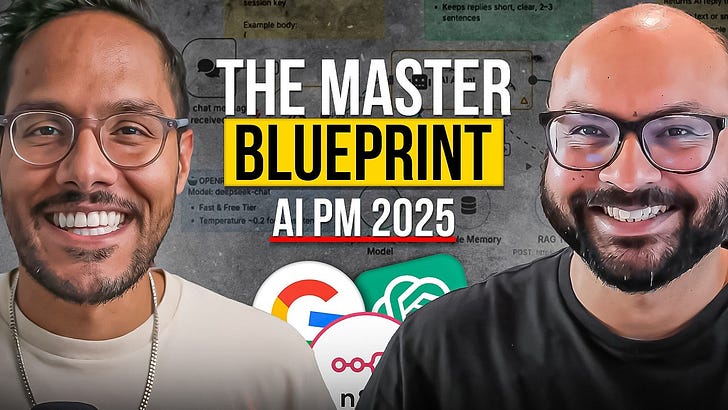
To stay current in a fast-moving field like AI, passive learning through articles and videos is insufficient. The key is active engagement: experimenting with new platforms, trying new features as they launch, and even building small applications to truly understand their capabilities and limitations.
The key differentiator for companies succeeding with AI isn't technical prowess but mastery of core behaviors: flexibility, targeted incremental delivery, being data-led, and cross-functional teams. Strong fundamentals are the prerequisite for benefiting from advanced technology.
