Get your free personalized podcast brief
We scan new podcasts and send you the top 5 insights daily.
Top mathematician Timothy Gowers was relieved an AI model disproved a conjecture with a counterexample rather than proving it, considering the former an 'easier' task. This reaction from one of the world's smartest people highlights the palpable and imminent arrival of superhuman intelligence.

Related Insights
The moment the future felt real wasn't a benchmark score, but when a reasoning model, solving a puzzle live, said "oh, damn it" upon realizing its own mistake. This emergent, un-programmed, and human-like self-correction was a profoundly humbling sign of latent capabilities.

A skeptical mathematician designed a problem based on 20 years of his research, intended to be impossible for AI. When GPT-5.4 Pro solved it with a creative, 'almost human' solution, he declared his 'personal singularity' had arrived, embracing AI as a top-tier collaborator.

Framing AGI as reaching human-level intelligence is a limiting concept. Unconstrained by biology, AI will rapidly surpass the best human experts in every field. The focus should be on harnessing this superhuman capability, not just achieving parity.

AI has reached a milestone by solving a theoretical physics problem that human experts were unable to resolve for over a year. This demonstrates AI's emerging superhuman capabilities in highly specialized scientific domains, marking a profound shift in research.
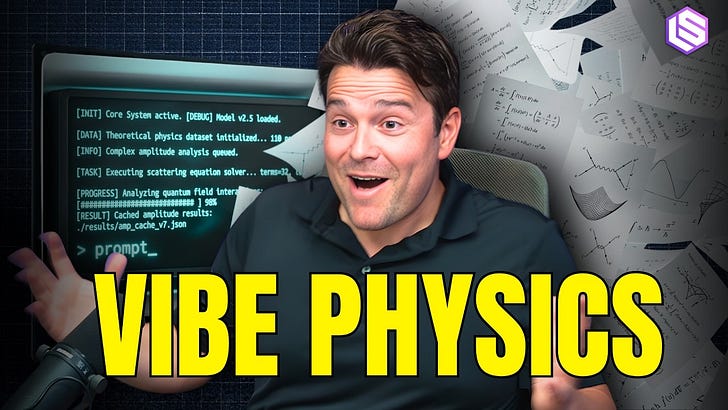
A theoretical physicist's skepticism about AI vanished when GPT-5 reproduced one of his most complex, significant research papers in half an hour. This personal "move 37" moment highlights the shocking speed of AI progress and its ability to master highly specialized knowledge.
While public discourse on AI models often focuses on incremental improvements in common tasks like writing emails, the most profound advancements are happening in specialized fields like science and mathematics. This capability gap creates a disconnect in perceived progress.
The discourse around AGI is caught in a paradox. Either it is already emerging, in which case it's less a cataclysmic event and more an incremental software improvement, or it remains a perpetually receding future goal. This captures the tension between the hype of superhuman intelligence and the reality of software development.
Dan Siroker argues AGI has already been achieved, but we're reluctant to admit it. He claims major AI labs have 'perverse incentives' to keep moving the goalposts, such as avoiding contractual triggers (like OpenAI with Microsoft) or to continue the lucrative AI funding race.

Current AI models exhibit "jagged intelligence," performing at a PhD level on some tasks but failing at simple ones. Google DeepMind's CEO identifies this inconsistency and lack of reliability as a primary barrier to achieving true, general-purpose AGI.
We perceive complex math as a pinnacle of intelligence, but for AI, it may be an easier problem than tasks we find trivial. Like chess, which computers mastered decades ago, solving major math problems might not signify human-level reasoning but rather that the domain is surprisingly susceptible to computational approaches.
