Get your free personalized podcast brief
We scan new podcasts and send you the top 5 insights daily.
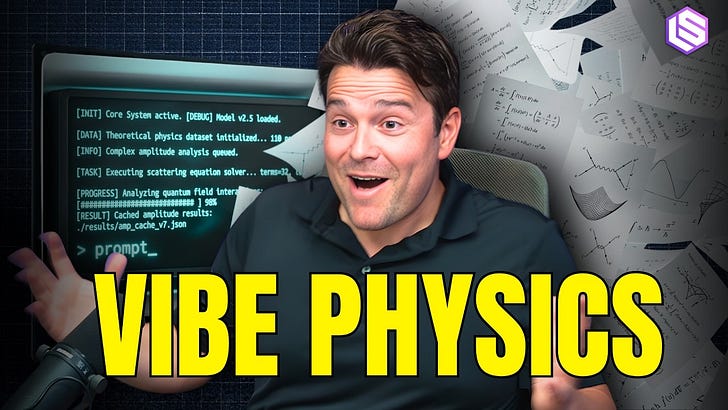
AI has reached a milestone by solving a theoretical physics problem that human experts were unable to resolve for over a year. This demonstrates AI's emerging superhuman capabilities in highly specialized scientific domains, marking a profound shift in research.
Related Insights
The physics breakthrough provides a scalable template for AI-assisted research. The model involves AI identifying patterns and generating hypotheses from data, with human experts then responsible for rigorous validation and ensuring consistency. This is augmented, not autonomous, science.

The new AI model is not just an incremental improvement. For top experts like mathematician Bartosz, it's solving problems they've worked on for decades. This marks a shift from AI as a productivity tool to a partner capable of unprecedented scientific breakthroughs, leading to what they call a "personal singularity."

An AI model solved a complex gravity problem by being "seeded" with a recent paper on gluons. The AI understood the conceptual framework and successfully applied it to a different mathematical area, showing it can transfer high-level insights to accelerate follow-up research.
An AI model solved a particle physics problem that stumped scientists by simplifying a complex formula and proposing a general solution. This marks a shift from AI as a mere computational tool to a creative partner in theoretical research, which the physicists described as a "collaborator."
Physicists were stuck on a problem because manual calculations grew with factorial complexity, creating a messy, unmanageable formula. ChatGPT discovered an underlying elegant formula where complexity grows linearly, a simplification human researchers had missed for a year.
A theoretical physicist's skepticism about AI vanished when GPT-5 reproduced one of his most complex, significant research papers in half an hour. This personal "move 37" moment highlights the shocking speed of AI progress and its ability to master highly specialized knowledge.
To make genuine scientific breakthroughs, an AI needs to learn the abstract reasoning strategies and mental models of expert scientists. This involves teaching it higher-level concepts, such as thinking in terms of symmetries, a core principle in physics that current models lack.

AI is developing spatial reasoning that approaches human levels. This will enable it to solve novel physics problems, leading to breakthroughs that create entirely new classes of technology, much like discoveries in the 1940s led to GPS and cell phones.

AI now generates complex scientific derivations faster than humans can validate them. For a recent quantum gravity paper, the AI produced the core results in days, but human collaborators spent three weeks just checking the work, shifting the research bottleneck from discovery to verification.
With AI generating complex formulas and proofs, the most challenging part of scientific research is no longer solving the core problem. Instead, the primary human task becomes verifying the AI-generated results and writing them up, fundamentally changing the research workflow.