Get your free personalized podcast brief
We scan new podcasts and send you the top 5 insights daily.
A major unsolved problem for MCP server providers is the lack of a feedback mechanism. When an AI agent uses a tool, the provider often doesn't know if the outcome was successful for the end-user. This "black box" makes iterating and improving the tools nearly impossible.

Related Insights
People struggle with AI prompts because the model lacks background on their goals and progress. The solution is 'Context Engineering': creating an environment where the AI continuously accumulates user-specific information, materials, and intent, reducing the need for constant prompt tweaking.

AI is not a 'set and forget' solution. An agent's effectiveness directly correlates with the amount of time humans invest in training, iteration, and providing fresh context. Performance will ebb and flow with human oversight, with the best results coming from consistent, hands-on management.

Users mistakenly evaluate AI tools based on the quality of the first output. However, since 90% of the work is iterative, the superior tool is the one that handles a high volume of refinement prompts most effectively, not the one with the best initial result.

Many AI projects fail to reach production because of reliability issues. The vision for continual learning is to deploy agents that are 'good enough,' then use RL to correct behavior based on real-world errors, much like training a human. This solves the final-mile reliability problem and could unlock a vast market.

A key metric for AI coding agent performance is real-time sentiment analysis of user prompts. By measuring whether users say 'fantastic job' or 'this is not what I wanted,' teams get an immediate signal of the agent's comprehension and effectiveness, which is more telling than lagging indicators like bug counts.

AI evaluation shouldn't be confined to engineering silos. Subject matter experts (SMEs) and business users hold the critical domain knowledge to assess what's "good." Providing them with GUI-based tools, like an "eval studio," is crucial for continuous improvement and building trustworthy enterprise AI.
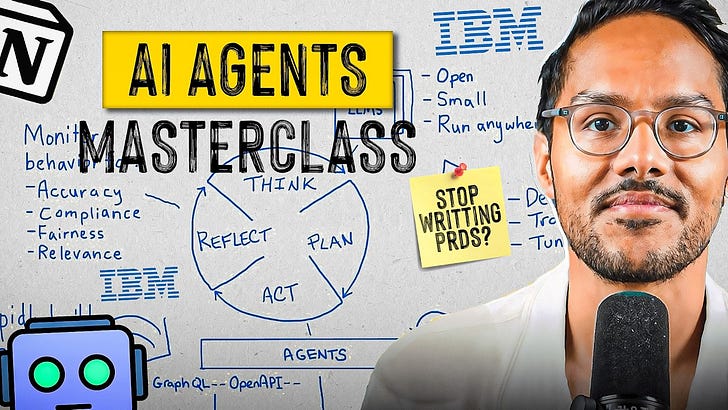
The primary bottleneck in improving AI is no longer data or compute, but the creation of 'evals'—tests that measure a model's capabilities. These evals act as product requirement documents (PRDs) for researchers, defining what success looks like and guiding the training process.

Developers often test AI systems with well-formed, correctly spelled questions. However, real users submit vague, typo-ridden, and ambiguous prompts. Directly analyzing these raw logs is the most crucial first step to understanding how your product fails in the real world and where to focus quality improvements.

The perceived limits of today's AI are not inherent to the models themselves but to our failure to build the right "agentic scaffold" around them. There's a "model capability overhang" where much more potential can be unlocked with better prompting, context engineering, and tool integrations.

Exposing a full API via the Model Context Protocol (MCP) overwhelms an LLM's context window and reasoning. This forces developers to abandon exposing their entire service and instead manually craft a few highly specific tools, limiting the AI's capabilities and defeating the "do anything" vision of agents.