Get your free personalized podcast brief
We scan new podcasts and send you the top 5 insights daily.
The new Vera Rubin racks are easier to install not just due to NVIDIA's design improvements, but because customers are now on their "third generation" of deploying rack-scale systems. The difficult rollout of the previous Blackwell chips served as a steep learning curve for data center operators, making them better prepared.

Related Insights
As NVIDIA moves to massive rack-scale systems, the primary installation challenge has evolved. It's no longer just about the chips, but the immense cabling and networking connecting them. Diagnosing a single failed cable among kilometers of wiring is now the crucial, non-linear problem, described by one expert as "black magic."
The initial deployment of a new AI cluster sees a high failure rate, with 10-15% of new-generation GPUs like Blackwell needing to be returned or reseated. This "infant mortality" is a standard operational challenge for data centers, underscoring the physical difficulties of scaling AI infrastructure with bleeding-edge chips.

The Rubin family of chips is sold as a complete "system as a rack," meaning customers can't just swap out old GPUs. This technical requirement creates a forced, expensive upgrade cycle for cloud providers, compelling them to invest heavily in entirely new rack systems to stay competitive.
OpenAI and Oracle canceled a major data center expansion because it wouldn't be ready before Nvidia's next-generation "Vera Rubin" chips arrived. This reveals a key operational strategy: OpenAI wants to avoid mixing different GPU generations within its large-scale AI training campuses for maximum efficiency.
New chip companies like MatEx accelerate their go-to-market by strategically adopting NVIDIA's open data center reference architecture, making their chips plug-and-play. This allows them to focus innovation on a specific bottleneck, like the logic die, while leveraging the incumbent's ecosystem instead of fighting on every front.
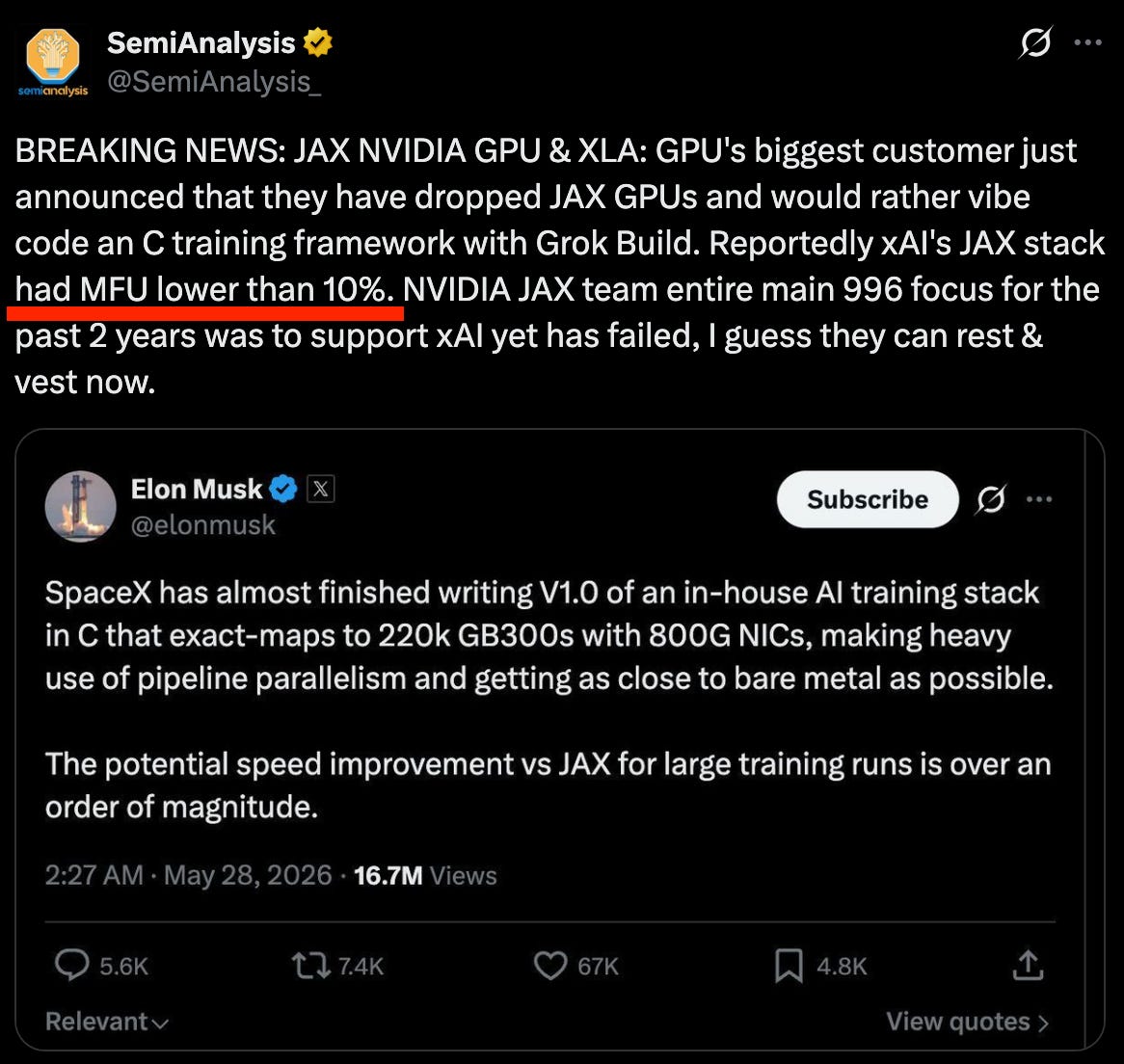
NVIDIA's complex Blackwell chip transition requires rapid, large-scale deployment to work out bugs. XAI, known for building data centers faster than anyone, serves this role for NVIDIA. This symbiotic relationship helps NVIDIA stabilize its new platform while giving XAI first access to next-generation models.
![Gavin Baker - Nvidia v. Google, Scaling Laws, and the Economics of AI - [Invest Like the Best, EP.451] thumbnail](https://megaphone.imgix.net/podcasts/d97fee14-d4d7-11f0-8951-8324b640c1c1/image/d3a8b5ecbf3957de5b91f278a191c9ff.jpg?ixlib=rails-4.3.1&max-w=3000&max-h=3000&fit=crop&auto=format,compress)
HydroHost CEO Aaron Ginn frames NVIDIA's chip releases like the automotive industry. Top-tier models like Vera Rubin are "halo products" (like a Porsche) for frontier customers, while older chips (like a Volkswagen) serve the bulk of the market. This diffuses technology and creates a healthy secondary market for powerful, but not cutting-edge, GPUs.
NVIDIA's upcoming AI chip platforms, like the Kyber rack combining Rubin and Grok chips, will require massive power draws of up to 600 kilowatts per rack. This extreme energy consumption could become a significant adoption challenge for data centers, creating an opening for more efficient alternatives.
Crusoe Cloud's CEO warns of an impending power density crisis. Today's racks are ~130kW, but NVIDIA's future "Vera Rubin Ultra" chips will demand 600kW per rack—the power of a small town. This massive leap will necessitate fundamental changes in cooling and electrical engineering for all AI infrastructure.

The fundamental unit of AI compute has evolved from a silicon chip to a complete, rack-sized system. According to Nvidia's CTO, a single 'GPU' is now an integrated machine that requires a forklift to move, a crucial mindset shift for understanding modern AI infrastructure scale.
