Get your free personalized podcast brief
We scan new podcasts and send you the top 5 insights daily.
The "harness" around a model is key to its performance. The Codex CLI is open-source so users can see exactly how OpenAI gets the best results from its own evolving models, serving as a real-time guide to advanced prompting and interaction techniques.
Related Insights
Expert-level prompting isn't about writing one-off commands. The advanced technique is to find effective prompt frameworks (e.g., a leaked system prompt), distill the core principles, and train a custom GPT on that methodology. This creates a specialized AI that can generate sophisticated prompts for you.

A major trend in AI development is the shift away from optimizing for individual model releases. Instead, developers can integrate higher-level, pre-packaged agents like Codex. This allows teams to build on a stable agentic layer without needing to constantly adapt to underlying model changes, API updates, and sandboxing requirements.

Simply offering the latest model is no longer a competitive advantage. True value is created in the system built around the model—the system prompts, tools, and overall scaffolding. This 'harness' is what optimizes a model's performance for specific tasks and delivers a superior user experience.
Browser-based ChatGPT cannot execute code or connect to external APIs, limiting its power. The Codex CLI unlocks these agentic capabilities, allowing it to interact with local files, run scripts, and connect to databases, making it a far more powerful tool for real-world tasks.
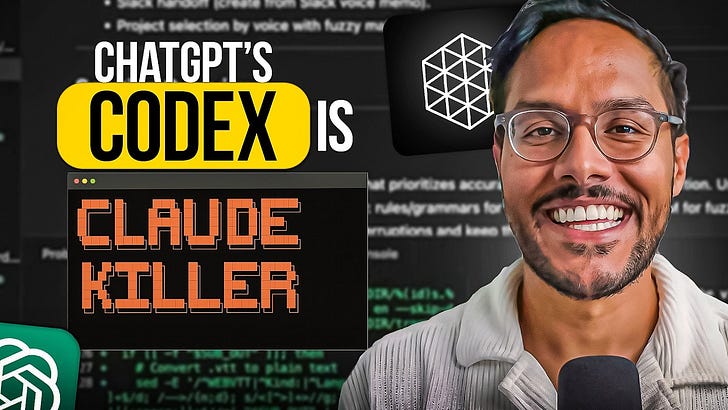
AI platforms using the same base model (e.g., Claude) can produce vastly different results. The key differentiator is the proprietary 'agent' layer built on top, which gives the model specific tools to interact with code (read, write, edit files). A superior agent leads to superior performance.

The vision for Codex extends beyond a simple coding assistant. It's conceptualized as a "software engineering teammate" that participates in the entire lifecycle—from ideation and planning to validation and maintenance. This framing elevates the product from a utility to a collaborative partner.

OpenAI recommends a bifurcated approach. Startups building bleeding-edge, code-focused agents should use the specialized Codex model line, which is highly opinionated and optimized for its tool harness. Applications requiring more general capabilities and steerability across various tools should use the mainline GPT model instead.
OpenAI favors "zero gradient" prompt optimization because serving thousands of unique, fine-tuned model snapshots is operationally very difficult. Prompt-based adjustments allow performance gains without the immense infrastructure burden, making it a more practical and scalable approach for both OpenAI and developers.
Many AI tools expose the model's reasoning before generating an answer. Reading this internal monologue is a powerful debugging technique. It reveals how the AI is interpreting your instructions, allowing you to quickly identify misunderstandings and improve the clarity of your prompts for better results.
Codex exposes every command and step, giving engineers granular control. Claude Code abstracts away complexity with a simpler UI, guessing user intent more often. This reflects a fundamental design difference: precision for technical users versus ease-of-use for non-technical ones.