Get your free personalized podcast brief
We scan new podcasts and send you the top 5 insights daily.
A quaternion network showed superior extrapolation, suggesting unique representational power. However, analysis revealed the equivalent real-valued network could find the solution; the quaternion parameterization just created an "optimization basin" that SGD found more reliably. The advantage was in optimization ease, not fundamental capability.

Related Insights
The choice of optimization algorithm dictates which model architectures are viable. While weaker optimizers require simpler models, a more powerful optimizer can successfully train more complex, harder-to-optimize architectures. This shows how optimizer and architecture research are deeply intertwined, unlocking new performance possibilities.

The success of neural networks on problems like Go and protein folding, long considered intractable NP-hard problems, is profound. It suggests our formal understanding of computational hardness, which focuses on worst-case scenarios, may be an incomplete model for how to find useful, approximate solutions in practice.

Reinforcement learning achieves superhuman results not by inventing alien concepts, but by surfacing and combining rare behaviors that are already possible within a model's vast pre-trained distribution. The goal of pre-training is to make this search for novel solutions more efficient and less random.

While the theories behind neural networks existed for decades, their practical application was infeasible. The true catalyst wasn't a new algorithm, but the parallel processing power of GPUs and the availability of massive datasets, which finally made training complex models a reality.
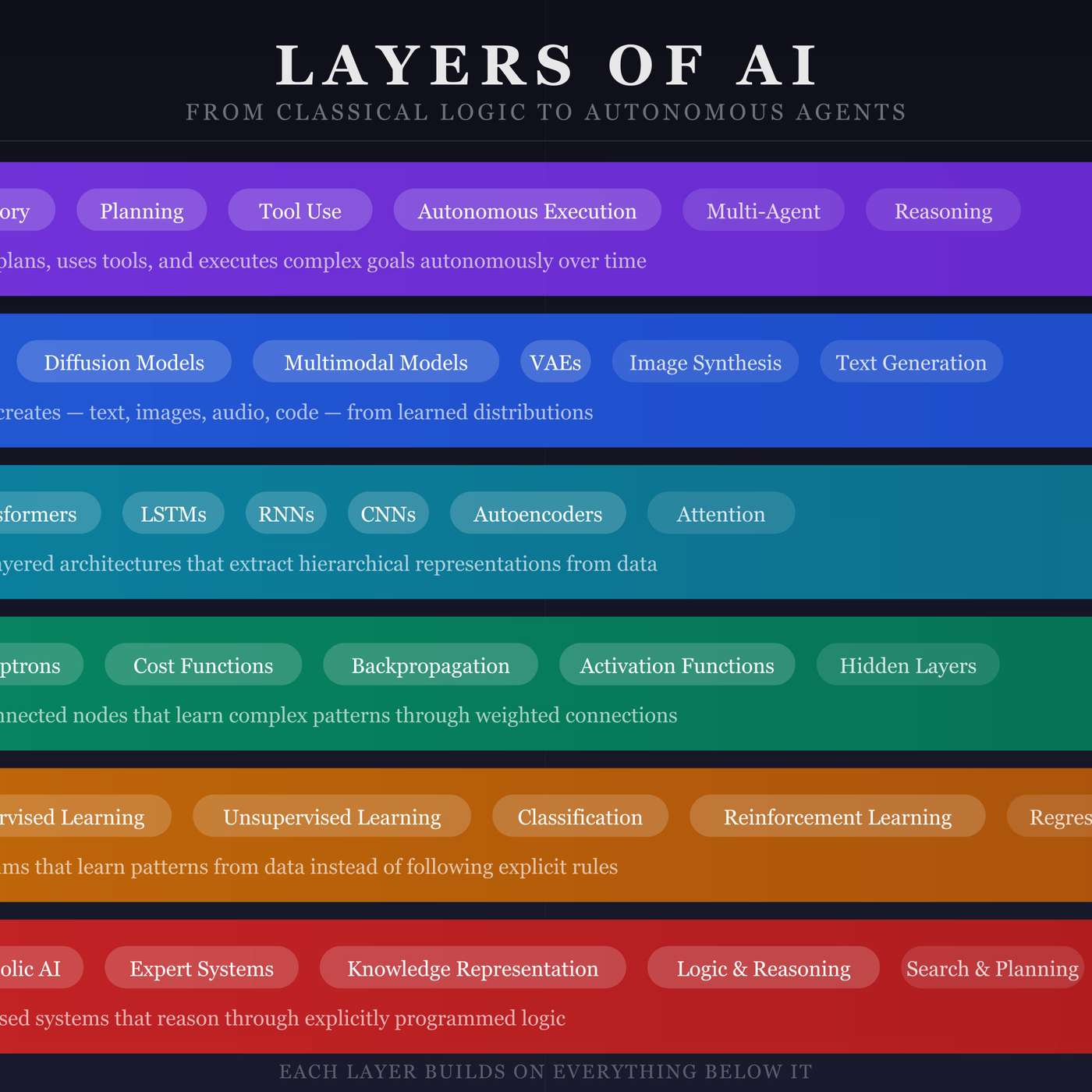
Attempting to interpret every learned circuit in a complex neural network is a futile effort. True understanding comes from describing the system's foundational elements: its architecture, learning rule, loss functions, and the data it was trained on. The emergent complexity is a result of this process.

The history of AI, such as the 2012 AlexNet breakthrough, demonstrates that scaling compute and data on simpler, older algorithms often yields greater advances than designing intricate new ones. This "bitter lesson" suggests prioritizing scalability over algorithmic complexity for future progress.

Many papers claim exotic algebras (Quaternion, etc.) are parameter-efficient. However, they often fail to compare against real-valued networks with equivalent structural constraints. When properly matched controls are introduced, the supposed advantage from the exotic algebra evaporates, revealing the benefit was simply from the imposed structure itself, not the algebra.
A key insight from AlphaGo is that a relatively shallow neural network can approximate the result of an incredibly deep and complex search tree. This suggests neural nets can learn to compress sequential, recursive computation into a single, efficient forward pass.
Even for tasks designed to require specific algebraic properties like non-associativity, a general-purpose real-valued network performs just as well. This is because any fixed algebra's product is just a fixed real bilinear tensor, which a universal approximator can learn and absorb, negating the need for a specialized, hard-coded architecture.
Even when a model performs a task correctly, interpretability can reveal it learned a bizarre, "alien" heuristic that is functionally equivalent but not the generalizable, human-understood principle. This highlights the challenge of ensuring models truly "grok" concepts.