Get your free personalized podcast brief
We scan new podcasts and send you the top 5 insights daily.
Onboarding users to complex AI capabilities through articles or tutorials is ineffective. The key to mass adoption is designing the product to 'show' its power in the moment, tailored to the user's specific context and needs. This makes the product itself the primary driver of discovery and education.

Related Insights
Learners demand hands-on experience. The next evolution of training involves AI agents that act as sidekicks, not just explaining concepts but also taking over the user's screen to demonstrate precisely how to perform a task, dramatically accelerating skill acquisition and reducing friction.

Users rarely seek out separate AI functionality. Adoption becomes natural when AI assistance appears contextually within existing workflows, addressing friction points directly where the user is already working. This embedded approach is far more effective than adding AI as a separate, layered-on tool.
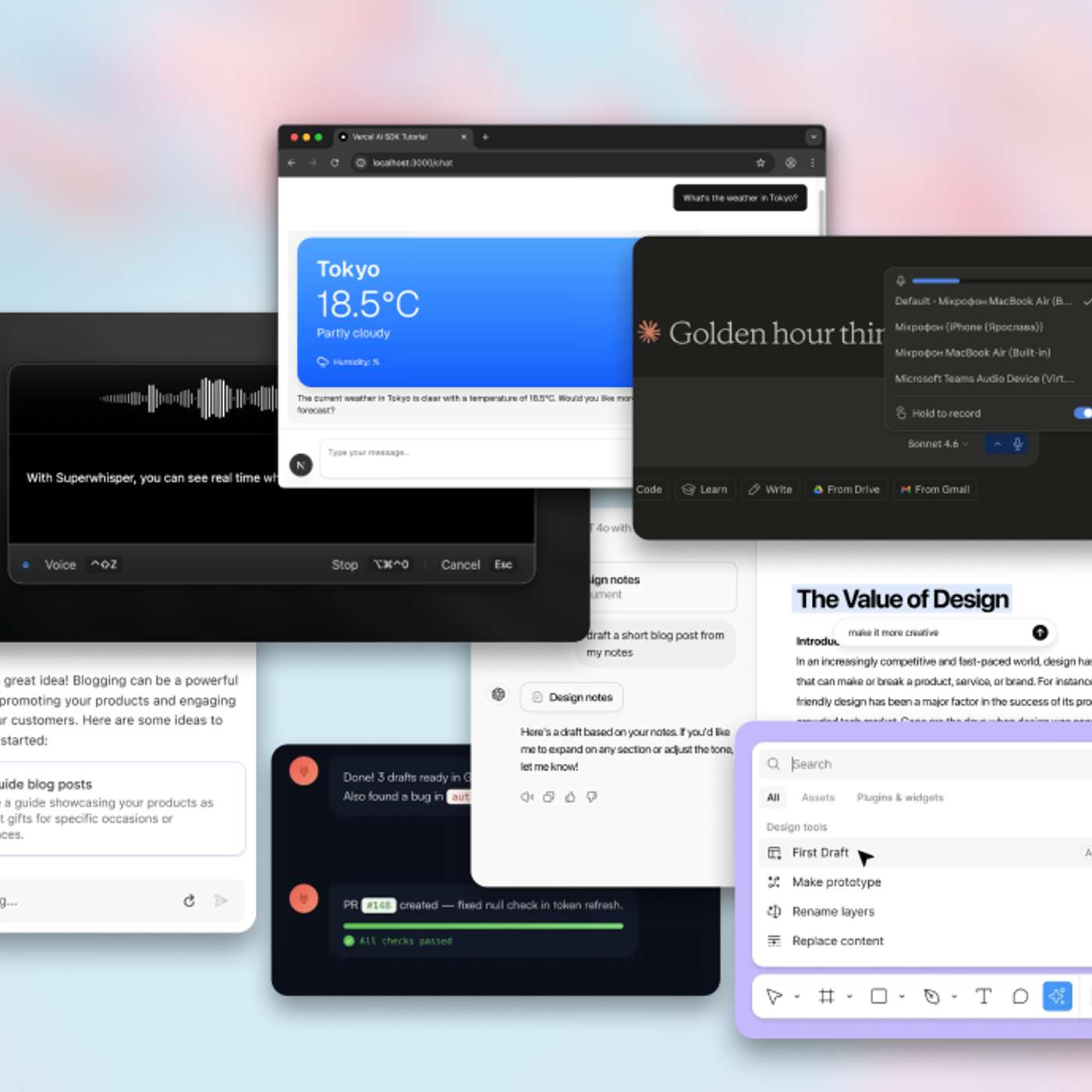
Traditional onboarding asks users for information. A more powerful AI pattern is to take a single piece of data, like a URL or email access, immediately derive context, and show the user what the AI understands about them. This "show, don't tell" approach builds trust and demonstrates value instantly.

Most users don't want abstract tools like 'agents' or 'connectors.' Successful AI products for the mainstream must solve specific, acute pain points and provide a 'golden path' to a solution. Selling a general platform to non-technical users often fails because it requires them to imagine the use case.

The viral experimentation with the AI tool 'Claude Code' over a holiday break revealed a powerful adoption catalyst. Actually seeing an agent autonomously perform a complex task creates an 'aha moment' that makes AI's potential tangible, suggesting interactive demos are crucial for convincing decision-makers and accelerating enterprise buy-in.
Anthropic's Cowork isn't a technological leap over Claude Code; it's a UI and marketing shift. This demonstrates that the primary barrier to mass AI adoption isn't model power, but productization. An intuitive UI is critical to unlock powerful tools for the 99% of users who won't use a command line.
The idea that AI has no learning curve is a myth. Users faced with a blank 'type anything' box are often paralyzed. Showcasing unconventional applications, like a broccoli farmer using GPT-5.6, helps people understand the tool's potential beyond obvious tasks.

RAMP discovered that the best way to teach employees AI is through the product itself. The most successful users learned by immediately using a feature and getting a result. This suggests designing AI tools where features act as implicit lessons, teaching best practices during use.
Since AI capabilities are novel, users often struggle with adoption. Rather than using traditional templates or tutorials, a more effective method is to build an AI agent or operator that guides users through the process. This approach uses the AI to teach the user how to leverage AI's potential within the product's specific context.

To achieve mass adoption, ChatGPT must move beyond its current 'computer terminal' interface. The next wave of users are too busy to learn prompting; the product needs clearer affordances and must proactively anticipate needs rather than waiting for commands to provide value.
