Get your free personalized podcast brief
We scan new podcasts and send you the top 5 insights daily.
AI Engineering leverages pre-trained foundation models as a service for rapid integration. This contrasts with traditional Machine Learning Engineering, which involves building a model from scratch, from data collection to deployment, resulting in a much slower time-to-market.

Related Insights
Deep learning models can process vast, unstructured datasets directly, unlike traditional machine learning which requires data scientists to pre-select and summarize variables ('features'). This automates a key data science task, freeing up teams for higher-value work.

For vertical AI applications, foundation models are now sufficiently intelligent. The primary challenge is no longer model capability but building the surrounding software infrastructure—tools, UIs, and workflows—that lets models perform useful work reliably and trustworthily.

Stripe avoids costly system rebuilds by treating its new payments foundation model as a modular component. Its powerful embeddings are simply added as new features to many existing ML classifiers, instantly boosting their performance with minimal engineering effort.

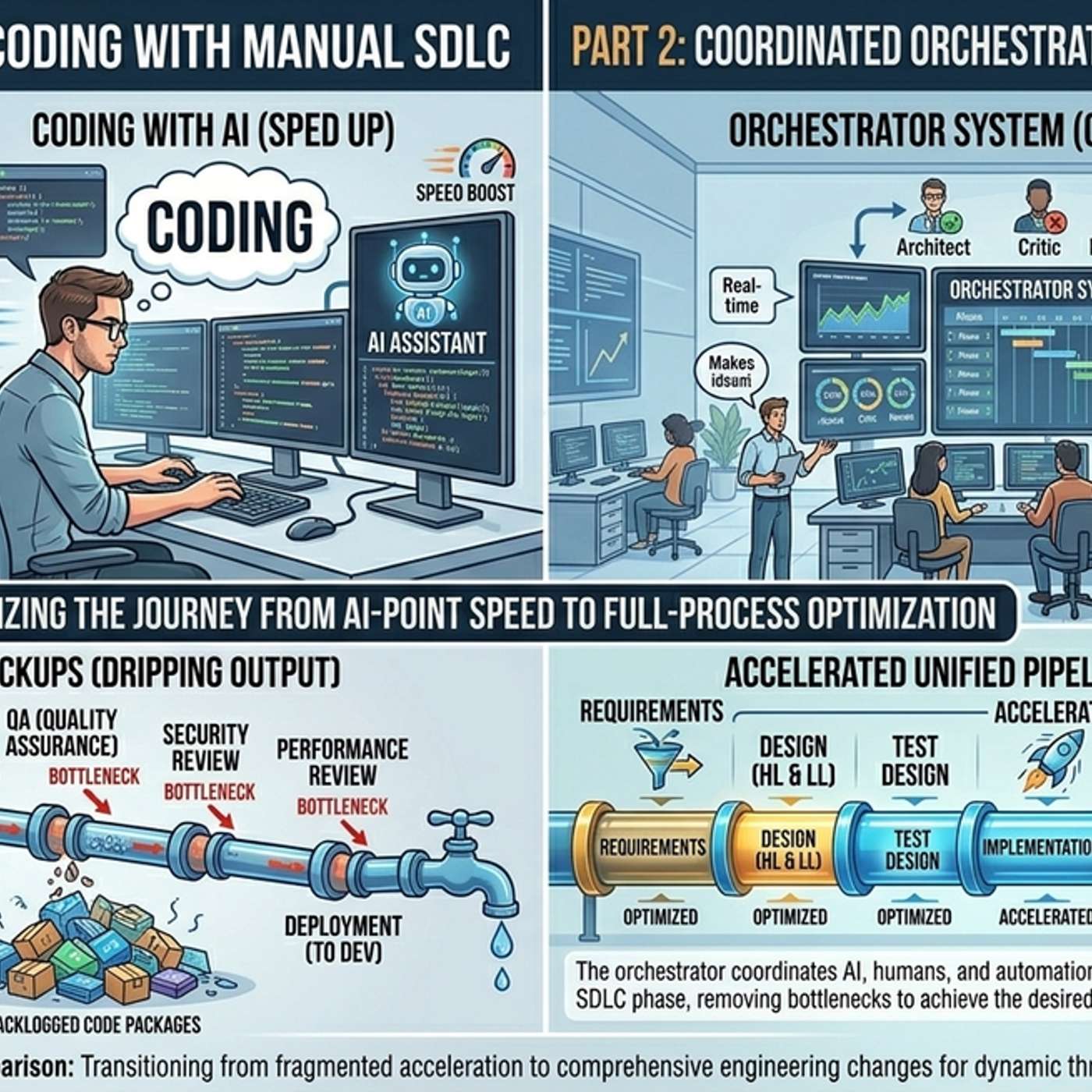
Breaking down the software development lifecycle into small, well-defined subtasks is not just for improving AI success rates. It creates a significant cost-saving opportunity by allowing teams to use cheaper, specialized AI models for most steps, reserving expensive frontier models only for high-complexity tasks like architectural design.
Early-stage AI startups should resist spending heavily on fine-tuning foundational models. With base models improving so rapidly, the defensible value lies in building the application layer, workflow integrations, and enterprise-grade software that makes the AI useful, allowing the startup to ride the wave of general model improvement.

AI's capabilities evolve so rapidly that business leaders can't grasp its value, creating a 'legibility gap.' This makes service-heavy, forward-deployed engineering models essential for enterprise AI startups to demonstrate and implement their products, bridging the knowledge gap for customers.

To get scientists to adopt AI tools, simply open-sourcing a model is not enough. A real product must provide a full-stack solution, including managed infrastructure to run expensive models, optimized workflows, and a UI. This abstracts away the complexity of MLOps, allowing scientists to focus on research.

Simply adding an AI layer on top of a traditional SaaS stack will fail. A true AI-native architecture requires an "AI data layer" sitting next to the "AI application layer," both controlled by ML engineers who need to constantly tune data ingestion and processing without dependencies on the core tech team.
With new foundation models launching constantly, end-users don't care about the specific model name. A durable AI application should be model-agnostic, using an intelligent agent to select the best model for a given task. This focuses the product on the user's desired outcome, not the underlying tech.

The focus in AI has shifted from crafting the perfect prompt (prompt engineering) to providing the right information (context engineering), and now to building the entire operational environment—tooling, systems, and access—that enables a model to perform complex tasks. This new paradigm is called harness engineering.
