Get your free personalized podcast brief
We scan new podcasts and send you the top 5 insights daily.
In a talk at Google, Rushdie humorously argued for the book's superior technological design. Unlike a laptop, it doesn't lose data when wet, isn't disabled by sand, and—unlike a floppy disk—doesn't become obsolete, making it a remarkably durable and timeless format.

Related Insights
The book's small, portable size was not just a convenience but a critical feature that enabled its subversive use. Enslaved people could easily hide the speller, making it a mobile, secret tool for learning to read in a society where their literacy was legally prohibited and brutally punished.

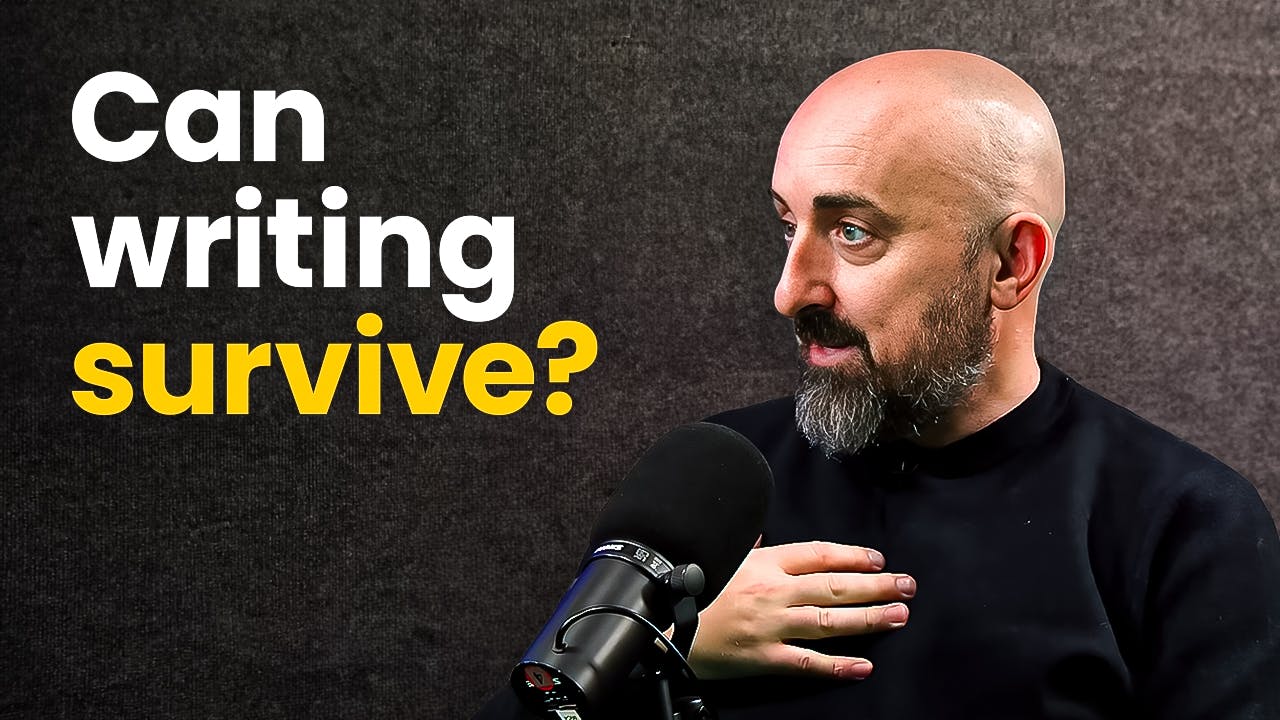
Medium's CEO argues that writing's future is secure because its core function is the process of structured thinking, not just content output. The act of articulating ideas reveals flaws and deepens understanding for the writer—a cognitive benefit that delegating to AI would eliminate.
Contrary to the belief that new form factors like phones replace laptops, the reality is more nuanced. New devices cause specific tasks to move to the most appropriate platform. Laptops didn't die; they became better at complex tasks, while simpler jobs moved to phones. The same will happen with wearables and AI.

Most books are 'dead' archives of past knowledge, like digesting old food. An 'alive' book channels the author's present, living transformation onto the page. This imbues the work with a dynamic life force of its own, capable of creating profound, real-time change in the reader.

Human communication is returning to its oral and visual roots. Text, a low-dimensional medium, was a temporary necessity for scalable knowledge storage—a 'parenthesis' in history. As AI makes creating rich media as easy as writing, society will default back to more natural, higher-bandwidth formats like audio and video.

A contrarian view on "destructive scanning" of old books for AI training. Instead of a loss, it's a form of preservation. This process transfers knowledge from a format no longer widely consumed (physical books) into a dynamic, interactive system (AI), making the information more accessible to the world.

While podcasts and videos are ephemeral and unlikely to be revisited in a decade, the written word endures. Writing well is the foundation of great communication and creates a permanent record of one's thoughts, establishing a legacy that can be consumed by future generations in a way other media formats cannot.

According to author Ian Bogost, optimizing life through apps and automation has a hidden cost. We've lost thousands of small physical encounters, from turning a faucet handle to tearing perforated paper, which makes life feel "flatter" and less connected.

The standard 250-page book is often a relic of a publishing business model that equates physical weight with value, leading to padded content. This reveals an opportunity for concise, high-impact formats like "one-hour books" that respect the reader's time and the idea's natural length.

Salman Rushdie posits that humor is more than just entertainment; it is a potent tool against oppression. He observes that dictators and narrow-minded individuals are characteristically humorless and that satire can provoke them more effectively than direct criticism, making it a crucial element in the struggle for free expression.