Get your free personalized podcast brief
We scan new podcasts and send you the top 5 insights daily.
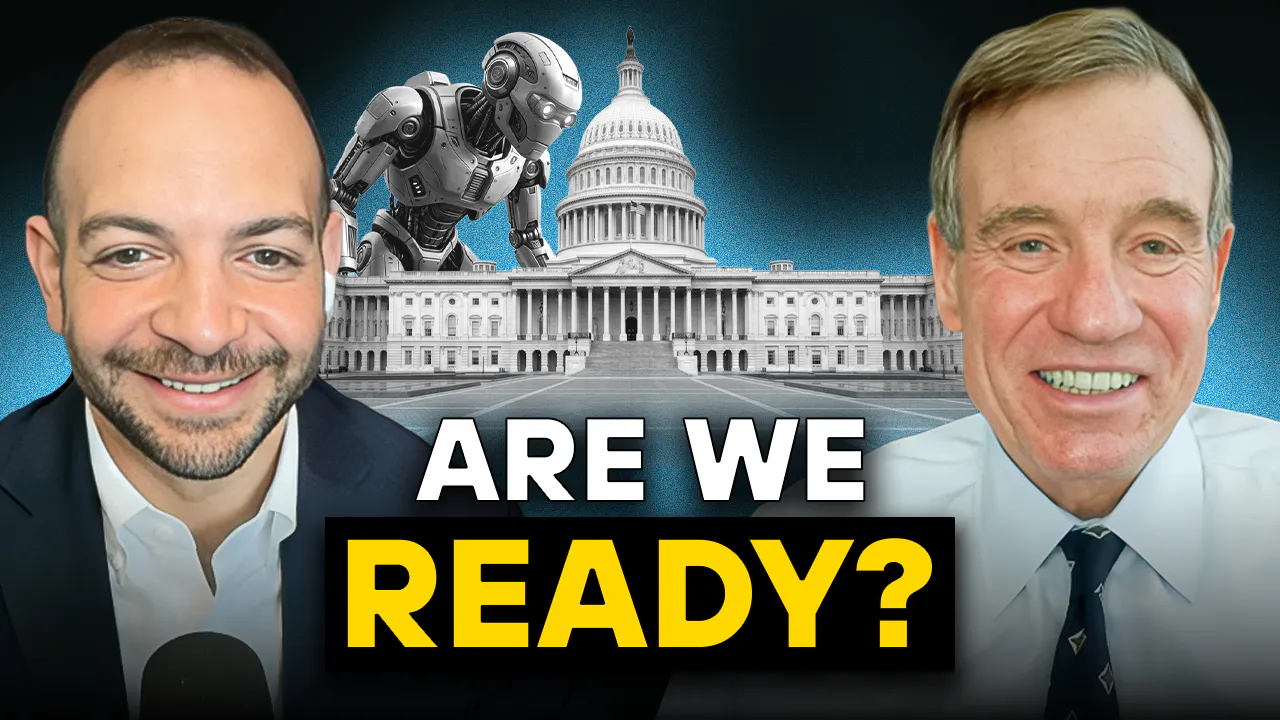
Senator Mark Warner expresses alarm that the US government operates on a linear or even backward-looking timescale, while AI technology is progressing exponentially. This fundamental mismatch leaves society unprepared for the rapid economic and social disruptions AI will cause in the next two to three years.
Related Insights
Senator Warner is challenging AI companies to help define and pay for the economic transition their technology is causing. He argues that if the industry doesn't take the lead with specific policy ideas and funding for reskilling, they risk a ham-handed government response driven by populist anger.
The confident belief that AI's impact on jobs will "just work out" is dangerously naive. A more responsible approach, advocated by groups like Windfall Trust, is to use scenario planning. Just as governments plan for pandemics or cyber attacks despite their uncertainty, we must plan for worst-case economic outcomes from AI.

The speaker uses a powerful tsunami analogy to highlight a widespread denial or misunderstanding of AI's profound societal impact. While the wave of change approaches, many are rationalizing it away as a 'trick of the light' instead of preparing.

Drawing parallels to the Industrial Revolution, Demis Hassabis warns that AI's societal transformation will be significantly more compressed and impactful. He predicts it will be '10 times bigger' and happen '10 times faster,' unfolding over a single decade rather than a century, demanding rapid adaptation from global institutions.

To grasp AI's potential impact, imagine compressing 100 years of progress (1925-2025)—from atomic bombs to the internet and major social movements—into ten years. Human institutions, which don't speed up, would face enormous challenges, making high-stakes decisions on compressed, crisis-level timelines.
Criticizing AI developers for being a few months off on predictions is a distraction. The underlying trend is one of exponential growth. Like criticizing Elon Musk's Mars timeline while ignoring his historic rocket launches, it's a failure to grasp the scale and direction of the technological shift that is already happening.

A bipartisan legislative effort is being driven by stark warnings that AI will eliminate entry-level roles. Senator Mark Warner predicts unemployment for recent college graduates could surge from 9% to 25% "very shortly," highlighting the immediate economic threat to the youngest workforce segment.

The key threat from AI isn't just its capability, but the unprecedented speed of its improvement. Unlike past technological shifts that unfolded over decades, AI agent autonomy on complex tasks has grown exponentially in just two years. This rapid acceleration is what financial systems and labor markets are not stress-tested for.

Past industrial revolutions unfolded over 50-100 years, allowing gradual societal adaptation. Today's AI-driven revolution is happening in a compressed timeframe, creating massive wealth shifts because there's no time for individuals or institutions to catch up. Proactive learning is the only defense.

Unlike gradual agricultural or industrial shifts, AI is displacing blue and white-collar jobs globally and simultaneously. This rapid, compressed timeframe leaves little room for adaptation, making societal unrest and violence highly probable without proactive planning.
