Get your free personalized podcast brief
We scan new podcasts and send you the top 5 insights daily.
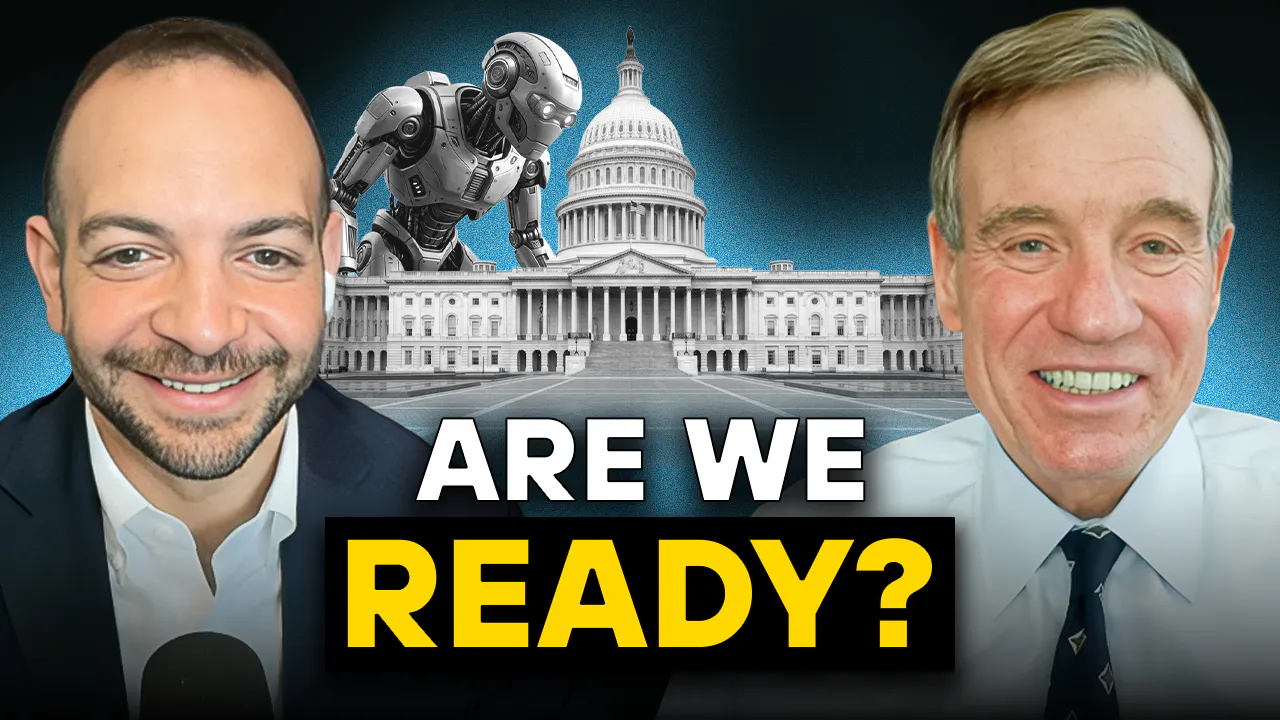
Senator Warner is challenging AI companies to help define and pay for the economic transition their technology is causing. He argues that if the industry doesn't take the lead with specific policy ideas and funding for reskilling, they risk a ham-handed government response driven by populist anger.
Related Insights
To manage AI's labor impact, former Commerce Secretary Gina Raimondo proposes a "grand bargain." This includes tax code reforms to reward companies that reinvest AI-driven savings into job creation, worker retention, and entry-level hiring, shifting focus from pure efficiency to opportunity.

The AI industry faces a major perception problem, fueled by fears of job loss and wealth inequality. To build public trust, tech companies should emulate Gilded Age industrialists like Andrew Carnegie by using their vast cash reserves to fund tangible public benefits, creating a social dividend.
Senator Mark Warner expresses alarm that the US government operates on a linear or even backward-looking timescale, while AI technology is progressing exponentially. This fundamental mismatch leaves society unprepared for the rapid economic and social disruptions AI will cause in the next two to three years.
When introducing AI automation in government, directly address job security fears. Frame AI not as a replacement, but as a partner that reduces overwhelming workloads and enables better service. Emphasize that adopting these new tools requires reskilling, shifting the focus to workforce evolution, not elimination.

With leaders like Marc Benioff admitting AI will reduce headcount, companies risk a culture of fear. The recommended strategy is for every CEO to publish an "AI Forward" memo that transparently addresses the future of work and outlines concrete commitments to reskilling the existing workforce.
Khan Academy's CEO proposes a 1% profit dedication from corporations for worker retraining. This highlights a critical challenge: with AI designed to replace all cognitive labor, it is unclear what future-proof jobs exist to train people for.

The critical barrier to AI adoption isn't technology, but workforce readiness. Beyond a business need, leaders have a moral—and in some regions, legal—responsibility to retrain every employee. This ensures people feel empowered, not afraid, and can act as the human control layer for AI systems.

A bipartisan legislative effort is being driven by stark warnings that AI will eliminate entry-level roles. Senator Mark Warner predicts unemployment for recent college graduates could surge from 9% to 25% "very shortly," highlighting the immediate economic threat to the youngest workforce segment.

Senator Mark Warner reveals that AI CEOs privately tell him they are drastically cutting first-year hires and interns due to AI. This contradicts their more optimistic public statements, suggesting they are "freaked out about freaking out people" and intentionally managing public perception to avoid backlash.
Research shows the public is deeply anxious about AI's impact on jobs and wages. When polled, policies that fund job creation and benefits decisively beat those prioritizing innovation to 'outcompete China,' even among conservative voters. This economic anxiety, not abstract risk, is the primary driver of public opinion on AI regulation.