Get your free personalized podcast brief
We scan new podcasts and send you the top 5 insights daily.
Google is disaggregating its model creation process to insert a "mid-training" stage. This allows models to become specialized for functions like coding before the final behavioral tuning phase, a technical shift aimed at closing the capability gap with rivals like Anthropic and OpenAI in enterprise applications.

Related Insights
The AI race has a new dimension beyond model performance. Leading labs like Google, Anthropic, and OpenAI are aggressively building consulting and forward-deployed engineering teams. The new battleground is successful enterprise integration and custom workflow deployment, not just benchmark scores.

Google holds a paradoxical position in the AI race. While it leads legacy tech giants like Apple and Microsoft in AI model building and application, it still trails dedicated AI labs like OpenAI and Anthropic in releasing cutting-edge models.

Instead of relying solely on massive, expensive, general-purpose LLMs, the trend is toward creating smaller, focused models trained on specific business data. These "niche" models are more cost-effective to run, less likely to hallucinate, and far more effective at performing specific, defined tasks for the enterprise.

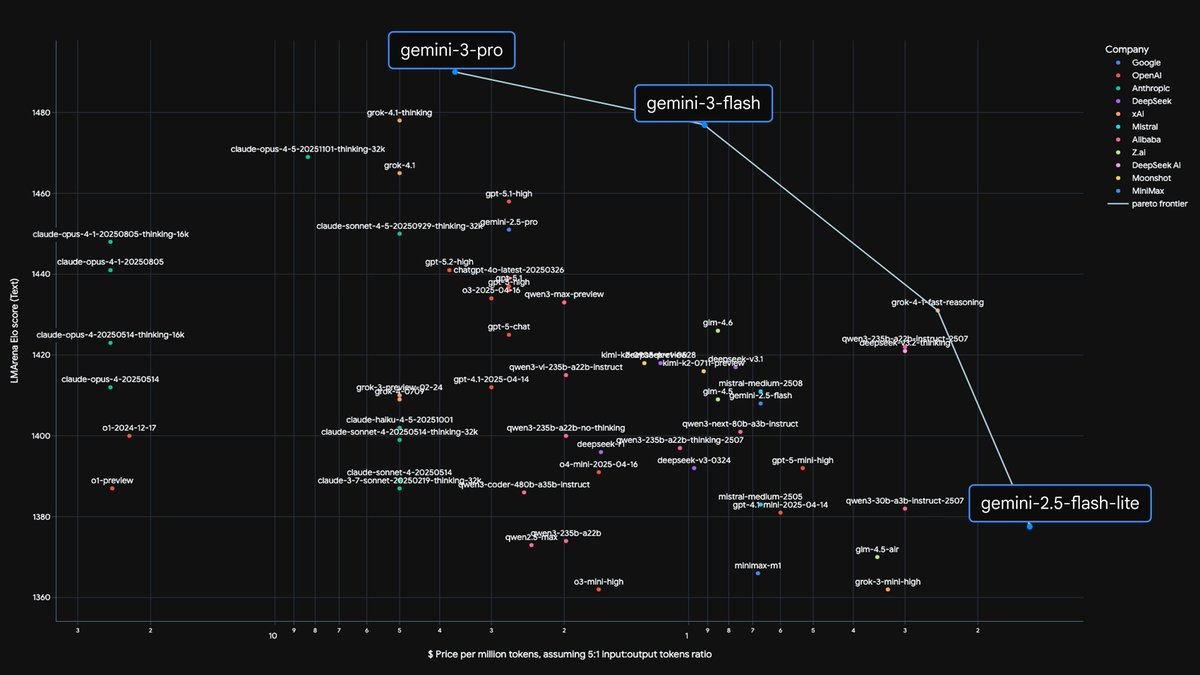
Google's strategy involves creating both cutting-edge models (Pro/Ultra) and efficient ones (Flash). The key is using distillation to transfer capabilities from large models to smaller, faster versions, allowing them to serve a wide range of use cases from complex reasoning to everyday applications.
Initially, even OpenAI believed a single, ultimate 'model to rule them all' would emerge. This thinking has completely changed to favor a proliferation of specialized models, creating a healthier, less winner-take-all ecosystem where different models serve different needs.

With model improvements showing diminishing returns and competitors like Google achieving parity, OpenAI is shifting focus to enterprise applications. The strategic battleground is moving from foundational model superiority to practical, valuable productization for businesses.
As AI model performance commoditizes, the strategic battleground is shifting from models to platforms. Tech giants like Google are positioning their offerings not as features, but as the fundamental 'operating system' for the agentic enterprise. The new competitive moat is the control plane that orchestrates agents.
Google's new AI coding "Strike Team," with personal involvement from Sergey Brin, is focused on improving its models for internal Google engineers first. The goal is to create a feedback loop where AI helps build better AI, a concept Brin calls "AI takeoff," treating any friction in this process as a top-priority blocker for achieving AGI.
In response to falling behind Anthropic, Google's new AI coding "strike team" is shifting focus. Instead of building general-purpose coding models for external customers, the team is prioritizing models trained on Google's vast, private codebase to improve internal development efficiency first.
Google's strategy involves building specialized models (e.g., Veo for video) to push the frontier in a single modality. The learnings and breakthroughs from these focused efforts are then integrated back into the core, multimodal Gemini model, accelerating its overall capabilities.