Get your free personalized podcast brief
We scan new podcasts and send you the top 5 insights daily.
Ditch random AI chats that have no memory. The first step for a marketing engineer is to build a structured "Growth Repo." This centralized folder acts as the company's marketing memory, storing customer data, brand voice, and performance history to continuously improve AI outputs.

Related Insights
Treat your AI marketing agents like employees. Write detailed job specifications, start them on small tasks, correct their mistakes, and add those corrections to a central memory (the growth repo). This human-centric management model ensures the AI system compounds its intelligence over time.
Use an AI assistant like Claude Code to create a persistent corporate memory. Instruct it to save valuable artifacts like customer quotes, analyses, and complex SQL queries into a dedicated Git repository. This makes critical, unstructured information easily searchable and reusable for future AI-driven tasks.

To ensure message consistency, Zapier developed a centralized "AI Marketing Brain." This system acts as a single source of truth for goals, brand guidelines, and campaign context, preventing the "lossless marketing" effect where messages degrade as they pass through different departments and channels.

View AI less as a tool for discrete tasks and more as the foundation for a central marketing hub. This system uses AI to create and maintain branded playbooks for all marketing activities, ensuring consistency and quality regardless of who is executing the work.

The highest leverage AI input is customer data. The speaker recommends creating a central "brain" or agent and feeding it a constant stream of data via APIs from reviews, customer support tickets, social media mentions, and ad comments. This gives the AI unparalleled context for creating effective landing pages.

Create a competitive advantage by developing a unique AI model trained on your brand and customer data. Feed it everything—reviews, Reddit posts, positive and negative feedback—to build a deep understanding that can be leveraged for content creation, with a human editor as the final check.

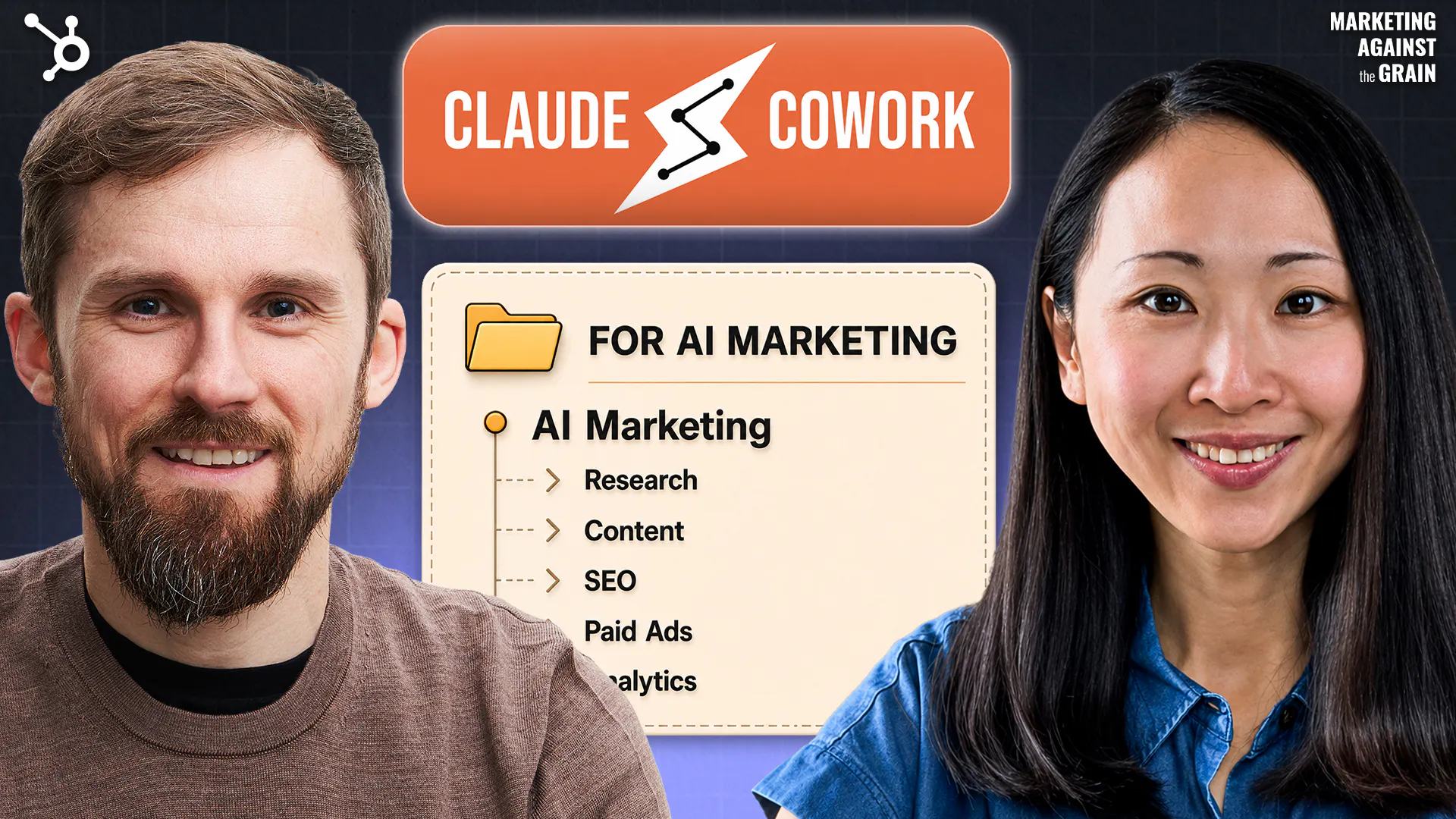
Effective AI marketing requires first building a structured system of folders and context files (brand voice, ICPs). This foundational work enables consistent, high-quality outputs and is more effective than ad-hoc prompting. It's about working slow first to eventually work fast.
Marketers should immediately start creating a private AI model by feeding it all company data: customer reviews (positive and negative), Reddit posts, brand voice guidelines, and past content. This creates a unique 'AI mind' that will outperform generic models and give the company a significant long-term edge in content creation and personalization.

Consolidate key company information—brand voice, copywriting rules, founder stories, and playbooks—into structured markdown (.md) files. This creates a portable knowledge base that can be used to consistently train any AI model, ensuring high-quality output across applications.

The ultimate value of AI will be its ability to act as a long-term corporate memory. By feeding it historical data—ICPs, past experiments, key decisions, and customer feedback—companies can create a queryable "brain" that dramatically accelerates onboarding and institutional knowledge transfer.
