Get your free personalized podcast brief
We scan new podcasts and send you the top 5 insights daily.
When running AI inference at extreme scale, the most surprising and difficult challenges are often not unique to LLMs. Instead, they are classic distributed systems problems—like kernel panics caused by logging overload—that only manifest under immense load. The immaturity of runtimes exacerbates these issues.

Related Insights
An AI model's operating environment—its "harness"—is now the primary driver of capability. Benchmarks show the same model achieves vastly different results in different harnesses, proving that the runtime, tools, and state management are as critical as the model's internal weights for achieving results.

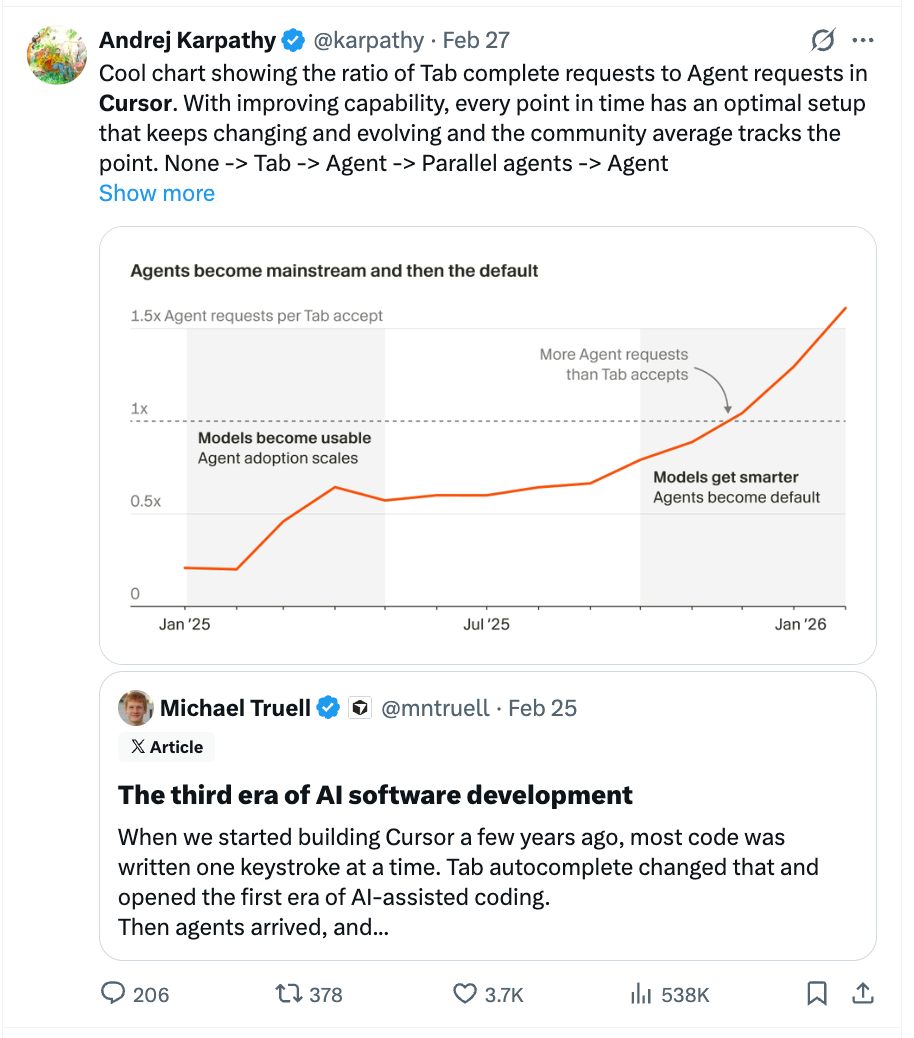
The focus in AI engineering is shifting from making a single agent faster (latency) to running many agents in parallel (throughput). This "wider pipe" approach gets more total work done but will stress-test existing infrastructure like CI/CD, which wasn't built for this volume.
Simply "scaling up" (adding more GPUs to one model instance) hits a performance ceiling due to hardware and algorithmic limits. True large-scale inference requires "scaling out" (duplicating instances), creating a new systems problem of managing and optimizing across a distributed fleet.

Anthropic's recent performance problems and capacity limits are not isolated failures. They are the first major public signal of a systemic issue: AI demand, driven by agentic workflows, is outstripping the available compute supply across the entire industry, affecting even top players like OpenAI.
Many organizations excel at building accurate AI models but fail to deploy them successfully. The real bottlenecks are fragile systems, poor data governance, and outdated security, not the model's predictive power. This "deployment gap" is a critical, often overlooked challenge in enterprise AI.

Contrary to the idea that infrastructure problems get commoditized, AI inference is growing more complex. This is driven by three factors: (1) increasing model scale (multi-trillion parameters), (2) greater diversity in model architectures and hardware, and (3) the shift to agentic systems that require managing long-lived, unpredictable state.

The shift from simple query-based AI to agentic AI, where AI calls itself recursively to solve complex tasks, increases compute demand by orders of magnitude. Most people, especially non-coders, fail to grasp this exponential shift, leading them to consistently underestimate the scale and duration of the AI infrastructure build-out.

Previously, the biggest constraint in AI was compute for training next-gen models. Now, the critical bottleneck is providing enough compute for *inference*—the real-time processing of queries from a rapidly growing user base.

While AI proofs-of-concept are easy, SAP's CTO states the real engineering hurdle is scaling reliably. The complexity lies in managing thousands of APIs, handling massive document volumes, and applying granular, user-specific context (like regional policies) consistently and accurately.

Unlike traditional computing where inputs were standardized, LLMs handle requests of varying lengths and produce outputs of non-deterministic duration. This unpredictability creates massive scheduling and memory management challenges on GPUs that were not designed for such chaotic, real-time workloads.