Get your free personalized podcast brief
We scan new podcasts and send you the top 5 insights daily.
Warp replays its own past development tasks using different LLMs to generate internal benchmarks. This data provides concrete evidence for a model routing strategy, allowing them to choose the optimal model based on their specific cost-quality tradeoffs for different types of tasks.

Related Insights
Recognizing there is no single "best" LLM, AlphaSense built a system to test and deploy various models for different tasks. This allows them to optimize for performance and even stylistic preferences, using different models for their buy-side finance clients versus their corporate users.

Companies like legal AI provider Lagora don't rely on a single frontier model. Instead, they build their own internal routers that intelligently direct different tasks to the most suitable model—whether it's from OpenAI, Anthropic, or open-source. This allows them to optimize for performance, cost, and specific capabilities for each component of their workflow.

Model leaderboards are misleading. To ensure a consistent user experience, companies must develop their own evaluation suites reflecting their specific workloads. This allows them to swap underlying models for cost or capability reasons with confidence that the customer-facing outcome remains reliable and high-quality.

To optimize AI costs and sustainability, UBS employs a "model garden" with various frontier and smaller models. An internal AI system then routes employee questions to the most appropriate, cost-effective model, preventing the wasteful use of powerful, expensive LLMs for simple, non-frontier problems.

Companies are building intelligent systems that analyze a user's prompt and automatically route it to the most cost-effective model that can handle the task. This avoids using expensive frontier models for simple requests, with some companies like Coinbase successfully keeping costs flat despite exponential usage growth.

A sophisticated gateway that routes queries to different models based on complexity is key to managing AI costs. Simple tasks go to cheap, open-source models, while difficult ones use the frontier. This "expert pattern" allows token usage to rise while keeping costs flat.

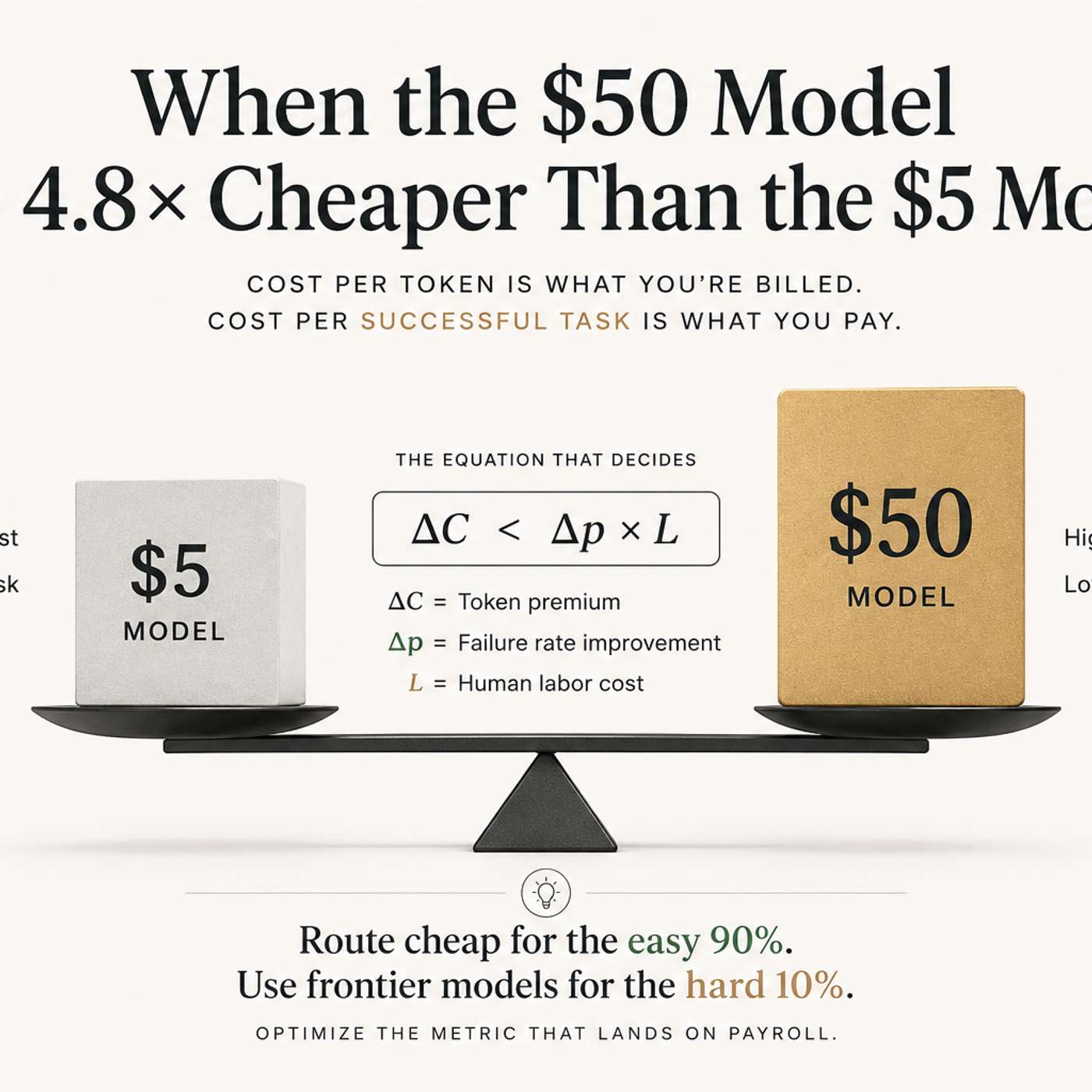
The dream of routing a query to the single "best" model for quality is likely an AI-complete problem. In practice, the primary value of model routers is cost optimization: finding the cheapest model on the Pareto frontier that meets a required quality bar, which is a high priority given expensive token costs.
To control inference costs, companies are implementing model routing systems. They differentiate between expensive tokens from frontier models for complex reasoning and cheaper tokens from fine-tuned open-source models for simpler workflow tasks. This tiered approach optimizes both performance and budget, avoiding "token maxing."
With most large models crossing a "good enough" intelligence threshold, the competitive advantage for AI agents is shifting. It's no longer about using the single smartest model, but about building a system that can intelligently route tasks to a variety of models to optimize for price, performance, and specific use cases.
An optimal AI architecture routes tasks to different models based on complexity and risk. Simple, low-stakes work like data extraction should go to the cheapest models. Ambiguous, high-stakes work like system design warrants expensive frontier models, where preventing one engineering mistake justifies the premium token cost.