Get your free personalized podcast brief
We scan new podcasts and send you the top 5 insights daily.
To contribute a major feature to Python, an AI agent first researched and formulated the idea. The proposal was then pitched to core developers on a message board for feedback and buy-in *before* any code was written, a crucial step for gaining acceptance.

Related Insights
A significant trend enabled by AI agents is the blurring of roles, where non-engineers like Product Managers can directly initiate code changes. For small bug fixes, they can prompt an agent via a chat interface, which then generates and submits a pull request, bypassing the traditional engineering backlog.

The ease of creating PRs with AI agents shifts the developer bottleneck from code generation to code validation. The new challenge is not writing the code, but gaining the confidence to merge it, elevating the importance of review, testing, and CI/CD pipelines.
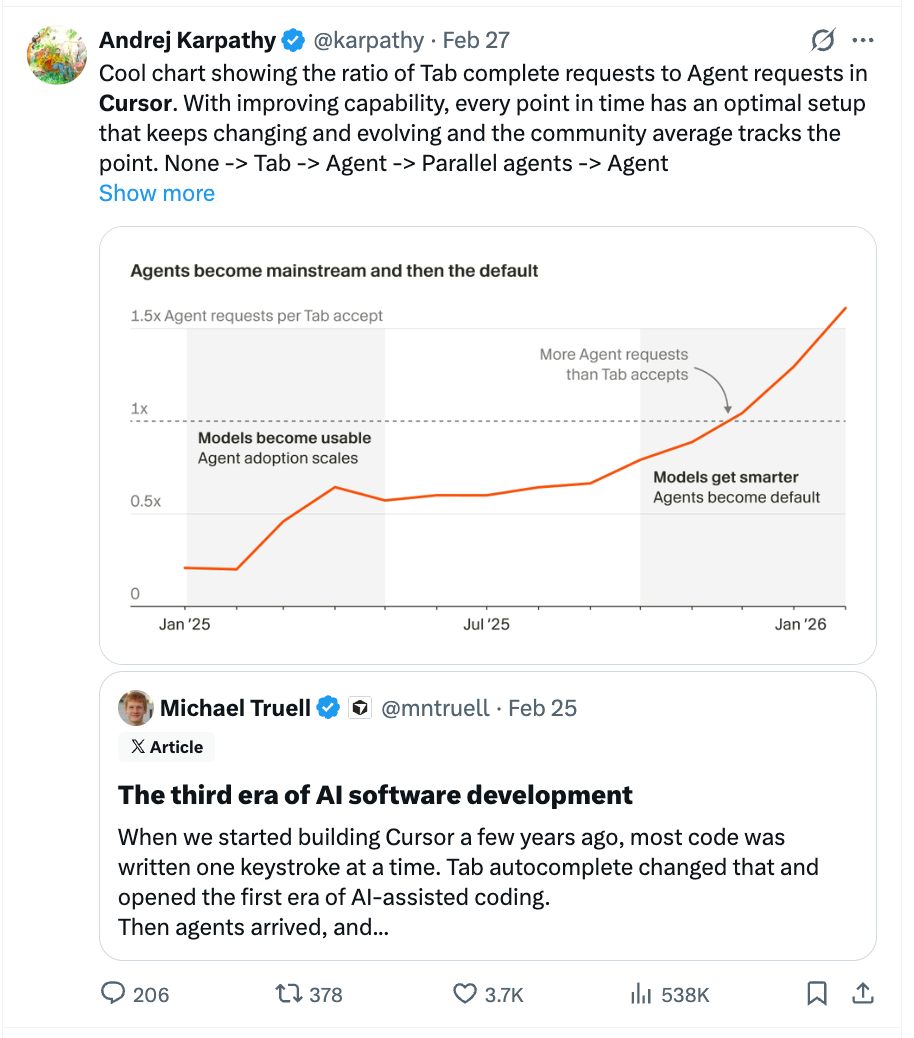
A self-described non-engineer became a top human contributor to major projects like Vercel's agent-browser and Python. He achieved this by building automated systems with AI agents that find contribution opportunities, write code, and submit pull requests, often while he sleeps.
Open-source initiatives like OpenClaw can surpass well-funded corporate R&D because they leverage a global pool of contributors. This distributed approach uncovers genius in unlikely places, allowing for breakthroughs that siloed internal teams might miss.

Go beyond static AI code analysis. After an AI like Codex automatically flags a high-confidence issue in a GitHub pull request, developers can reply directly in a comment, "Hey, Codex, can you fix it?" The agent will then attempt to fix the issue it found.
Since AI makes coding cheap, the real advantage lies in 'product taste.' Develop this by building an agent that consumes and synthesizes feedback from all sources—GitHub, Slack, Gong transcripts, and Twitter—to identify key user pains and roadmap priorities.

The rapid succession of Claude's agent-like upgrades is a direct response to the capabilities demonstrated by the open-source project OpenClaw. This trend, termed 'Clawification,' highlights how the open-source community is now setting the pace for product development at major AI labs like Anthropic.

When an engineering team is hesitant about a new feature due to unfamiliarity (e.g., mobile development), a product leader can use AI tools to build a functional prototype. This proves feasibility and shifts the conversation from a deadlock to a collaborative discussion about productionizing the code.
AI is evolving from a coding tool to a proactive product contributor. Claude analyzes user feedback, bug reports, and telemetry to autonomously suggest bug fixes and new features, acting more like a product-aware coworker than a simple code generator.

Borrowing from classic management theory, the most effective way to use AI agents is to fix problems at the earliest 'lowest value stage'. This means rigorously reviewing the agent's proposed plan *before* it writes any code, preventing costly rework later on.
