Get your free personalized podcast brief
We scan new podcasts and send you the top 5 insights daily.
AI can handle the 'writing lift,' much like historical rewrite desks. This forces a re-evaluation of a journalist's core value, shifting the emphasis from prose composition to the irreplaceable skills of investigation, sourcing, fact-gathering, and identifying what story matters.

Related Insights
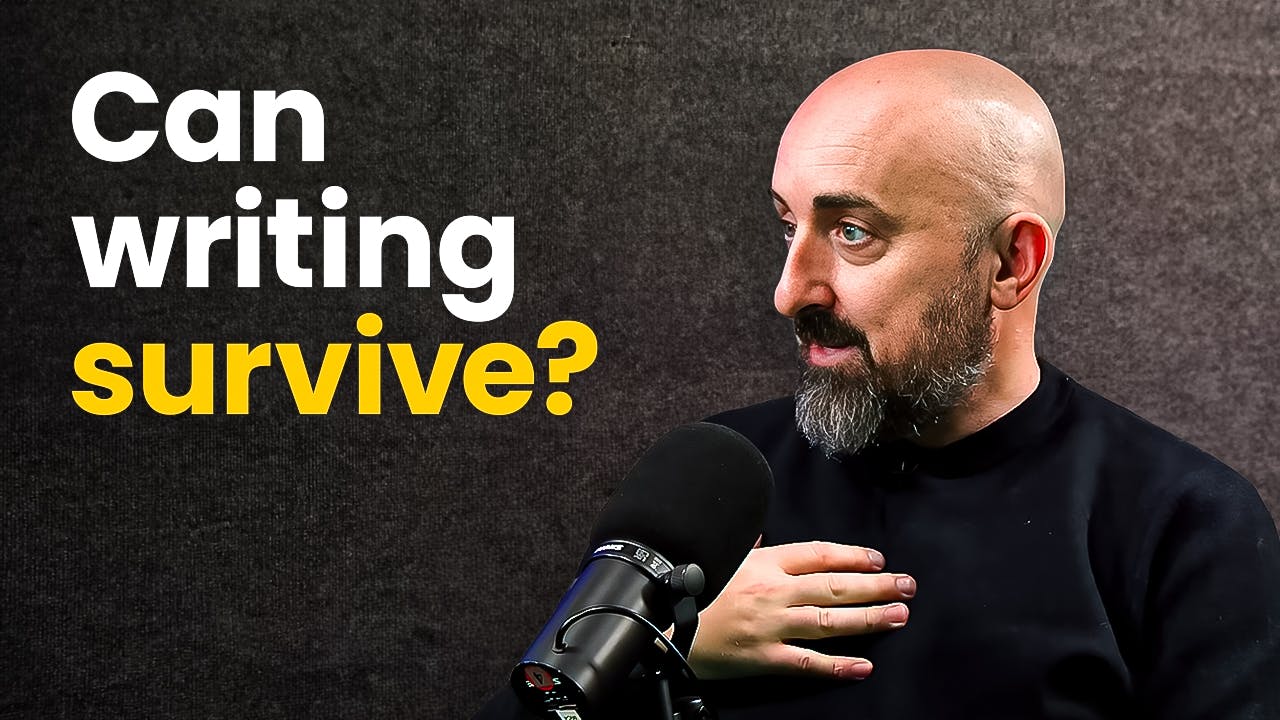
Medium's CEO argues that writing's future is secure because its core function is the process of structured thinking, not just content output. The act of articulating ideas reveals flaws and deepens understanding for the writer—a cognitive benefit that delegating to AI would eliminate.
For knowledge workers like authors, up to 50% of their time is spent on tedious "chores" like organizing sources or creating timelines. AI automates this drudgery, freeing up mental bandwidth for higher-value creative tasks like narrative construction and prose.

As AI democratizes the technical aspects of content creation, the ability to guide it with unique perspective, craft, and taste becomes the key differentiator. AI is a powerful tool for experts to scale their vision, but it cannot replace the vision itself.

In an era of rampant AI-generated misinformation, consumers will increasingly seek out and pay for trusted, human-vetted sources. Established media brands with a reputation for accuracy and editorial oversight gain a significant competitive advantage as arbiters of truth.
The Atlantic's CEO Nick Thompson draws a clear line for AI in journalism. He advocates for using it extensively for reporting tasks like finding stories, analyzing data, or checking for chronological gaps. However, since a byline promises human authorship, AI should never write the final prose, even if it becomes a better writer.

The traditional content model of writers producing a small volume of high-quality pieces is being inverted by AI. Now, smaller teams can generate massive volumes of lower-quality drafts instantly. The team's primary role shifts to curating, refining, and perfecting this output, rather than originating every word.

AI will commoditize the *act* of creating content (the 'doing'). The value will shift entirely to the *idea* behind the content (the 'thinking'), making strategic creativity the most valuable skill.

Tech journalist Alex Heath has integrated AI into his workflow, using it to write first drafts which he then edits. This has cut his writing time by 50%, freeing him up to focus on his core competitive advantages: networking with sources, conducting interviews, and breaking stories. It's a model for how knowledge workers can leverage AI.

Since AI can generate output rapidly, the differentiator is no longer speed but the quality of your judgment and clarity. AI acts as an amplifier; if your input lacks taste or direction, you'll simply produce "garbage faster." The most valuable skills become decision-making and refinement.

AI will automate the creation of first drafts, which are often based on existing ideas. This shifts the value from initial creation to refinement. The editor, who curates and improves the AI's output, will become more critical and valued than the writer who once created from scratch.
