Get your free personalized podcast brief
We scan new podcasts and send you the top 5 insights daily.
Publishing unvetted machine proofs creates chaotic races where researchers risk duplicate work trying to decode difficult outputs. Instead of dumping raw solutions, AI companies are increasingly likely to contract professional mathematicians to interpret, translate, and verify arguments before release.

Related Insights
As AI increasingly handles the bottleneck of generating proofs, the primary value of human mathematicians will shift. Skills like understanding, explaining, and curating an explosion of new results will become more critical than the act of proving itself. The community will reward those who can build frameworks for this new knowledge.

Generating proofs via one-shot prompting provides minimal individual research value if any user could replicate it. Scientific norms will likely evolve so that human credit is awarded for digesting vast dumps of automated proofs, validating them, and clarifying the core logic.
While AI is set to exponentially increase the output of mathematical proofs, it simultaneously provides the tools to manage this explosion. The same models that generate complex results can be used to quickly summarize, explain, and help humans absorb sophisticated mathematics, making the field more accessible, not less.
OpenAI's Astra model solving major open math problems highlights a critical issue: even experts cannot easily understand or verify the solutions. This forces a reliance on other AIs or formal proof systems for validation, signaling a future where human comprehension is no longer the gold standard for scientific progress.

Current AI models struggle to reliably verify their own mathematical steps. To establish trustworthy proofs, researchers now pair large language models with separate formal software like the Lean language, which verifies the logical validity of generated code against strict mathematical axioms.

While AI tools can empower talented students, they also enable amateurs to generate seemingly plausible but incorrect proofs. This floods professional mathematicians with requests to verify AI-assisted work from individuals who lack the foundational skills to check it themselves, creating a new form of expert burden.
Although automated systems can solve major open conjectures, raw AI proofs are often needlessly convoluted and bloated with trivialities. Human mathematicians will remain essential by setting research agendas, identifying fundamental conceptual stories, and refining machine-generated arguments into intelligible proofs.
Simply generating a mathematical proof in natural language is useless because it could be thousands of pages long and contain subtle errors. The pivotal innovation was combining AI reasoning with formal verification. This ensures the output is provably correct and usable, solving the critical problems of trust and utility for complex, AI-generated work.

AI now generates complex scientific derivations faster than humans can validate them. For a recent quantum gravity paper, the AI produced the core results in days, but human collaborators spent three weeks just checking the work, shifting the research bottleneck from discovery to verification.
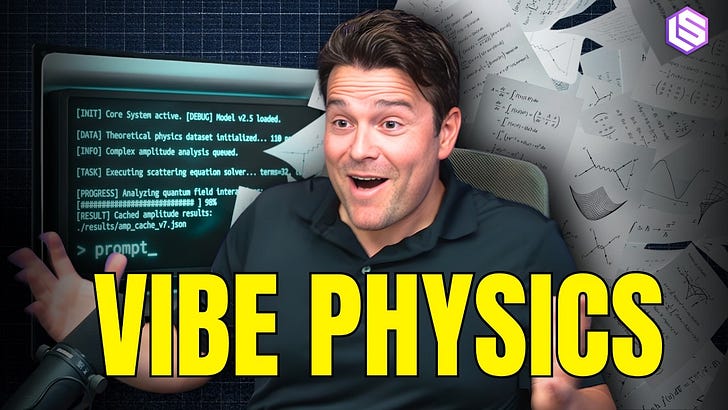
With AI generating complex formulas and proofs, the most challenging part of scientific research is no longer solving the core problem. Instead, the primary human task becomes verifying the AI-generated results and writing them up, fundamentally changing the research workflow.