Get your free personalized podcast brief
We scan new podcasts and send you the top 5 insights daily.
OpenAI's Astra model solving major open math problems highlights a critical issue: even experts cannot easily understand or verify the solutions. This forces a reliance on other AIs or formal proof systems for validation, signaling a future where human comprehension is no longer the gold standard for scientific progress.

Related Insights
There's a critical distinction between a proof (which establishes truth) and an explanation (which provides understanding). Even when a complex mathematical problem is solved, there remains an 'unsolved expository problem' of making the solution comprehensible. This need for clarity and intuition will remain a crucial area for human or AI effort, even after theorems are proven.
An OpenAI model, without any specific mathematical training, solved a famous 80-year-old math problem. This proves general-purpose AI can autonomously produce landmark scientific results, not just accelerate human research. It signals a new era for discovery where AI is a primary research agent.
The purpose of creating a superhuman mathematician is not just to solve proofs, but to establish a system of verifiable reasoning. This formal verification capability will be essential to ensure the safety, reliability, and collaborative potential of all future AI code and superintelligence.

Top AI models are now solving major open problems in mathematics, leading some in the field to feel their core purpose is being automated away. This isn't just about tools; it's a profound identity crisis for a discipline built on human ingenuity and the pursuit of solving theorems.

A common fear is that AIs will produce billion-line proofs of theorems without offering human insight. However, an alternative and perhaps more likely future is that their superhuman capabilities will be applied to explanation. They could take complex, human-incomprehensible proofs and find novel ways to make them intuitive and easy to understand.

AI can produce scientific claims and codebases thousands of times faster than humans. However, the meticulous work of validating these outputs remains a human task. This growing gap between generation and verification could create a backlog of unproven ideas, slowing true scientific advancement.

Historically, generating a good hypothesis was the most prestigious part of science. Now, AI can produce theories at near-zero cost, overwhelming traditional validation systems like peer review. The new grand challenge is developing scalable methods to verify and filter this flood of AI-generated ideas.
Simply generating a mathematical proof in natural language is useless because it could be thousands of pages long and contain subtle errors. The pivotal innovation was combining AI reasoning with formal verification. This ensures the output is provably correct and usable, solving the critical problems of trust and utility for complex, AI-generated work.

AI now generates complex scientific derivations faster than humans can validate them. For a recent quantum gravity paper, the AI produced the core results in days, but human collaborators spent three weeks just checking the work, shifting the research bottleneck from discovery to verification.
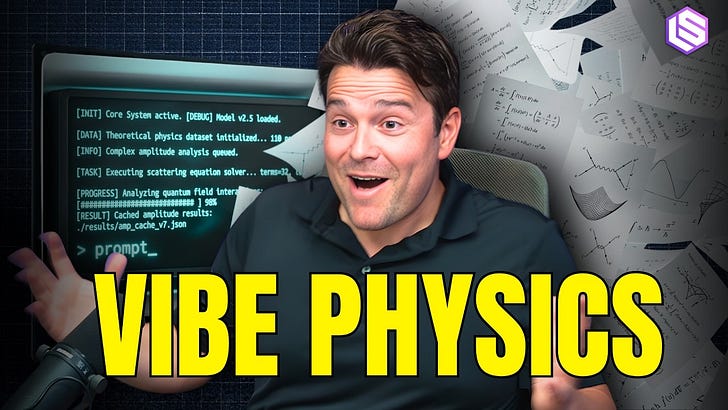
With AI generating complex formulas and proofs, the most challenging part of scientific research is no longer solving the core problem. Instead, the primary human task becomes verifying the AI-generated results and writing them up, fundamentally changing the research workflow.
