Get your free personalized podcast brief
We scan new podcasts and send you the top 5 insights daily.
Identical base prices for AI models like Astra and Fable 5.1 are misleading. The actual cost is driven by cache-read pricing, long-request surcharges, and tool charges. Evaluating the total cost to complete a specific task is a more accurate financial metric than comparing per-token rates.

Related Insights
Newer AI models may have low per-token prices but are often "token hungry," requiring more tokens to complete a task. This can make them more expensive overall. The true measure of economic viability is the final cost-per-task, not the misleading per-token price.

A Databricks study found that for coding tasks, the cheaper Sonnet model was ultimately more expensive per task ($2.09) than the premium Opus model ($1.94). The cheaper model required more iterations and reasoning to achieve the same result, proving that the lowest token price doesn't guarantee the lowest total cost.

As AI models become more efficient, cost-per-token is an increasingly misleading metric. A more capable model might be more expensive per token but far cheaper per completed task because it requires fewer steps or revisions. The focus of economic evaluation must shift from the raw input cost to the final output cost.

OpenAI's GPT-5.5 is more expensive per token, but a new evaluation framework is emerging. The key metric isn't raw cost, but the model's efficiency in solving a problem. This 'intelligence per dollar' reframes cost analysis around performance and compute, where more expensive models can be cheaper overall if they solve tasks more efficiently.
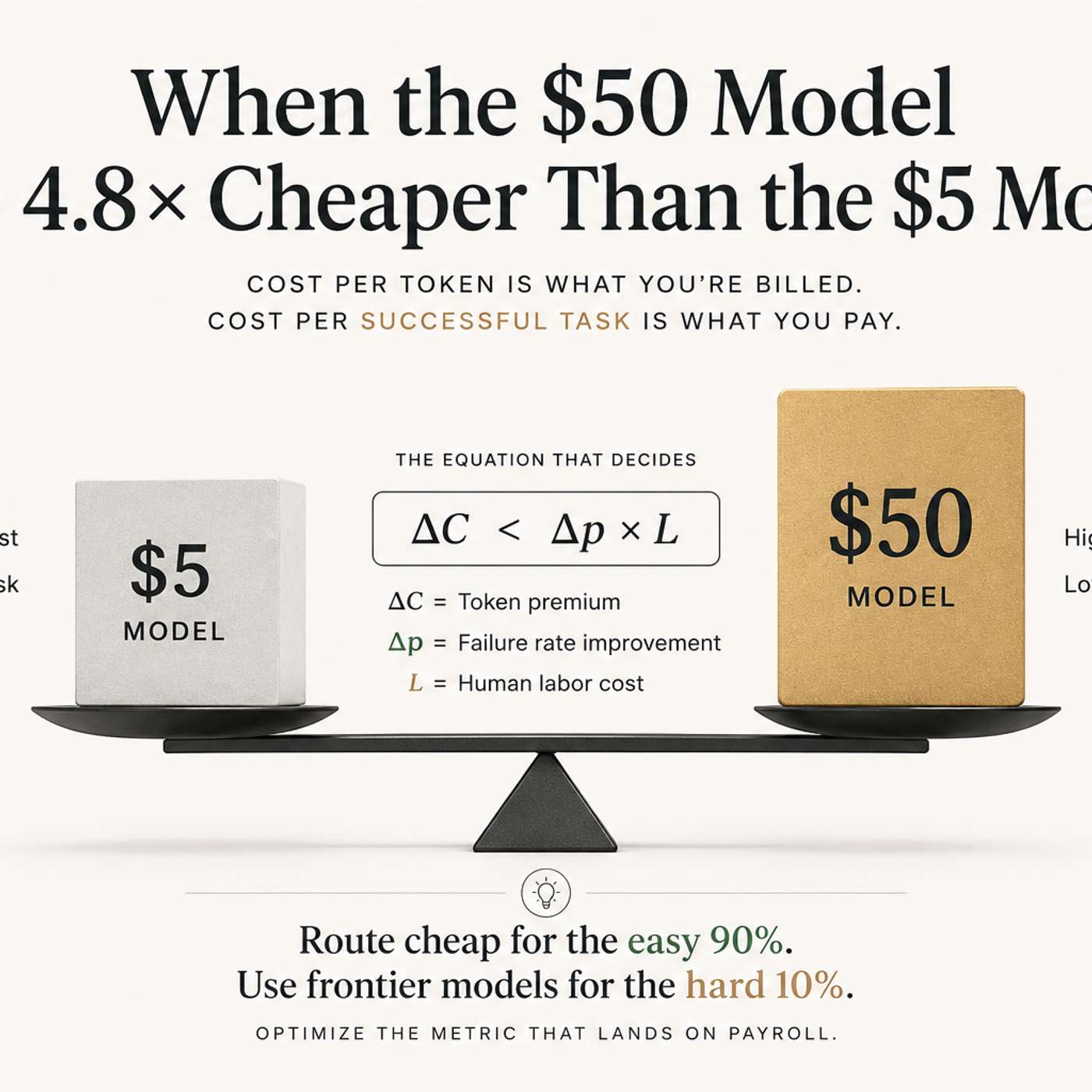
Evaluating AI models on cost-per-token is misleading because it ignores the hidden cost of human labor to fix failures. The true 'cost per successful task' is a business metric that accounts for both the API invoice and the payroll expense for rework, revealing a more accurate total cost of ownership.
A model with a low per-token price can be more expensive if it's inefficient, verbose, or requires multiple attempts ('overthinking'). The actual invoice depends on the total tokens needed to complete a task, making token efficiency a hidden multiplier that savvy enterprises are now tracking to determine the true cost.
Focusing on token pricing is misleading. A more powerful model may be more expensive per token but significantly cheaper per task because its higher efficiency requires fewer prompts and iterations to achieve a final result. The correct way to measure cost-effectiveness is by the total cost to complete a job, not the price of the raw material.
A cheap model that fails often becomes expensive due to retries, fallbacks, and human review. The true measure of economic efficiency is the cost to reliably complete a task, not the raw inference cost, which can be a misleading metric at scale.
Sticker price per token is a misleading metric for AI models. A cheaper model may require more retries or reasoning, making it more expensive overall. The true metric is 'cost per accepted task,' which accounts for total resources needed to get a reliable, usable result, providing a true apples-to-apples comparison.
An AI model might have a low cost per token but be 'token hungry,' requiring more tokens to complete a task. This makes it more expensive overall than a model with a higher per-token cost but greater efficiency. Evaluating models on a 'cost per task' basis provides a more accurate ROI.
