Get your free personalized podcast brief
We scan new podcasts and send you the top 5 insights daily.
While AI compute demand seems limitless, its price is not infinitely elastic. As inference becomes a core cost of goods sold (COGS) for AI products, excessively high compute prices will break the business models of infrastructure customers, ultimately limiting demand.

Related Insights
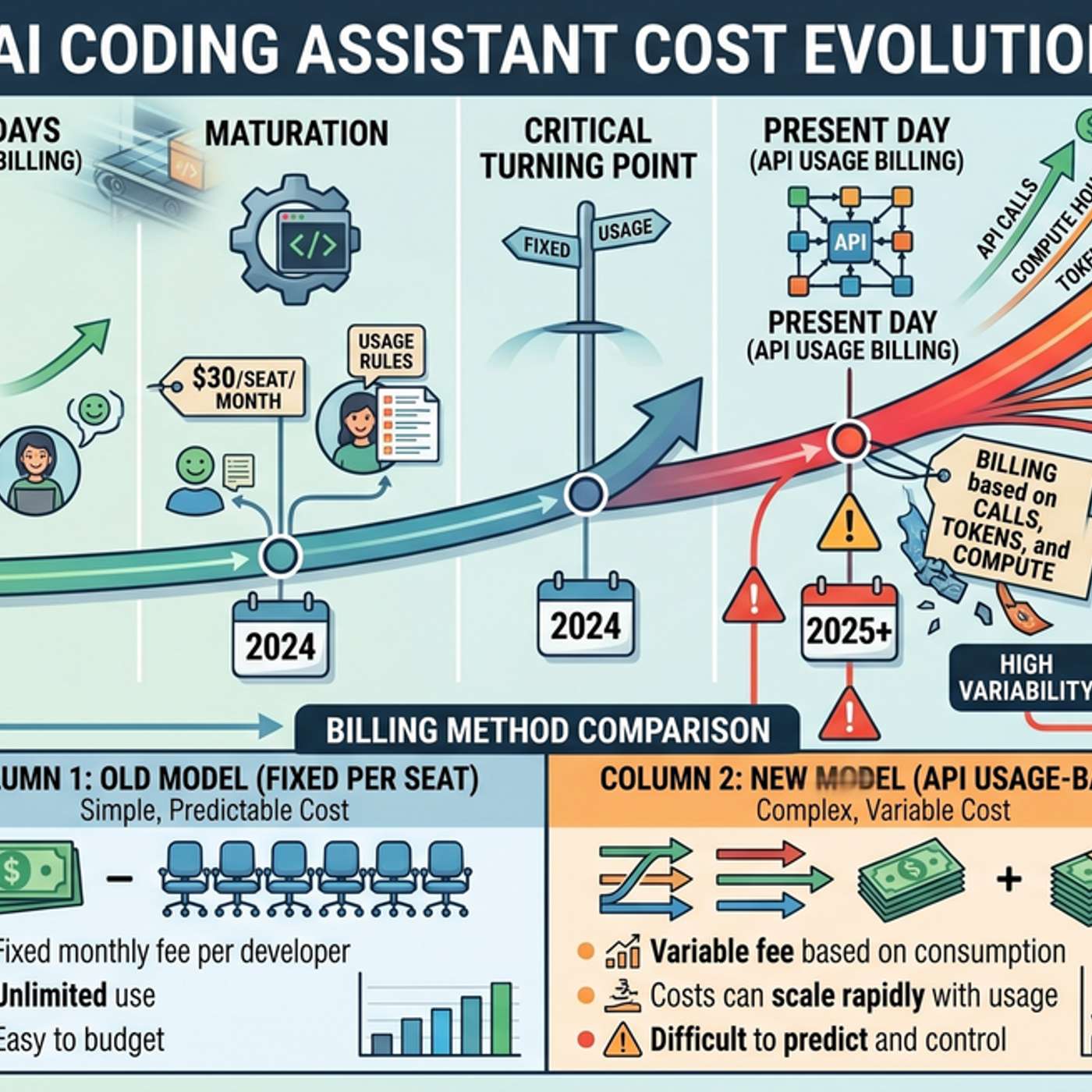
Amidst a 48% spike in GPU rental costs, AI companies like Anthropic are shifting heavy enterprise users from flat-rate to usage-based pricing. This move, framed as unblocking power users, is fundamentally a response to the industry-wide compute shortage, directly linking the high cost-to-serve with customer pricing.

Companies like Anthropic and OpenAI could generate even more parabolic revenue if they had access to infinite power and data centers. Their financial performance is a function of supply-side bottlenecks, making traditional demand-based forecasting less relevant for now.

Unlike traditional SaaS, achieving product-market fit in AI is not enough for survival. The high and variable costs of model inference mean that as usage grows, companies can scale directly into unprofitability. This makes developing cost-efficient infrastructure a critical moat and survival strategy, not just an optimization.

The compute power required for AI agents to operate ('inference') is a significant new cost. Without an optimized infrastructure to manage these costs, companies risk spending all their AI-driven productivity gains on 'feeding' their digital workers, making the initiative unprofitable.

A primary risk for major AI infrastructure investments is not just competition, but rapidly falling inference costs. As models become efficient enough to run on cheaper hardware, the economic justification for massive, multi-billion dollar investments in complex, high-end GPU clusters could be undermined, stranding capital.
The perceived constraint on AI compute isn't a true supply issue, but a consequence of VC-funded companies pricing their services below cost to fuel growth. This creates artificial demand that masks the true, profitable market size until unit economics are forced.

Software has long commanded premium valuations due to near-zero marginal distribution costs. AI breaks this model. The significant, variable cost of inference means expenses scale with usage, fundamentally altering software's economic profile and forcing valuations down toward those of traditional industries.

Rising AI API costs are not merely a vendor strategy but a direct result of real-world bottlenecks. These include surging electricity prices for data centers, a structural shortage of high-bandwidth memory (HBM), and constrained hardware supply chains, which are fundamentally altering the cost basis for AI compute.
AI companies like OpenAI are losing money on their popular subscription plans. The computational cost (inference) to serve a user, especially a power user, often exceeds the subscription fee. This subsidized model is propped up by venture capital and is not sustainable long-term.

The shift to usage-based pricing for AI tools isn't just a revenue growth strategy. Enterprise vendors are adopting it to offset their own escalating cloud infrastructure costs, which scale directly with customer usage, thereby protecting their profit margins from their own suppliers.
