Get your free personalized podcast brief
We scan new podcasts and send you the top 5 insights daily.
While powerful for analyzing existing medical data, AI struggles with true scientific discovery where the underlying biological principles are still unknown. Since AI learns from existing data, it cannot easily generate hypotheses that violate the very rules it was trained on, limiting its role in frontier science.

Related Insights
While AI excels at screening vast compound libraries for potential drug candidates, it cannot overcome the ultimate bottleneck: the messy, complex, and poorly documented reality of human biology. The need for physical clinical trials remains the fundamental constraint on medical progress.

Future progress in biology requires moving beyond static models. The new paradigm involves an AI that reasons over hypotheses, prioritizes experiments, learns from the empirical outcomes, and updates its internal world model. This creates a scalable, closed-loop system for scientific discovery.

The bottleneck for AI in drug discovery is not the algorithm but the lack of high-quality, large-scale biological data. New platforms are needed to generate this necessary "substrate" for AI models to learn from, challenging the narrative that better models alone are the solution.

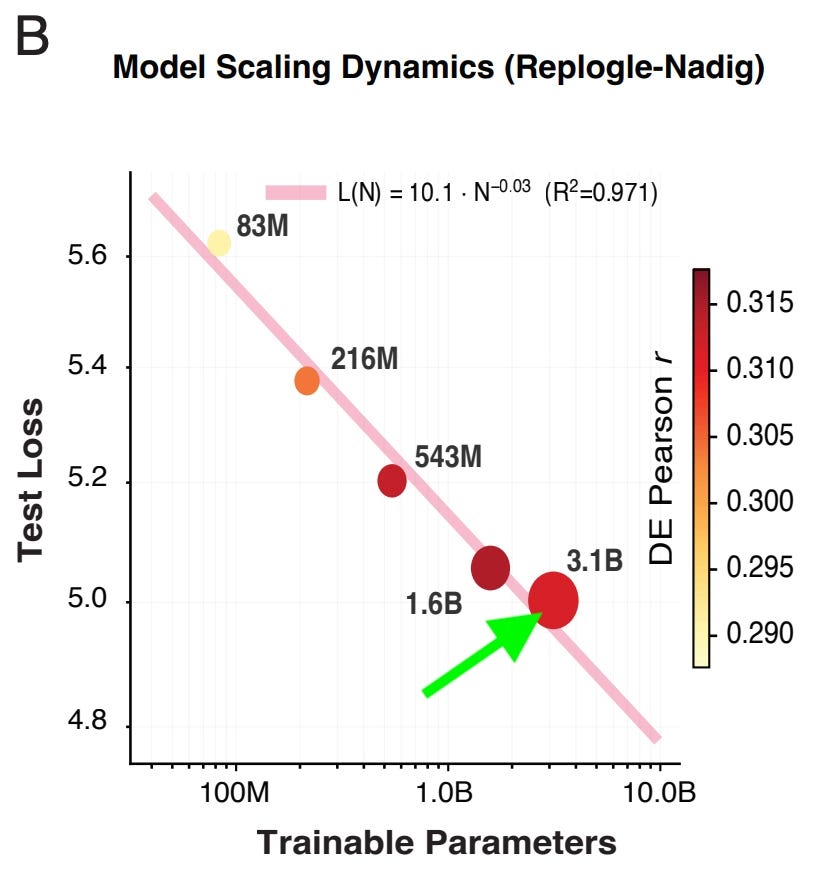
Standard AI models trained on public, observational biological data excel at descriptive tasks but underperform even linear models on causal predictions. To predict cellular responses to drug-like perturbations, models must be trained specifically on causal data generated from targeted experiments.
AI cannot yet revolutionize drug discovery because its strength is synthesizing existing knowledge. The problem is that humans only understand about 20% of the human body's biology, meaning the foundational dataset is too incomplete for AI to reliably predict outcomes for the unknown 80%.

Unlike coding, where AI models get immediate feedback on whether code runs, drug development faces immense delays. A biological hypothesis can take a decade and hundreds of millions of dollars to test in the clinic. This lack of rapid validation checkpoints is a core obstacle for AI's ability to learn and reliably improve drug target selection.

The ultimate goal isn't just modeling specific systems (like protein folding), but automating the entire scientific method. This involves AI generating hypotheses, choosing experiments, analyzing results, and updating a 'world model' of a domain, creating a continuous loop of discovery.

Unlike math or code with cheap, fast rewards, clinically valuable biology problems lack easily verifiable ground truths. This makes it difficult to create the rapid reinforcement learning loops that drive explosive AI progress in other fields.

A major frontier for AI in science is developing 'taste'—the human ability to discern not just if a research question is solvable, but if it is genuinely interesting and impactful. Models currently struggle to differentiate an exciting result from a boring one.
Current LLMs fail at science because they lack the ability to iterate. True scientific inquiry is a loop: form a hypothesis, conduct an experiment, analyze the result (even if incorrect), and refine. AI needs this same iterative capability with the real world to make genuine discoveries.
