Get your free personalized podcast brief
We scan new podcasts and send you the top 5 insights daily.
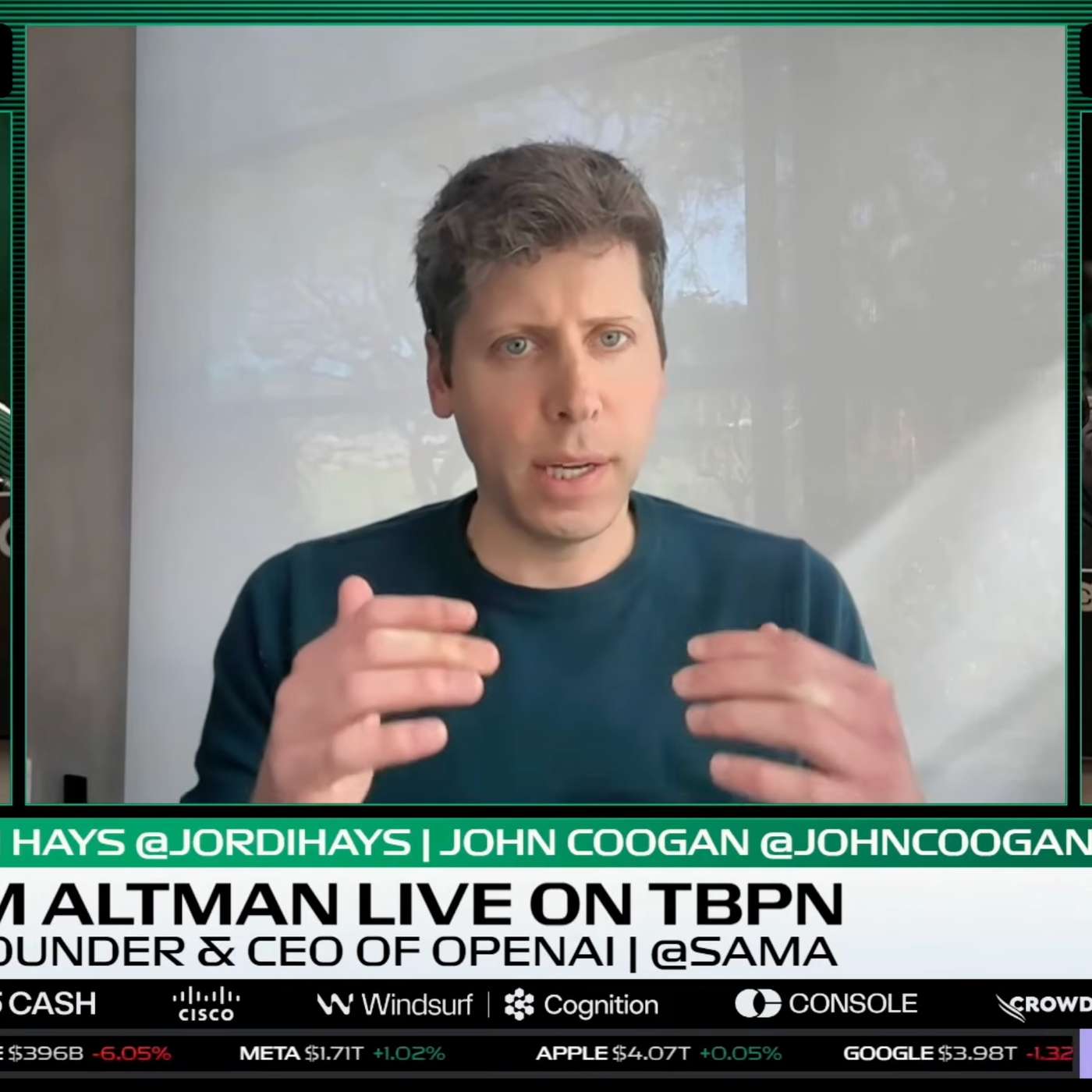
Sam Altman reveals a stark disconnect between the "crazy hurricane" of media perception and the focused internal reality at OpenAI. The team is too busy building to be consumed by external drama, which they often view as being almost completely divorced from reality.
Related Insights
Sam Altman demystifies leadership, stating that contrary to the myth of the visionary with a master plan, the reality is constant improvisation. His experience reveals that no one has it all figured out; success comes from incremental progress and reacting to new information.

The lawsuit is unlikely to financially cripple OpenAI or reverse its for-profit structure. Its primary impact will be shaping the public narrative around Sam Altman and Elon Musk by revealing internal documents and testing which figure a jury finds more sympathetic. It's a battle for perception, not an existential threat.

CEO Sam Altman reveals "code reds" are a deliberate, frequent strategy, not panic. OpenAI treats competitive threats like pandemics, believing intense, early action is far more effective than delayed responses, even if the threat doesn't fully materialize. This reframes a crisis as a calculated, proactive maneuver.

When questioned on OpenAI's massive $1.4T spending commitments, CEO Sam Altman's response was not a financial justification but a challenge. He stated that if investors are concerned, he can easily find buyers for their shares, highlighting intense market demand over traditional financial planning.

Instead of hiding during controversy, Sam Altman's strategy of continuous podcast appearances creates a constant stream of new content. This "post through the pain" approach ensures that any negative clips are quickly buried by the next news cycle, demonstrating a modern, aggressive communications tactic.
OpenAI operates with a "truly bottoms-up" structure because it's impossible to create rigid long-term plans when model capabilities are advancing unpredictably. They aim fuzzily at a 1-year+ horizon but rely on empirical, rapid experimentation for short-term product development, embracing the uncertainty.
A growth fund GP frames the market's intense scrutiny of OpenAI's slowing growth as "anxiety displacement." With the market being up for a long time and broader societal anxieties, negative focus on a high-performing company like OpenAI becomes an outlet for unrelated fears.
The media portrays AI development as volatile, with huge breakthroughs and sudden plateaus. The reality inside labs like OpenAI is a steady, continuous process of experimentation, stacking small wins, and consistent scaling. The internal experience is one of "chugging along."
![[State of RL/Reasoning] IMO/IOI Gold, OpenAI o3/GPT-5, and Cursor Composer — Ashvin Nair, Cursor thumbnail](https://assets.flightcast.com/V2Uploads/nvaja2542wefzb8rjg5f519m/01K4D8FB4MNA071BM5ZDSMH34N/square.jpg)
OpenAI is aggressively shifting its narrative from a consumer-focused company (ChatGPT) to an enterprise powerhouse. CEO Sam Altman is personally hosting dinners for executives from companies like Disney, signaling a major push to capture large corporate clients and grow OpenAI's API business.

Sam Altman reveals his primary role has evolved from making difficult compute allocation decisions internally to focusing almost entirely on securing more compute capacity, signaling a strategic shift towards aggressive expansion over optimization.