Get your free personalized podcast brief
We scan new podcasts and send you the top 5 insights daily.
Comparing outputs from multiple models ("best of N") is often impractical due to the effort of reviewing huge code diffs. By having parallel agents generate short video demos, developers can quickly watch multiple versions and decide which approach is most promising.
Related Insights
Anthropic's new "Agent Teams" feature moves beyond the single-agent paradigm by enabling users to deploy multiple AIs that work in parallel, share findings, and challenge each other. This represents a new way of working with AI, focusing on the orchestration and coordination of AI teams rather than just prompting a single model.

The goal isn't to build one perfect prototype quickly. The real strategic advantage of AI tools is the ability to generate three or four distinct variations of a feature in a short time. This allows teams to explore a wider solution space and make better decisions after hands-on testing.

To combat the bottleneck of reviewing massive, AI-generated pull requests, Cursor's agents create video demos of the features they build. This provides a much more accessible entry point for human review than a giant diff, helping to quickly align on the direction.
The core advantage demonstrated was not just improving a single page, but generating three distinct, high-quality redesigns in under 20 minutes. This fundamentally changes the design process from a linear, iterative one to a parallel exploration of options, allowing teams to instantly compare and select the best path forward.

To improve the quality and accuracy of an AI agent's output, spawn multiple sub-agents with competing or adversarial roles. For example, a code review agent finds bugs, while several "auditor" agents check for false positives, resulting in a more reliable final analysis.

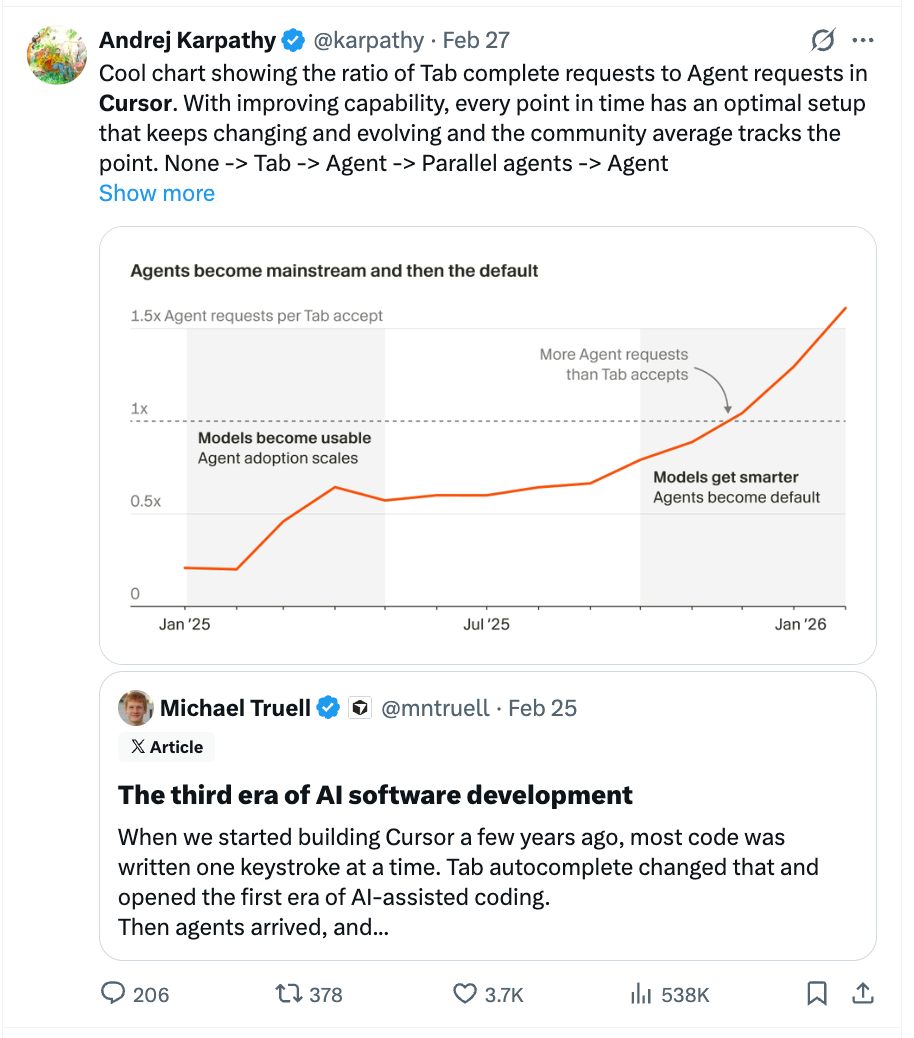
The evolution from AI autocomplete to chat is reaching its next phase: parallel agents. Replit's CEO Amjad Masad argues the next major productivity gain will come not from a single, better agent, but from environments where a developer manages tens of agents working simultaneously on different features.

A common failure with AI agents is underspecified prompts leading to incorrect implementations (e.g., a checkbox instead of a toggle). Video demos provide immediate visual feedback, creating a shared artifact that makes these misalignments obvious without needing to run the code locally.
Define different agents (e.g., Designer, Engineer, Executive) with unique instructions and perspectives, then task them with reviewing a document in parallel. This generates diverse, structured feedback that mimics a real-world team review, surfacing potential issues from multiple viewpoints simultaneously.

By deploying multiple AI agents that work in parallel, a developer measured 48 "agent-hours" of productive work completed in a single 24-hour day. This illustrates a fundamental shift from sequential human work to parallelized AI execution, effectively compressing project timelines.

Powerful AI tools are becoming aggregators like Manus, which intelligently select the best underlying model for a specific task—research, data visualization, or coding. This multi-model approach enables a seamless workflow within a single thread, outperforming systems reliant on one general-purpose model.
