Get your free personalized podcast brief
We scan new podcasts and send you the top 5 insights daily.
Following positive Phase III data for adjuvant atezolizumab plus chemotherapy in Stage III MSI-high colon cancer, clinicians are extrapolating this approach to high-risk Stage II patients. For some, they favor using immunotherapy alone, omitting chemotherapy due to its perceived limited additional benefit in the Stage II setting.

Related Insights
Trials like the dostarlimab study in rectal cancer and NICHE in colon cancer show neoadjuvant immunotherapy can induce profound responses in MSI-high tumors. This is creating a new paradigm where major surgery might be avoided entirely for some patients, marking a significant shift in treatment strategy.
Historically, discussing adjuvant therapy for Stage III colon cancer was quick and straightforward, while Stage II was complex. The advent of ctDNA testing has reversed this dynamic. Stage II decisions are now clearer (treat if positive), while Stage III discussions have become much longer and more nuanced as clinicians integrate ctDNA data with patient preferences.

Experts favor a Nivolumab plus Ipilimumab (NIVO+EP) combination for newly diagnosed, MSI-high, stage IV gastroesophageal cancer patients who can tolerate it. This approach avoids chemotherapy and yields high, sustained response rates, including potential for complete pathologic responses in metastatic settings.

The landmark DYNAMIC-2 study showed that using ctDNA to guide adjuvant therapy decisions in Stage II colon cancer cut chemotherapy use by 50% (from 30% to 15% of patients). This de-escalation was achieved without any negative impact on patient outcomes, validating the approach.
While the ATOMIC trial established FOLFOX plus atezolizumab as a new standard for adjuvant therapy in MSI-high colon cancer, its design lacked an immunotherapy-only arm. This leaves a critical, unanswered question about the actual contribution and necessity of the chemotherapy component.
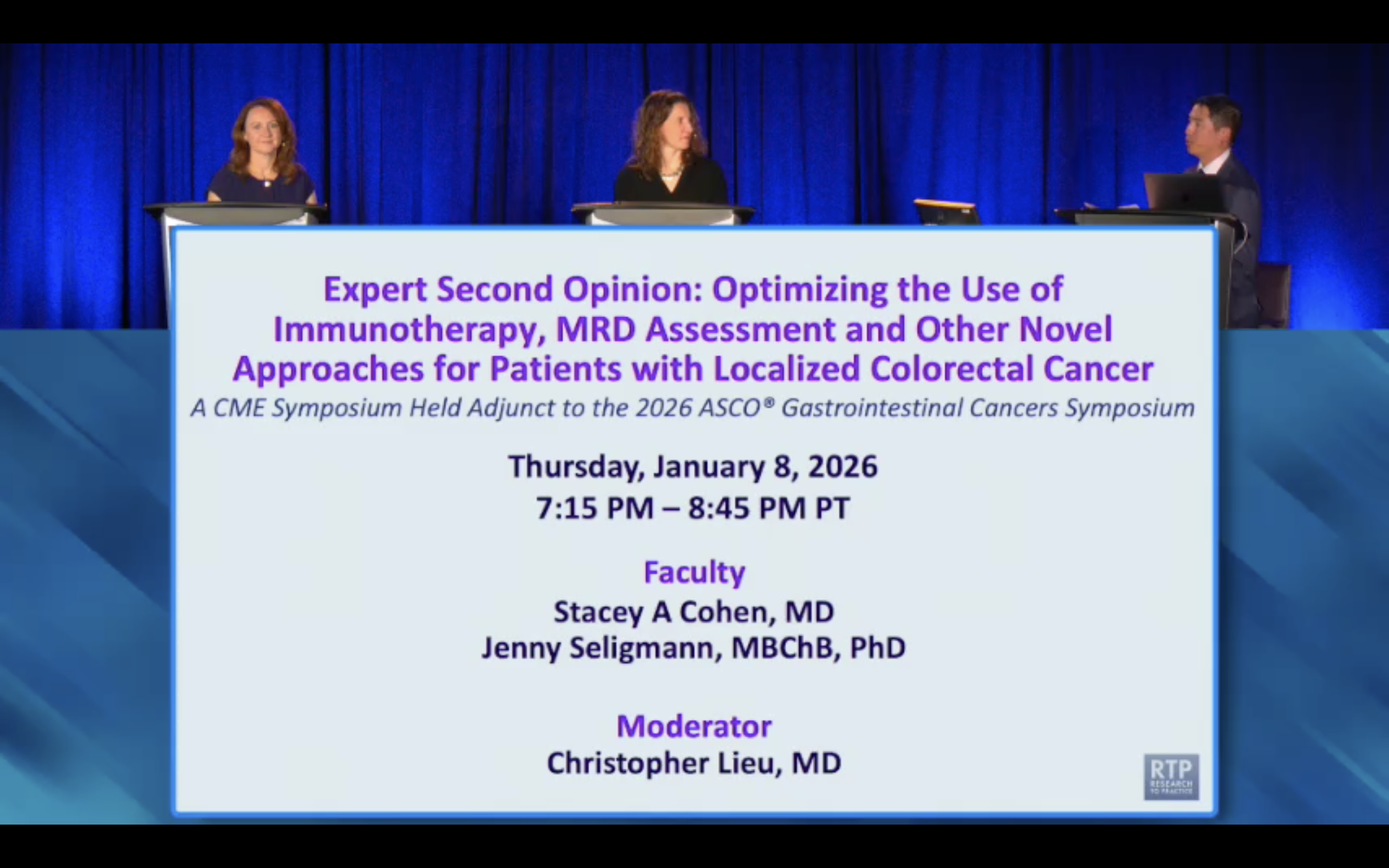
The practice-changing DYNAMIC trial showed that a ctDNA-guided strategy for stage II colorectal cancer reduces adjuvant chemotherapy use by 50%. Despite this significant de-escalation of treatment, patient outcomes and survival rates were identical to the standard-of-care approach.

While immunotherapy is largely ineffective in metastatic microsatellite stable (MSS) colorectal cancer, emerging data suggests it may have surprising efficacy in the early-stage (neoadjuvant) setting. This differential response is likely due to a more favorable tumor microenvironment in earlier disease, suggesting a new therapeutic window.
The COMET study found combining chemotherapy with atezolizumab did not improve overall survival versus atezolizumab alone. However, it nearly eliminated early progressive disease (2.8% vs. 32.4%), suggesting a critical role for patients with high tumor burden who cannot risk initial progression on monotherapy.

For fit patients with metastatic MSI-high colorectal cancer, the combination of ipilimumab and nivolumab is the preferred frontline treatment over pembrolizumab monotherapy. This is based on Phase III data showing the dual IO approach is superior. Single-agent PD-1 inhibitors are reserved for frail patients or those with autoimmune comorbidities.
While the ATOMIC trial combined FOLFOX with atezolizumab, clinicians should not de-escalate by simply dropping oxaliplatin. Historical data suggests single-agent 5-FU is ineffective and potentially harmful in MSI-high patients, a risk that is not presumed to be overcome by adding immunotherapy.