/
© 2026 RiffOn. All rights reserved.

Get your free personalized podcast brief

We scan new podcasts and send you the top 5 insights daily.

  1. Research To Practice | Oncology Videos
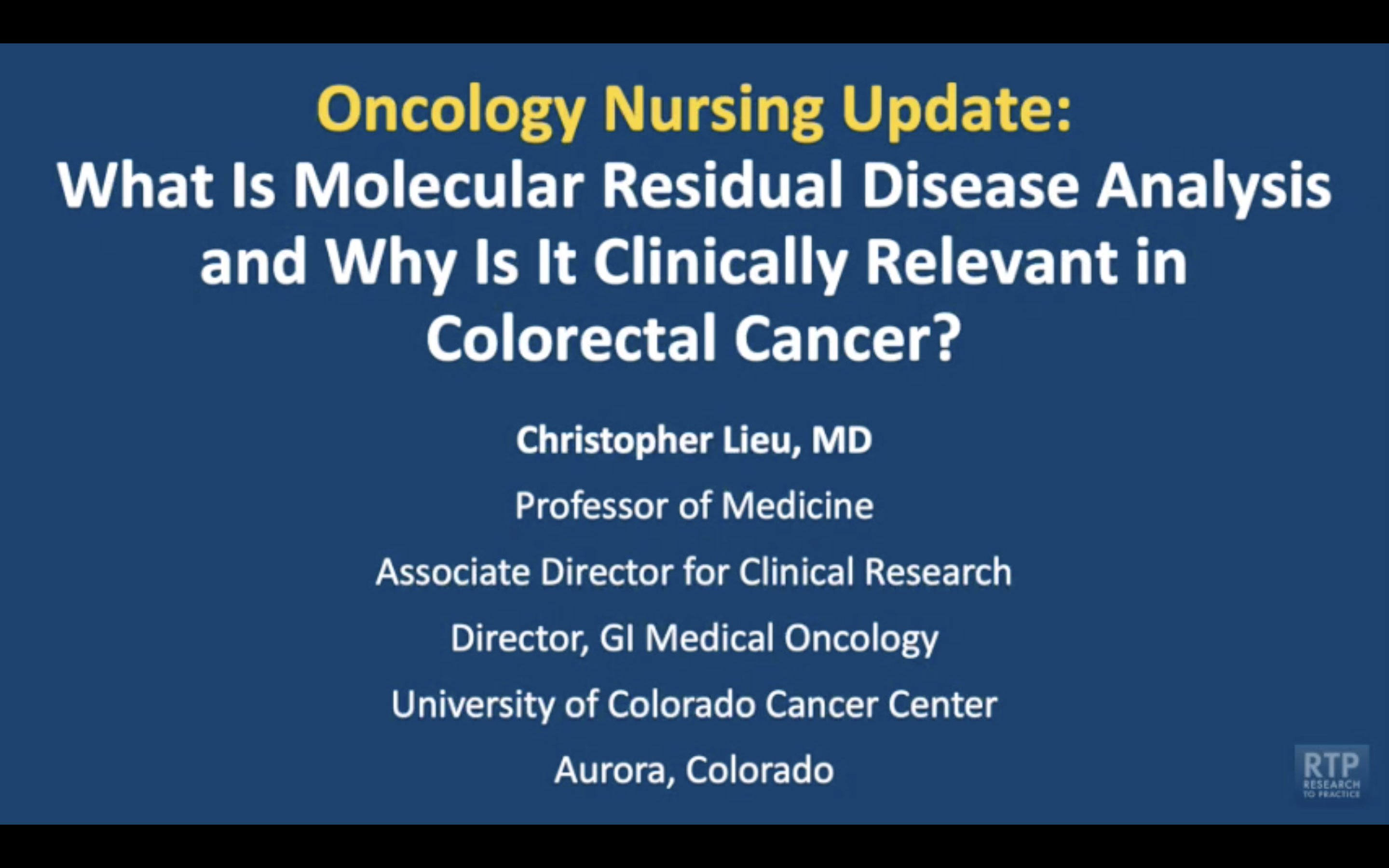
  2. Oncology Nursing Update: Colorectal Cancer — An Interview with Dr Christopher Lieu on Molecular Residual Disease Analysis
Oncology Nursing Update: Colorectal Cancer — An Interview with Dr Christopher Lieu on Molecular Residual Disease Analysis

Oncology Nursing Update: Colorectal Cancer — An Interview with Dr Christopher Lieu on Molecular Residual Disease Analysis

Research To Practice | Oncology Videos · Mar 6, 2026

Dr. Chris Lieu discusses ctDNA analysis in colorectal cancer, a powerful prognostic tool guiding adjuvant chemotherapy and personalizing patient care.

Negative ctDNA Can Unmask "Ghost Tumors" in MSI-High CRC Patients on Immunotherapy

For MSI-high patients responding to immunotherapy, a lingering mass on a CT scan may not be active cancer. A negative ctDNA test can help confirm that the visible lesion is likely just scar tissue, potentially averting unnecessary surgery.

Oncology Nursing Update: Colorectal Cancer — An Interview with Dr Christopher Lieu on Molecular Residual Disease Analysis thumbnail

Oncology Nursing Update: Colorectal Cancer — An Interview with Dr Christopher Lieu on Molecular Residual Disease Analysis

Research To Practice | Oncology Videos·13 hours ago

Tumor-Informed ctDNA Assays Offer Higher Sensitivity at the Cost of Speed

Tumor-informed assays like Signatera sequence a patient's tumor to create a personalized test, making it highly sensitive but taking 3-4 weeks. Tumor-uninformed assays are faster (1 week) but less sensitive as they screen for a generic panel of cancer mutations.

Oncology Nursing Update: Colorectal Cancer — An Interview with Dr Christopher Lieu on Molecular Residual Disease Analysis thumbnail

Oncology Nursing Update: Colorectal Cancer — An Interview with Dr Christopher Lieu on Molecular Residual Disease Analysis

Research To Practice | Oncology Videos·13 hours ago

ctDNA Is The Most Powerful Prognostic Test Ever Developed for Colorectal Cancer

Circulating tumor DNA (ctDNA) testing is described as unequivocally the most prognostic tool available for colorectal cancer. Patients who remain serially negative have a minimal recurrence risk, while a positive result almost universally predicts a future clinical recurrence by 6-8 months.

Oncology Nursing Update: Colorectal Cancer — An Interview with Dr Christopher Lieu on Molecular Residual Disease Analysis thumbnail

Oncology Nursing Update: Colorectal Cancer — An Interview with Dr Christopher Lieu on Molecular Residual Disease Analysis

Research To Practice | Oncology Videos·13 hours ago

Asking CRC Patients About Future Regret Is A Key Shared Decision-Making Tool

A powerful counseling technique for complex adjuvant therapy decisions is to ask patients: "If your cancer recurs, will you look back and regret the choice you're making today?" This forces patients to confront their own risk tolerance and helps them commit to a treatment path.

Oncology Nursing Update: Colorectal Cancer — An Interview with Dr Christopher Lieu on Molecular Residual Disease Analysis thumbnail

Oncology Nursing Update: Colorectal Cancer — An Interview with Dr Christopher Lieu on Molecular Residual Disease Analysis

Research To Practice | Oncology Videos·13 hours ago

Standard Stage III Colon Cancer Chemo Needlessly Treats 7-8 of Every 10 Patients

For every 10 Stage III patients receiving adjuvant chemo, 5 are already cured by surgery and 2-3 will recur regardless. This means therapy only benefits 2-3 patients, leading to significant overtreatment for the majority who endure toxicity without benefit.

Oncology Nursing Update: Colorectal Cancer — An Interview with Dr Christopher Lieu on Molecular Residual Disease Analysis thumbnail

Oncology Nursing Update: Colorectal Cancer — An Interview with Dr Christopher Lieu on Molecular Residual Disease Analysis

Research To Practice | Oncology Videos·13 hours ago

Early-Onset CRC Makes Chemo-Induced Neuropathy a 50-Year Sentence for Young Patients

With colorectal cancer rates rising in young adults, the long-term toxicity of oxaliplatin-induced peripheral neuropathy is a graver concern. A 30-year-old patient could face debilitating side effects for 40-50 years, fundamentally altering the risk-benefit calculation for adjuvant therapy.

Oncology Nursing Update: Colorectal Cancer — An Interview with Dr Christopher Lieu on Molecular Residual Disease Analysis thumbnail

Oncology Nursing Update: Colorectal Cancer — An Interview with Dr Christopher Lieu on Molecular Residual Disease Analysis

Research To Practice | Oncology Videos·13 hours ago

Clinicians Use Positive ctDNA to Escalate CRC Treatment But Hesitate to De-Escalate

Oncologists are more comfortable using a positive ctDNA test to escalate care (e.g., recommend chemo for a low-risk Stage II patient). However, they are more hesitant to use a negative test to de-escalate or withhold standard chemo for higher-risk patients, pending more definitive trial data.

Oncology Nursing Update: Colorectal Cancer — An Interview with Dr Christopher Lieu on Molecular Residual Disease Analysis thumbnail

Oncology Nursing Update: Colorectal Cancer — An Interview with Dr Christopher Lieu on Molecular Residual Disease Analysis

Research To Practice | Oncology Videos·13 hours ago

The DYNAMIC-2 Trial Proved ctDNA-Guided Therapy Halves Chemo Use in Stage II Colon Cancer

The landmark DYNAMIC-2 study showed that using ctDNA to guide adjuvant therapy decisions in Stage II colon cancer cut chemotherapy use by 50% (from 30% to 15% of patients). This de-escalation was achieved without any negative impact on patient outcomes, validating the approach.

Oncology Nursing Update: Colorectal Cancer — An Interview with Dr Christopher Lieu on Molecular Residual Disease Analysis thumbnail

Oncology Nursing Update: Colorectal Cancer — An Interview with Dr Christopher Lieu on Molecular Residual Disease Analysis

Research To Practice | Oncology Videos·13 hours ago