Get your free personalized podcast brief
We scan new podcasts and send you the top 5 insights daily.
Despite widespread experimentation with AI across the product development lifecycle, prototyping is the only function that has emerged as a standardized, commonly adopted application. Teams are even using AI prototypes as formal stage gates, while other AI uses remain ad-hoc and experimental.

Related Insights
AI tools democratize prototyping, but their true power is in rapidly exploring multiple ideas (divergence) and then testing and refining them (convergence). This dramatically accelerates the creative and validation process before significant engineering resources are committed.

The goal isn't to build one perfect prototype quickly. The real strategic advantage of AI tools is the ability to generate three or four distinct variations of a feature in a short time. This allows teams to explore a wider solution space and make better decisions after hands-on testing.

The traditional workflow (Idea -> PRD -> Alignment) is outdated. Now, PMs first create a functional AI prototype. This visual, interactive artifact is then brought to engineers and scientists for debate, accelerating alignment and making the development process more creative and collaborative from the start.

Capable AI coding assistants allow PMs to build and test functional prototypes or "skills" in a single day. This changes the product development philosophy, prioritizing quick validation with users over creating detailed UI mockups and specifications upfront.

In traditional software, building is the slowest step. With AI, a functional prototype can be created almost instantly. This shifts the critical bottleneck to the 'define' and 'feedback' stages of the development loop, demanding new organizational skills.

In AI, low prototyping costs and customer uncertainty make the traditional research-first PM model obsolete. The new approach is to build a prototype quickly, show it to customers to discover possibilities, and then iterate based on their reactions, effectively building the solution before the problem is fully defined.

Historically, resource-intensive prototyping (requiring designers and tools like Figma) was reserved for major features. AI tools reduce prototype creation time to minutes, allowing PMs to de-risk even minor features with user testing and solution discovery, improving the entire product's success rate.
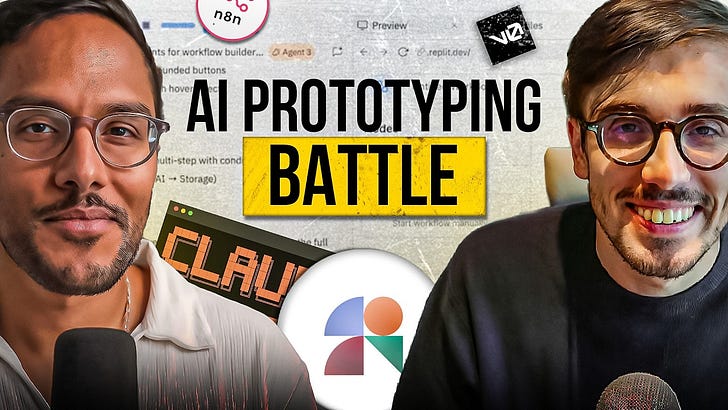
AI prototyping should be viewed as a fundamental skill for modern PMs, not an extra job responsibility. Just like using Figma to communicate design, AI prototyping tools allow PMs to make abstract AI concepts tangible for stakeholders and customers. This accelerates feedback loops and improves alignment on complex product behaviors.

Traditional agile development, despite its intent, still involves handoffs between research, design, and engineering which create opportunities for misinterpretation. AI tools collapse this sequential process, allowing a single person to move from idea to interactive prototype in minutes, keeping human judgment and creativity tightly coupled.

In an AI-driven workflow, the primary value of a rapid prototype is not for design exploration but as a communication tool. It makes the product vision tangible for stakeholders in reviews, increasing credibility and buy-in far more effectively than a slide deck.