Get your free personalized podcast brief
We scan new podcasts and send you the top 5 insights daily.
For older, transplant-ineligible patients, well-tolerated, long-term regimens from trials like CFIUS shift the treatment goal. Success is defined as managing myeloma so effectively that patients are more likely to die of other age-related causes, effectively outliving their cancer.

Related Insights
For elderly or comorbid patients, the high toxicity of powerful, time-limited combination therapies can outweigh their efficacy. A less harsh, continuous monotherapy is often preferable as it better preserves quality of life, even if it doesn't offer a treatment-free interval or a theoretical "100% life back."

The field of multiple myeloma has transformed from having few treatments to an abundance of effective drugs. The primary clinical challenge is no longer finding a therapy that works, but rather determining the optimal sequence and combination of available options, highlighting a unique form of market maturity.

For an older patient population, the ultimate goal in prostate cancer treatment might not be a traditional cure, but rather turning it into a quiescent, chronic disease manageable with well-tolerated therapy, similar to HIV. This reframes success as long-term control until a patient dies of other causes.

Traditional endpoints like progression-free survival (PFS) incentivize continuous treatment. The NCI group proposes "treatment-free survival," a novel metric that quantifies time spent *off* therapy. This endpoint better captures the patient experience and rewards treatments that provide durable responses after a finite course.
The clinical decision for newly diagnosed, transplant-ineligible myeloma patients has fundamentally shifted. Instead of determining who is eligible for a quadruplet regimen, the primary question for clinicians is now identifying the few patients who are not fit enough for this new standard of care.
Dr. Carbone argues that traditional metrics like median survival or response rate are less relevant for immunotherapies. The true measure of success is the percentage of patients alive at five or six years—the "tail of the curve"—as this indicates a durable, potentially curative, response.
In treating elderly AML patients, safety is paramount. The current standard, venetoclax, has an early (30-60 day) mortality rate of around 7%. Early data for mesutoclax shows zero early deaths in over 40 patients. This, combined with shorter durations of severe cytopenias, suggests a superior safety profile that could be a more important clinical differentiator than efficacy alone.

Five-year follow-up from the CARTITUDE-1 trial suggests a potential cure for multiple myeloma is achievable. With roughly one-third of heavily pretreated patients remaining in remission at five years—and some confirmed as MRD-negative—the concept of a cure is now part of the operational discussion among specialists, a monumental shift for a disease long considered incurable.
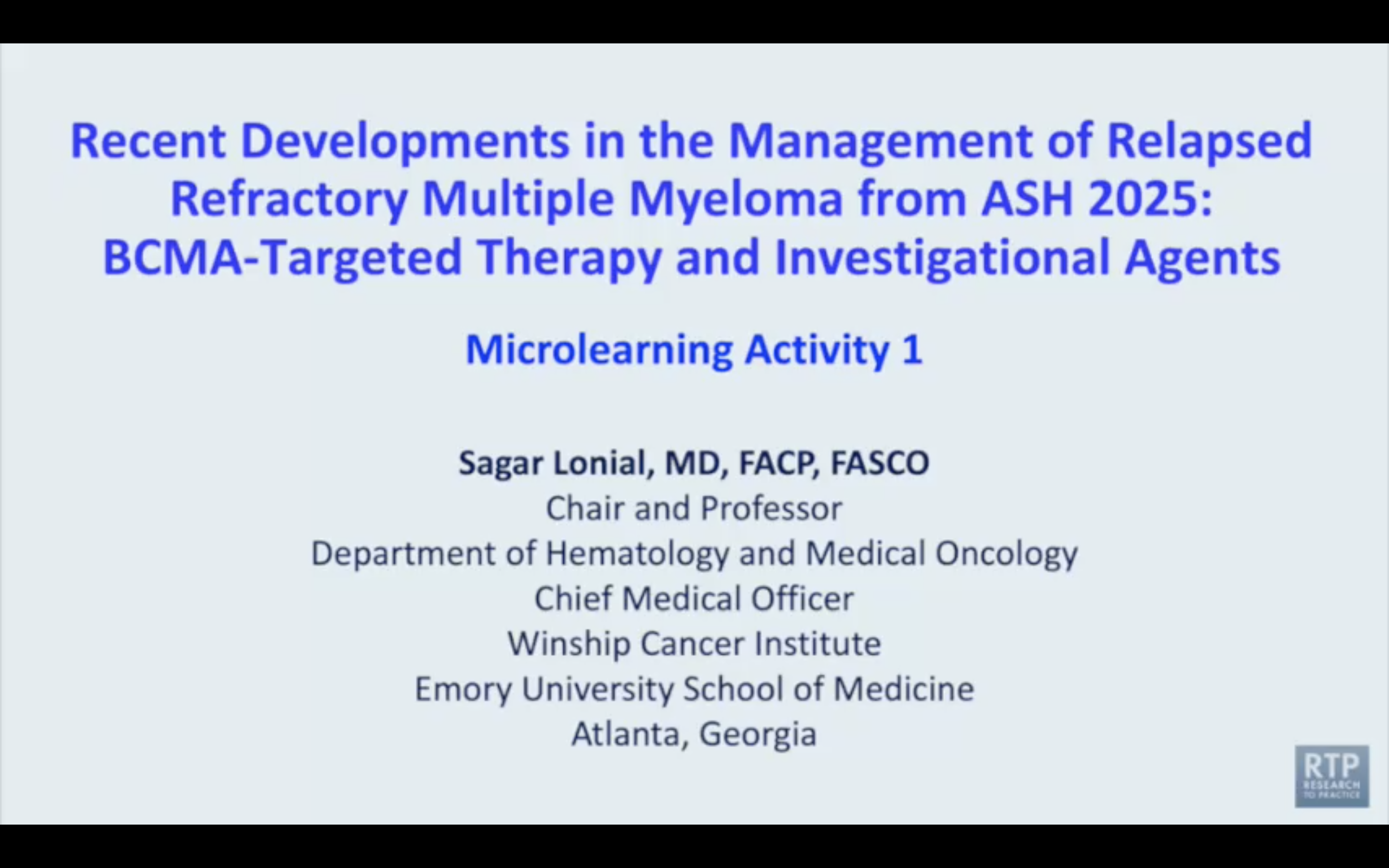
For older, transplant-ineligible myeloma patients, quadruplet regimens are not administered at full strength. Clinicians proactively reduce doses of bortezomib, lenalidomide, and dexamethasone based on patient fitness and renal function to manage toxicity while maintaining efficacy.
The term "functional cure" is misleading and hinders progress. With one-third of heavily pretreated patients in the Cartitude 1 trial remaining disease-free for five years without maintenance, the data supports the classical definition of a "cure" used in other cancers. This semantic shift is crucial for advancing the field.
