Get your free personalized podcast brief
We scan new podcasts and send you the top 5 insights daily.
Because most large businesses run on Microsoft, metrics like Azure growth, cloud margins, and M365 seat growth offer the cleanest read on how AI is actually flowing through the global economy. These numbers indicate real-world adoption and willingness to pay beyond the tech hype cycle.

Related Insights
AI's high computational cost (COGS) threatens SaaS margins. Nadella explains that just as the cloud expanded the market for computing far beyond the original server-license model, AI will create entirely new categories and user bases, offsetting the higher costs.
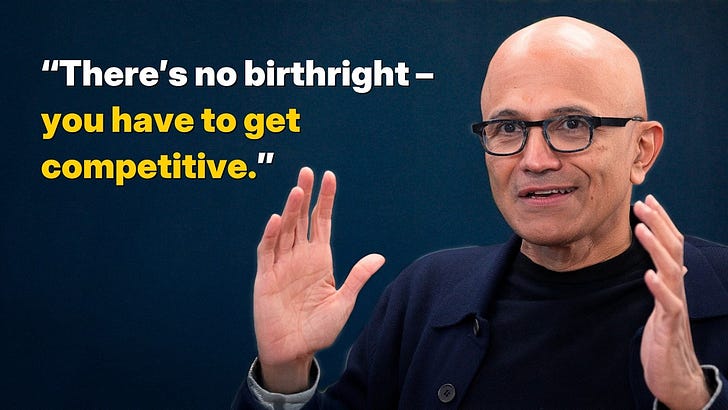
The compute-heavy nature of AI makes traditional 80%+ SaaS gross margins impossible. Companies should embrace lower margins as proof of user adoption and value delivery. This strategy mirrors the successful on-premise to cloud transition, which ultimately drove massive growth for companies like Microsoft.

Traditional metrics like GDP fail to capture the value of intangibles from the digital economy. Profit margins, which reflect real-world productivity gains from technology, provide a more accurate and immediate measure of its true economic impact.

Satya Nadella suggests a fundamental shift in enterprise software monetization. As autonomous AI agents become prevalent, the value unit will move from the human user ("per seat") to the AI itself. "Agents are the new seats," signaling a future where companies pay for automated tasks and outcomes, not just software access for employees.

Satya Nadella predicts that SaaS disruption from AI will hit "high ARPU, low usage" companies hardest. He argues that products like Microsoft 365, with their high usage and low average revenue per user (ARPU), create a constant stream of data. This data graph is crucial for grounding AI agents, creating a defensive moat.
Despite strong earnings and its OpenAI partnership, Microsoft's stock dropped because limited AI hardware and data center capacity are constraining Azure's revenue growth. This shows physical infrastructure is a major bottleneck for cloud giants, directly impacting market perception.

The explosive AI revenue growth stems from corporations re-categorizing the spending. It's no longer a line item in a constrained IT budget but a strategic investment in labor augmentation and replacement. This unlocks a vastly larger pool of capital from operational budgets, fueling hypergrowth.

CoreWeave, a major AI infrastructure provider, reports its compute workload is shifting from two-thirds training to nearly 50% inference. This indicates the AI industry is moving beyond model creation to real-world application and monetization, a crucial sign of enterprise adoption and market maturity.

Ramp's AI index shows paid AI adoption among businesses has stalled. This indicates the initial wave of adoption driven by model capability leaps has passed. Future growth will depend less on raw model improvements and more on clear, high-ROI use cases for the mainstream market.

Microsoft's staggering $625 billion in Remaining Performance Obligations (RPO), largely from long-term compute contracts, serves as a key financial justification for its heavy AI CapEx. This metric shows that it's not just Microsoft forecasting growth, but the entire industry committing to future compute needs.
