Get your free personalized podcast brief
We scan new podcasts and send you the top 5 insights daily.
The standard web chat is too restrictive. Starting in Cowork or Code provides access to file systems, remote sessions, and coding capabilities from the outset, avoiding the need to restart your workflow in a different tool when you hit a limitation.

Related Insights
Browser-based ChatGPT cannot execute code or connect to external APIs, limiting its power. The Codex CLI unlocks these agentic capabilities, allowing it to interact with local files, run scripts, and connect to databases, making it a far more powerful tool for real-world tasks.
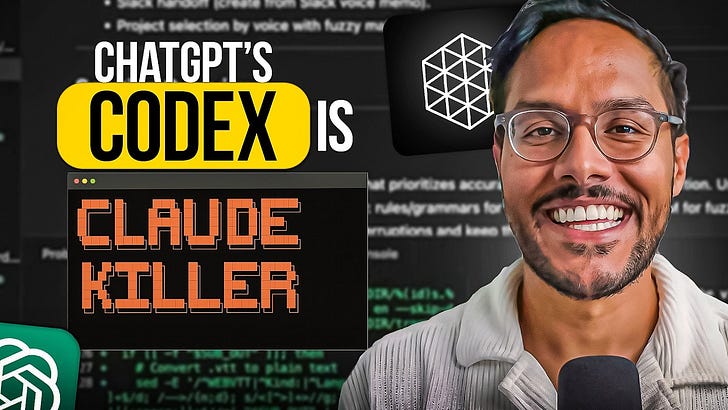
The host observed that error messages from Cowork were identical to those from Claude Code, suggesting Cowork is a streamlined interface designed to make the powerful, long-running capabilities of Claude Code accessible to non-technical users, rather than a separate backend system.

Claude Code's terminal-based interaction within a specific folder allows it to automatically read and reference local files. This makes "context engineering" drastically faster and more powerful than manually pasting information into a traditional chat interface, as the context is implicitly understood.

By integrating tools like Google Workspace, Linear, and Slack, Claude Code becomes a centralized command center. This eliminates the need to constantly switch between different applications, reducing cognitive load and saving time spent on routine tasks like updating documents or sending status messages.

The term "user-friendly" often implies simplification. However, as with Visual Studio Code versus Visual Studio, a more accessible interface can actually be a superset of functionality. Claude Cowork, while easier to use than Claude Code, is more powerful due to better integrations.
The term 'Claude Code' is a misnomer. Advanced users see these tools not just for coding, but as a generalized 'cloud computer.' By giving an agent access to files, terminals, and browsers, it becomes a versatile tool capable of any task, from program management to data analysis.

Tools like Claude Code offer superior capabilities beyond standard chatbots. They can access local file systems, enabling them to read and write files, maintain persistent memory, and execute complex, multi-step "recipes" autonomously, acting as a true virtual assistant rather than a simple text generator.

A key advantage of Claude Cowork is its ability to run locally and access files directly on a user's computer. This provides the AI with vastly more context than is possible with cloud tools that have limited file uploads, enabling complex analysis of large, local datasets like hundreds of documents.

Cowork originated from observing non-coders using the command-line tool, Claude Code, for general knowledge work. This prompted Anthropic to build a more accessible version with a GUI and safety guardrails, running the core agent in a virtual machine.
Desktop-based AI agents like Claude Co-Work, which can see your screen and local files, are a game-changer. They enable non-engineers to tackle complex projects like building production apps with single sign-on by providing real-time assistance and debugging.