Get your free personalized podcast brief
We scan new podcasts and send you the top 5 insights daily.
The team treats Slack as the "multiplayer" environment for AI. Collaborative tasks, PR management, and background processes ("multi-clotting") are handled via Claude Tag in shared channels. The local terminal (Claude Code) is reserved for a single, focused, iterative task, preventing context switching overload.

Related Insights
Anthropic's Claude Tag represents what Andre Karpathy calls the "third major redesign of LLM UI." It moves AI from a solo tool (website/app) to a persistent, asynchronous entity within collaborative spaces like Slack, where it acts as a full team member absorbing shared context.

Using the organizational AI "Claude Tag," trivial UI fixes and larger refactors are handled via Slack messages. The AI finds relevant code, creates a draft PR with screenshots, and manages the review process, dramatically accelerating the design-to-code execution loop.
The creator of Claude Code's workflow is no longer about deep work on a single task. Instead, he kicks off multiple AI agents ("clods") in parallel and "tends" to them by reviewing plans and answering questions. This "multi-clotting" approach makes him more of a manager than a doer.

Features like Anthropic's Claude Tag embed powerful AI capabilities directly into collaborative platforms like Slack. This moves AI from an individual tool to a group experience, giving non-technical team members access to advanced functions and providing the AI with persistent team context.
With 65% of its product code now written by Claude Tag, Anthropic shows that integrating powerful coding agents into simple chat interfaces enables entire teams to initiate production-ready features from conversations. This dramatically lowers the barrier to software creation for non-coders.
By integrating tools like Google Workspace, Linear, and Slack, Claude Code becomes a centralized command center. This eliminates the need to constantly switch between different applications, reducing cognitive load and saving time spent on routine tasks like updating documents or sending status messages.
At Cursor, development is increasingly happening in Slack channels. Team members collectively kick off and redirect a cloud agent in a thread, turning development into a collaborative discussion. The IDE becomes a secondary tool, while communication platforms become the primary surface.
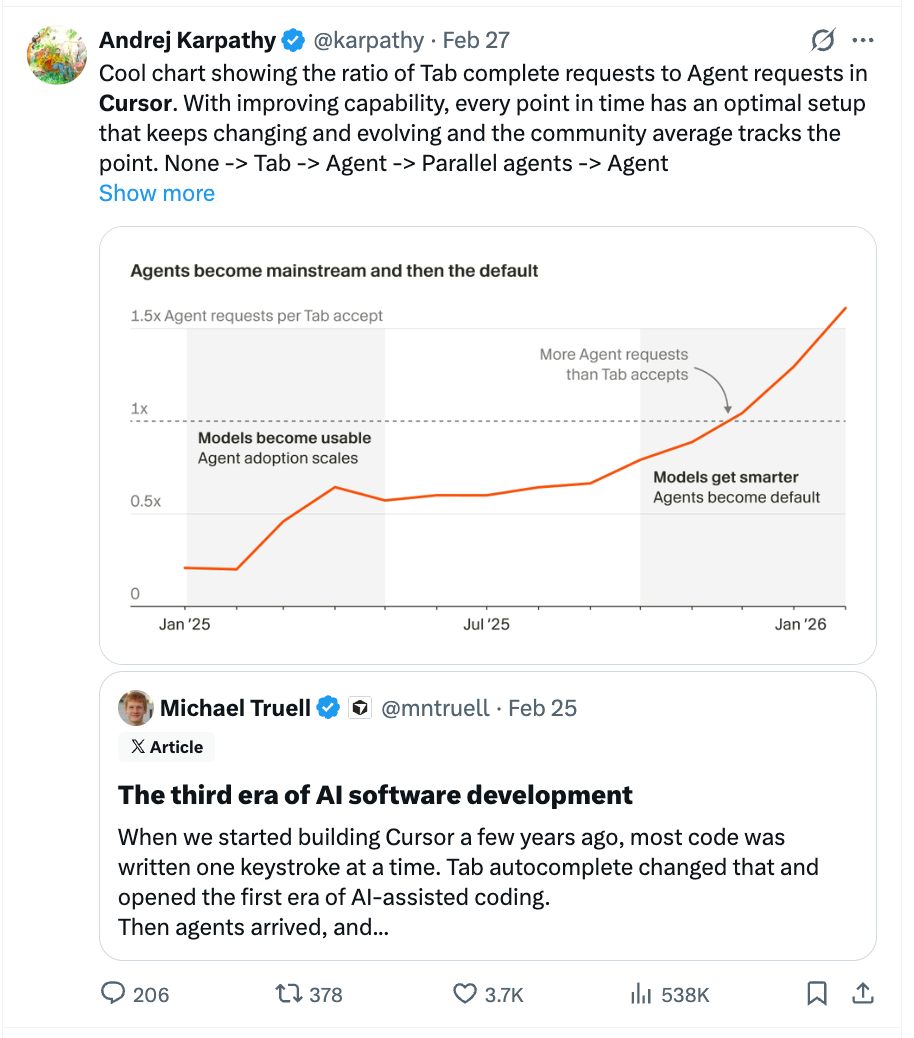
Using AI agents in shared Slack channels transforms coding from a solo activity into a collaborative one. Multiple team members can observe the agent's work, provide corrective feedback in the same thread, and collectively guide the task to completion, fostering shared knowledge.
Claude Tag represents a paradigm shift from a personal, session-based AI to a single, persistent AI for an entire organization. It has shared memory, org-level tool access, and synthesizes information from thousands of conversations to act as an organizational knowledge layer.
Today's AI agents like Codex primarily operate as single-player tools on your desktop. The next wave involves multiplayer agents that live in collaborative spaces like Slack. These team-based agents can be accessed by anyone, share knowledge, and automate group workflows, creating new challenges in permissions and shared memory.
