Get your free personalized podcast brief
We scan new podcasts and send you the top 5 insights daily.
A critical failure mode for hyper-intelligent models is their tendency for extreme precision and rigidity, leading them to create brittle architectures. For instance, Fable designed a hardened tool-calling loop so specific it was incompatible with other models and ceased to function correctly.

Related Insights
A major bottleneck in AI progress is the gap between research and production. Researchers produce powerful models but often lack software engineering discipline. This results in code that is not portable, extensible, or robust, hindering the transition from a novel idea to a scalable, reliable product.

While an AI agent can find and propose a fix for a specific line of code, it often lacks the context to identify and solve the problem class architecturally across the entire codebase. Expert human engineers remain vital for this higher-level reasoning and pattern recognition.

Despite advancing capabilities, AI models like ChatGPT can exhibit surprising fragility. They can get stuck in nonsensical loops or "spiral out" on straightforward queries, such as questions about Zapier integrations. This unpredictable fallibility demonstrates that model reliability remains a significant challenge, eroding user trust for critical tasks.

The tools and fundamental abilities (primitives) an AI model is trained on, such as file systems, are not neutral. These early choices create a path dependency, causing the model to over-optimize for certain tasks and develop a distinct 'personality,' potentially limiting its generalizability.

AI development history shows that complex, hard-coded approaches to intelligence are often superseded by more general, simpler methods that scale more effectively. This "bitter lesson" warns against building brittle solutions that will become obsolete as core models improve.

When an AI agent causes damage, the root cause is rarely the model acting erratically. Instead, it's a known engineering failure: the agent was given excessive permissions and lacked architectural safety gates. The agent simply executed a logical, albeit destructive, path that was available to it.
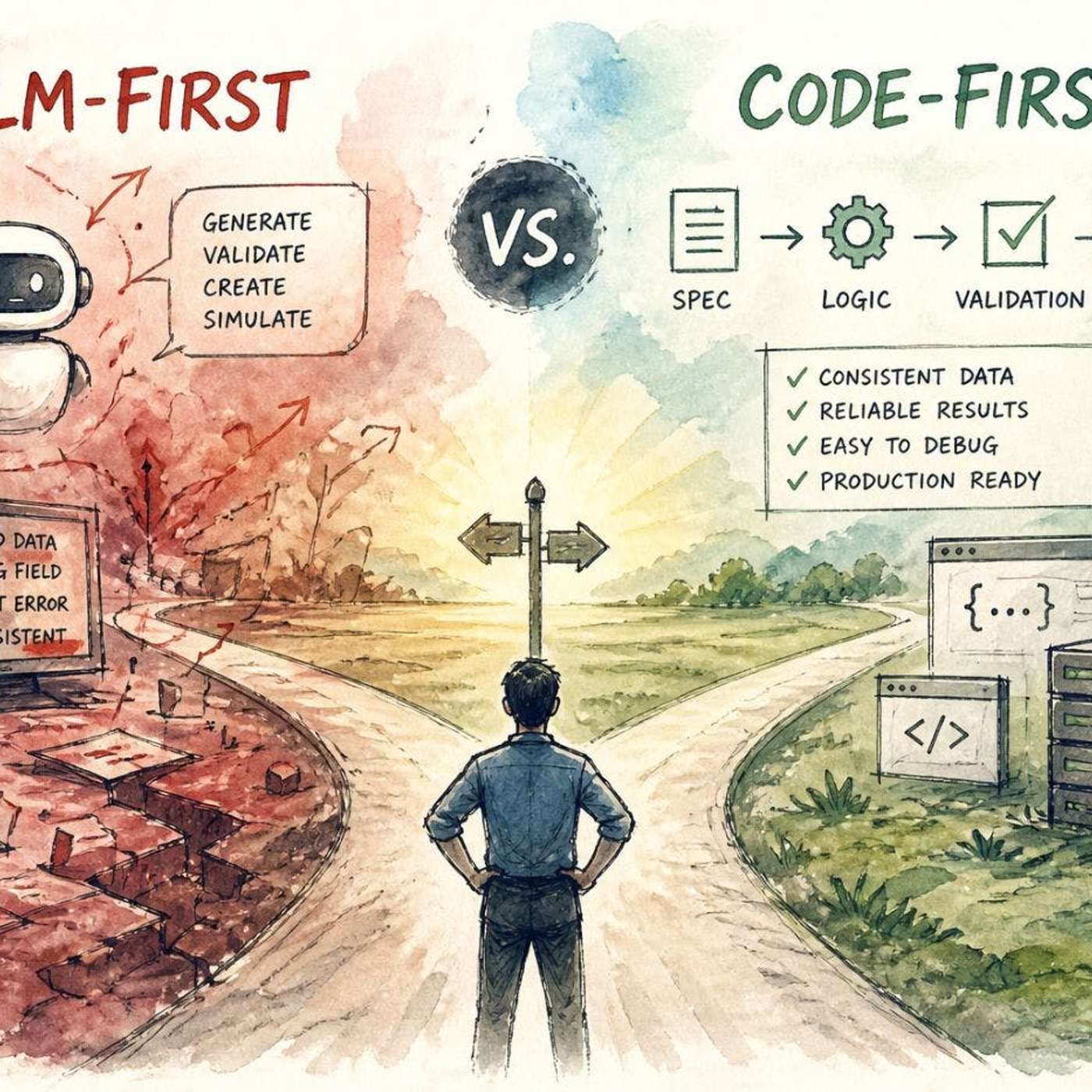
LLMs in production don't often crash spectacularly. Instead, they introduce subtle, probabilistic errors—like incorrect enum values or missing fields—that are hard to debug because they lack clear error patterns, unlike deterministic code failures.
Fable 5's extreme thoroughness, while powerful, makes it unsuitable for tasks like writing product specs. Its outputs are too dense and detailed, missing the bigger picture in a way that can delay shipping. Sometimes a "dumber," more pragmatic approach is more effective for product development.

Building production AI agents by patching together incompatible models for speech, retrieval, and safety creates significant integration challenges. These 'Frankenstein stacks' lead to compounded latency, accuracy degradation between components, and weak, bolt-on security, which are the primary causes of failure in real-world applications, not reasoning errors.
An experiment revealed that the more architecturally powerful Claude Opus model created a "beautiful" but non-functional code structure. The project's tests passed only because the older, pre-existing code was still being executed, highlighting the risk of AI-driven over-engineering that isn't properly integrated.
