Get your free personalized podcast brief
We scan new podcasts and send you the top 5 insights daily.
The most impactful AI in social systems may not be super-intelligent agents that replace humans, but simple AI designed to supplement interactions. These AIs can act as catalysts, like platinum in a chemical reaction, to facilitate and optimize how humans work together, improving both individual and collective performance.

Related Insights
AI's current strength lies in enhancing efficiency by handling tasks like summarization and data categorization. It is not suited for big-picture thinking or complex processes. The goal should be to make existing teams more effective—augmenting their abilities rather than pursuing wholesale replacement, which is a common misconception among business leaders.
A core principle for developing successful AI products is to focus on amplifying human capabilities, not just replacing them. The vision should be to empower human teams to perform the most demanding cognitive tasks and increase their impact, which leads to better product design and user adoption.

Business owners should view AI not as a tool for replacement, but for multiplication. Instead of trying to force AI to replace core human functions, they should use it to make existing processes more efficient and to complement human capabilities. This reframes AI from a threat into a powerful efficiency lever.

Users who treat AI as a collaborator—debating with it, challenging its outputs, and engaging in back-and-forth dialogue—see superior outcomes. This mindset shift produces not just efficiency gains, but also higher quality, more innovative results compared to simply delegating discrete tasks to the AI.
In its current form, AI primarily benefits experts by amplifying their existing knowledge. An expert can provide better prompts due to a richer vocabulary and more effectively verify the output due to deep domain context. It's a tool that makes knowledgeable people more productive, not a replacement for their expertise.

The strategic narrative for AI integration is shifting from automation (replacement) to augmentation (collaboration). Augmentation positions AI as an assistant that enhances human skills, enabling teams to achieve outcomes that neither humans nor AI could accomplish independently. This fosters a more inclusive and productive environment.
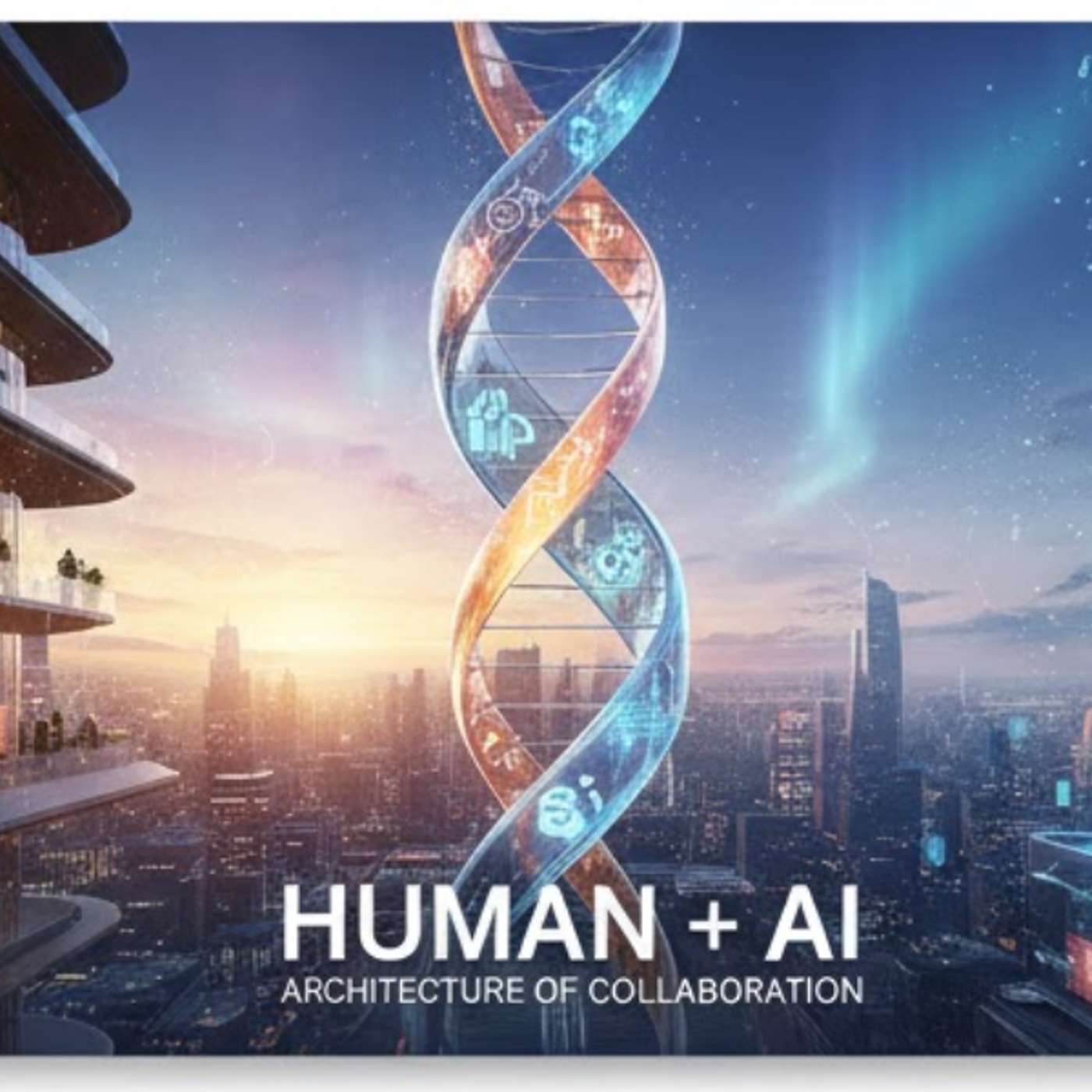
The next frontier for AI isn't just personal assistants but "teammates" that understand an entire team's dynamics, projects, and shared data. This shifts the focus from single-user interactions to collaborative intelligence by building a knowledge graph connecting people and their work.

Citing Nobel laureate Danny Kahneman, who estimated 95% of human behavior is learned by observing others, AI systems should be designed to complement this "social foraging" nature. AI should act as an advisor providing context, rather than assuming users are purely logical decision-makers.

Human intelligence leaped forward when language enabled horizontal scaling (collaboration). Current AI development is focused on vertical scaling (creating bigger 'individual genius' models). The next frontier is distributed AI that can share intent, knowledge, and innovation, mimicking humanity's cognitive evolution.

The most powerful current use case for enterprise AI involves the system acting as an intelligent assistant. It synthesizes complex information and suggests actions, but a human remains in the loop to validate the final plan and carry out the action, combining AI speed with human judgment.
