Get your free personalized podcast brief
We scan new podcasts and send you the top 5 insights daily.
A defining characteristic of antibody-drug conjugates is not just their response rate, but their remarkable duration of response. Patients who respond often maintain that response for a significantly longer period than with standard chemotherapy, a benefit likely attributable to the ADC's effect on the tumor microenvironment.

Related Insights
The concept of Antibody-Drug Conjugates (ADCs) as simple "chemo attached to an antibody" is a significant oversimplification. True efficacy is highly dependent on complex factors like the linker's cleavage properties within the acidic tumor microenvironment, creating a "bystander effect" that is crucial to their function.

Modern antibody-drug conjugates (ADCs) like trastuzumab deruxtecan can kill nearby cancer cells that don't express the target protein. This 'bystander effect' is a game-changer, allowing ADCs to be effective even in tumors with varied (heterogeneous) protein expression, which has historically been a major clinical challenge.

An ADC may show better response rates than chemotherapy, but its true benefit is compromised if toxicities lead to treatment discontinuation. As seen with failed PARP/IO combinations, if patients cannot tolerate a drug long enough, the regimen's overall effectiveness can become inferior to standard therapy.
A new wave of antibody-drug conjugates (ADCs) is transforming ovarian cancer treatment. These 'heat-seeking missiles' deliver potent chemotherapy payloads directly to tumor cells, achieving response rates from 23% to over 60% in biomarker-selected populations. This far surpasses the efficacy of conventional chemotherapy in resistant settings.

Though ADCs like Sacituzumab Govitekan cause notable side effects like diarrhea and neutropenia, patient-reported outcome data shows they provide a meaningful and sustained improvement in quality of life compared to standard chemotherapy. This was observed even with longer treatment durations and lower discontinuation rates.
A surprising trend in ovarian cancer is the consistent efficacy of antibody-drug conjugates (ADCs) with a TOPA1 payload. Regardless of the specific cell surface target, these agents are achieving response rates around 50%, suggesting the payload's potency is the primary driver.
Unlike older antibody-drug conjugates (ADCs), newer agents are designed so their chemotherapy payload can diffuse out of the target cell and kill nearby tumor cells that may not even express the target antigen. This "bystander effect" significantly enhances their anti-tumor activity.
As multiple effective Antibody-Drug Conjugates (ADCs) become available, the primary clinical challenge is no longer *if* they work, but *how* to use them best. Key unanswered questions involve optimal sequencing, dosing for treatment versus maintenance, and overall length of therapy, mirroring issues already seen in breast cancer.
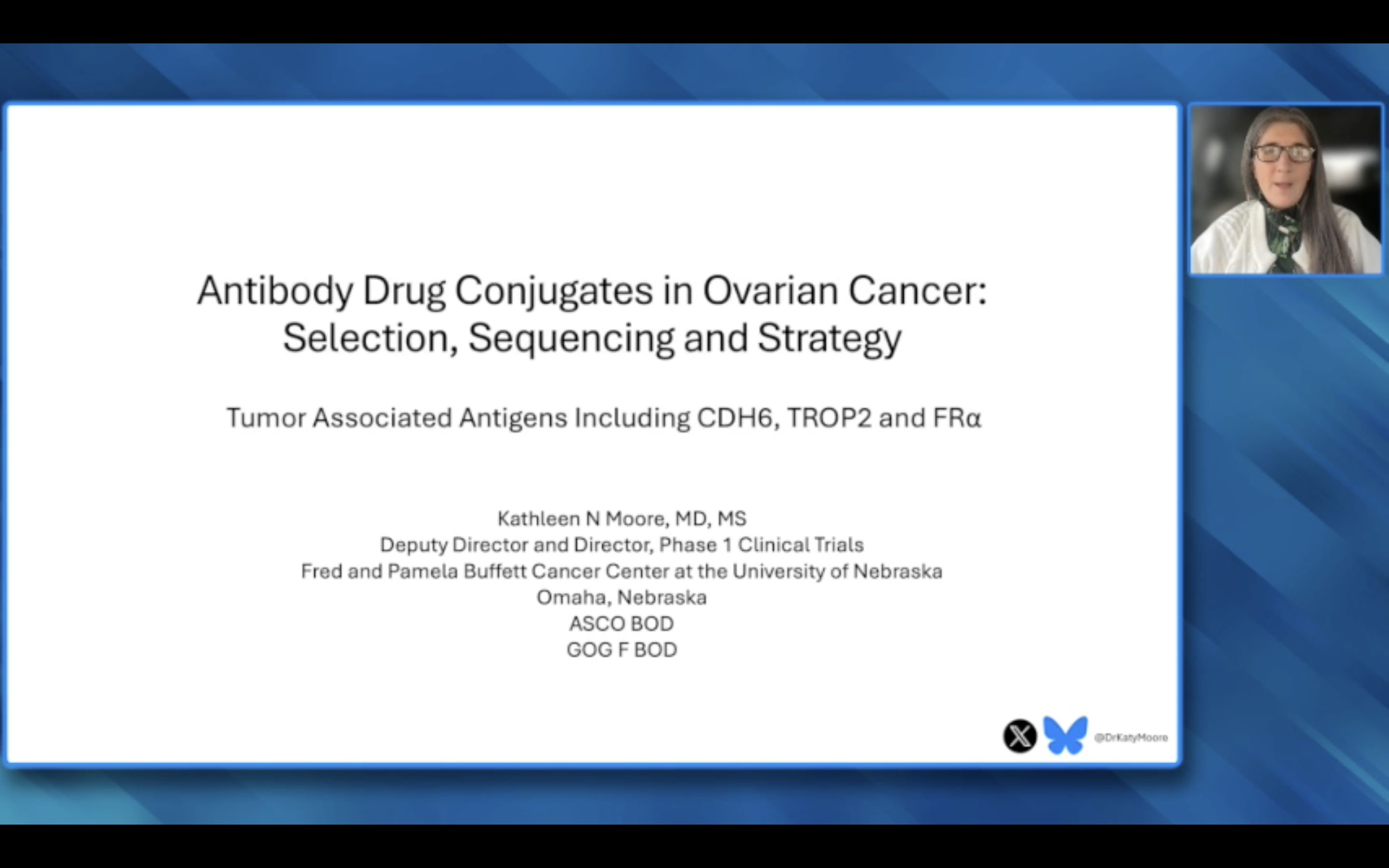
A high-level discussion among experts reveals a growing debate about the long-term use of antibody-drug conjugates (ADCs). They question whether the benefits of continuous chemotherapy delivery outweigh the cumulative and novel toxicities, suggesting a need for a more balanced approach to treatment duration.

Clinical trial data shows that despite specific toxicities, antibody-drug conjugates (ADCs) can be better tolerated overall than standard chemotherapy. For example, trials for both sacituzumab govitecan and dato-DXd reported fewer patients discontinuing treatment in the ADC arm compared to the chemotherapy arm.