Get your free personalized podcast brief
We scan new podcasts and send you the top 5 insights daily.
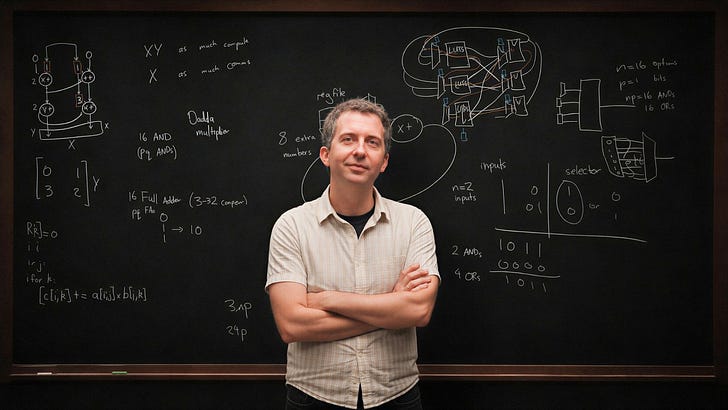
At a high level, a GPU's architecture consists of many replicated, smaller compute units (SMs), each with its own logic and memory. A TPU has a more centralized, coarse-grained design with a few very large, specialized units. One can think of a GPU as a collection of many tiny TPUs tiled across a chip.
Related Insights
The AI inference process involves two distinct phases: "prefill" (reading the prompt, which is compute-bound) and "decode" (writing the response, which is memory-bound). NVIDIA GPUs excel at prefill, while companies like Grok optimize for decode. The Grok-NVIDIA deal signals a future of specialized, complementary hardware rather than one-size-fits-all chips.

The performance gains from Nvidia's Hopper to Blackwell GPUs come from increased size and power, not efficiency. This signals a potential scaling limit, creating an opportunity for radically new hardware primitives and neural network architectures beyond today's matrix-multiplication-centric models.

The AI hardware market is fragmenting. Google is now producing two distinct eighth-generation TPUs: one for training (8t) and one for inference (8i). This move away from one-size-fits-all GPUs shows that optimizing for specific AI workloads is the next competitive frontier.
While purpose-built chips (ASICs) like Google's TPU are efficient, the AI industry is still in an early, experimental phase. GPUs offer the programmability and flexibility needed to develop new algorithms, as ASICs risk being hard-coded for models that quickly become obsolete.

A GPU is like a truck: its value is the massive payload (parallel data processing), not the driver (control logic). It excels at going straight for a long time. A CPU is like a motorcycle: it's mostly driver, designed for agility and complex steering through obstacle courses (branching instructions).

Model architecture decisions directly impact inference performance. AI company Zyphra pre-selects target hardware and then chooses model parameters—such as a hidden dimension with many powers of two—to align with how GPUs split up workloads, maximizing efficiency from day one.
The intense power demands of AI inference will push data centers to adopt the "heterogeneous compute" model from mobile phones. Instead of a single GPU architecture, data centers will use disaggregated, specialized chips for different tasks to maximize power efficiency, creating a post-GPU era.

Specialized chips (ASICs) like Google's TPU lack the flexibility needed in the early stages of AI development. AMD's CEO asserts that general-purpose GPUs will remain the majority of the market because developers need the freedom to experiment with new models and algorithms, a capability that cannot be hard-coded into purpose-built silicon.

The fundamental unit of AI compute has evolved from a silicon chip to a complete, rack-sized system. According to Nvidia's CTO, a single 'GPU' is now an integrated machine that requires a forklift to move, a crucial mindset shift for understanding modern AI infrastructure scale.

Unlike CPUs that use hardware-managed caches leading to unpredictable latency, AI accelerators like TPUs often use software-managed scratchpads. This gives the programmer explicit control over data placement, ensuring deterministic memory access times critical for synchronizing large parallel computations.