Get your free personalized podcast brief
We scan new podcasts and send you the top 5 insights daily.
Investor Brent Beshore's experience demonstrates a step-function change, not a gradual evolution. His firm's agentic AI projects, which failed after months of effort, were completed in minutes using Claude Cowork just weeks later. This highlights the surprisingly rapid transition of agentic AI from a theoretical concept to a practical, value-creating tool.

Related Insights
The development of Claude Cowork demonstrates a massive acceleration in product velocity. The entire application was written by its underlying AI agent, Claude Code, in just a week and a half. This showcases how AI-driven coding is collapsing development cycles for new software products.

Moving beyond chatbots, tools like Claude Cowork empower non-coders to create complex, multi-step autonomous workflows using natural language. This 'agentic' capability—connecting documents, searches, and data—is a key trend that will democratize automation and software creation for all knowledge workers.

Contrary to the view that useful AI agents are a decade away, Andrew Ng asserts that agentic workflows are already solving complex business problems. He cites examples from his portfolio in tariff compliance and legal document processing that would be impossible without current agentic AI systems.

Claude Code can take a high-level goal, ask clarifying questions, and then independently work for over an hour to generate code and deploy a working website. This signals a shift from AI as a simple tool to AI as an autonomous agent capable of complex, multi-step projects.
Claude Cowork demonstrates a significant evolution from conversational AI by functioning as an agent that creates finished deliverables. Instead of just suggesting a strategy in text, it can be prompted to write the underlying code to build a complete presentation deck with charts and custom files.
Traditionally, building software required deep knowledge of many complex layers and team handoffs. AI agents change this paradigm. A creator can now provide a vague idea and receive a 60-70% complete, working artifact, dramatically shortening the iteration cycle from months to minutes and bypassing initial complexities.

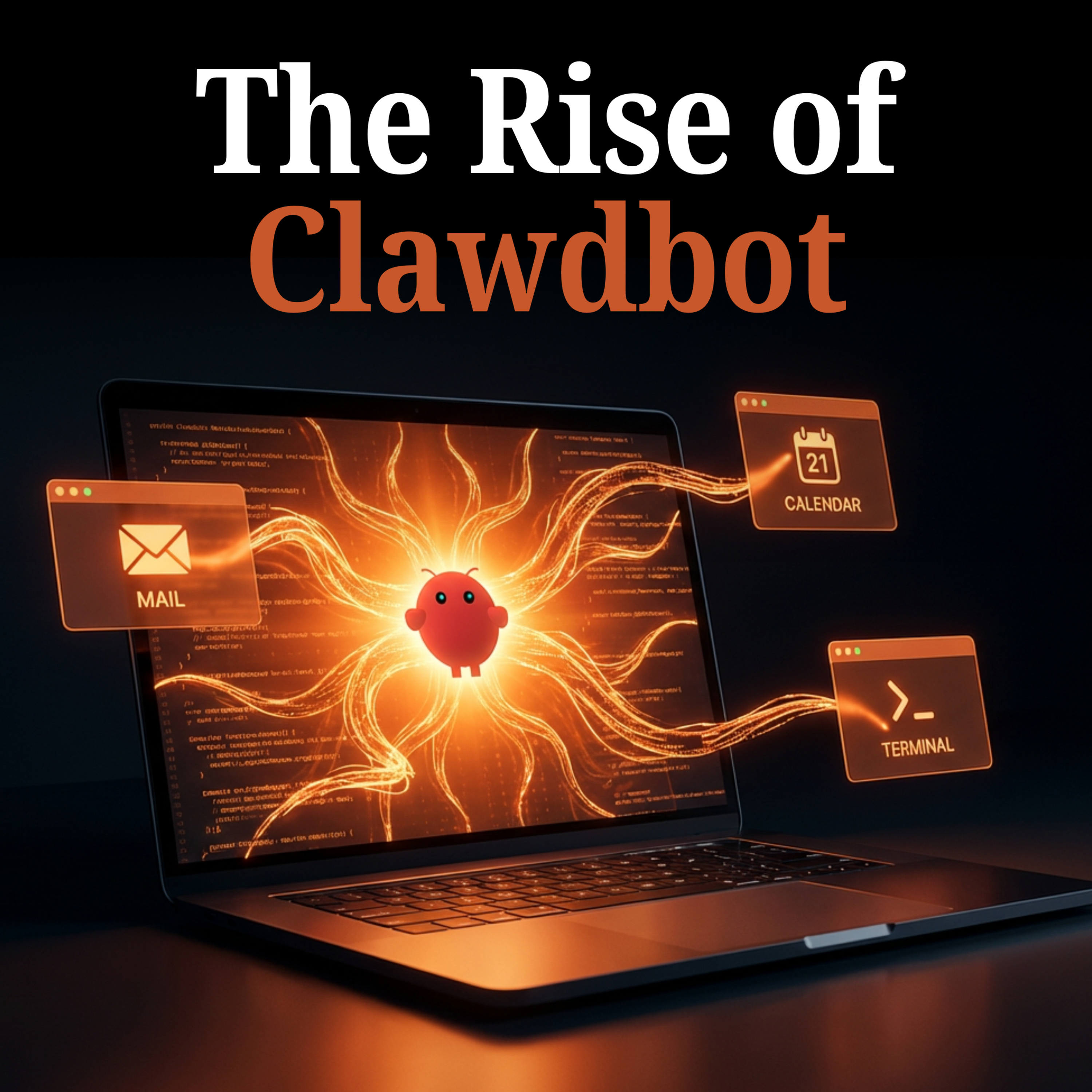
Clawdbot, an open-source project, has rapidly achieved broad, agentic capabilities that large AI labs (like Anthropic with its 'Cowork' feature) are slower to release due to safety, liability, and bureaucratic constraints.
The recent leap in AI coding isn't solely from a more powerful base model. The true innovation is a product layer that enables agent-like behavior: the system constantly evaluates and refines its own output, leading to far more complex and complete results than the LLM could achieve alone.

Cowork, a polished product from a major AI lab, was developed in just over a week using Claude Code itself. This is a major proof point that AI-assisted "vibe coding" is no longer just for prototypes but is a viable method for achieving extreme product velocity on production-grade software.
By deploying multiple AI agents that work in parallel, a developer measured 48 "agent-hours" of productive work completed in a single 24-hour day. This illustrates a fundamental shift from sequential human work to parallelized AI execution, effectively compressing project timelines.
