Get your free personalized podcast brief
We scan new podcasts and send you the top 5 insights daily.
The idea that AI will kill SaaS is too simplistic. It most accurately applies to large, public companies with significant inertia whose existing moats are disappearing. Startups and growth-stage companies that can maintain a 'day one' mentality and constantly re-evaluate their product have a significant advantage.

Related Insights
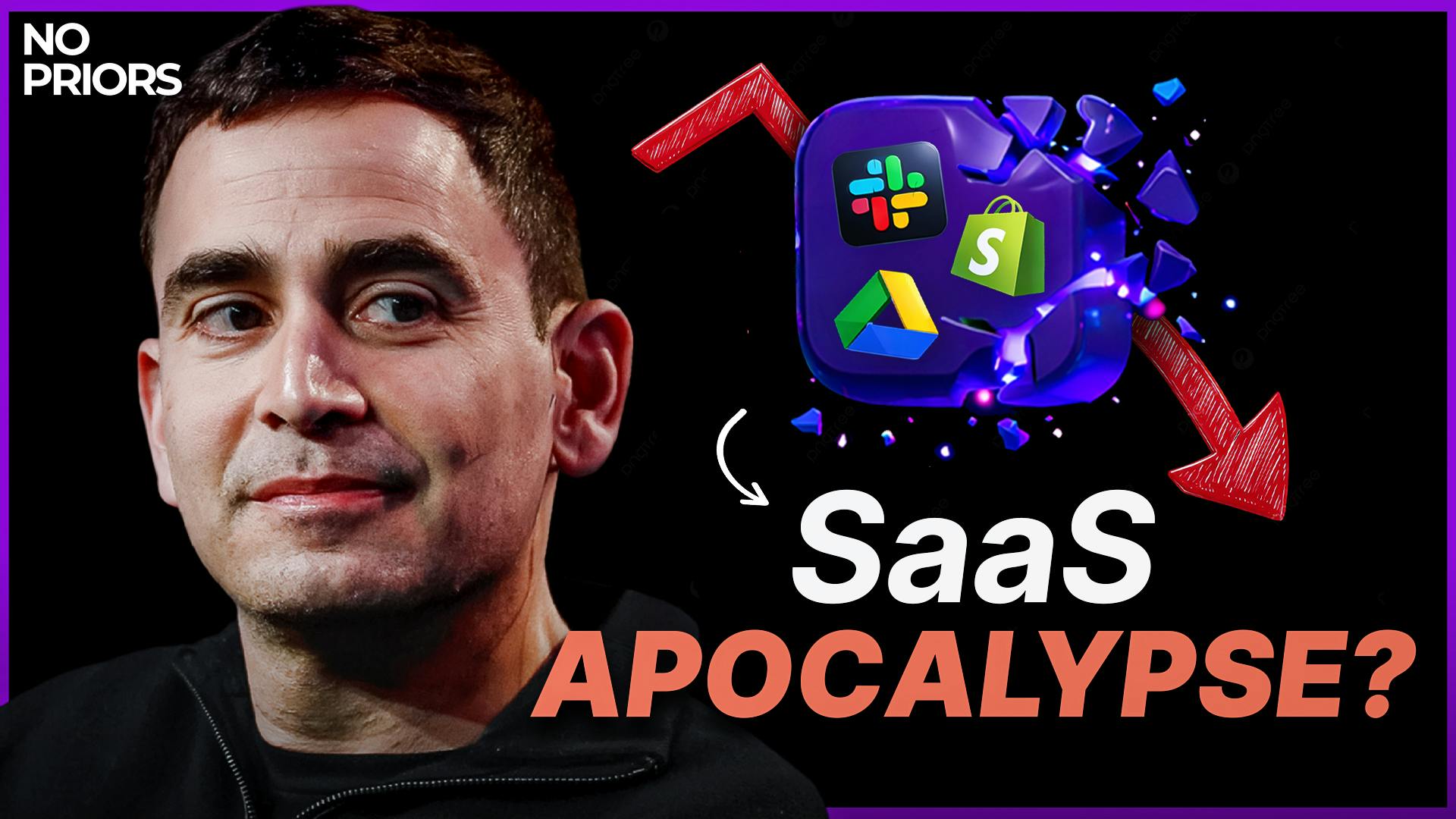
The "SaaSpocalypse" is not an indiscriminate event. A clear divergence is emerging between SaaS companies that are successfully integrating AI to strengthen their business models and those legacy companies that are unable to pivot, becoming "sloppable."

Disruptive AI innovations are counter-positioned against traditional seat-based SaaS pricing. Incumbents struggle to pivot because it would make them deeply unprofitable, spook investors, and require a complete cultural rewiring. This organizational inertia, not a technology gap, is their biggest vulnerability to AI-native startups.
Established SaaS companies struggle to implement AI because their teams are burdened with supporting existing customers, fixing feature gaps, and fighting legacy competitors. AI-native startups have a massive advantage as they don't have this baggage and can focus entirely on the new paradigm.

The "SaaS apocalypse" will target "beta" software—tools that make companies more similar to their competitors. Conversely, "alpha" software—platforms that allow a company to express its unique strategy and competitive advantage—will thrive as AI makes customization and differentiation easier.

AI doesn't kill all software; it bifurcates the market. Companies with strong moats like distribution, proprietary data, and enterprise lock-in will thrive by integrating AI. However, companies whose only advantage was their software code will be wiped out as AI makes the code itself a commodity. The moat is no longer the software.

In the age of AI, 10-15 year old SaaS companies face an existential crisis. To stay relevant, they must be willing to make radical changes to culture and product, even if it threatens existing revenue. The alternative is becoming a legacy player as nimbler startups capture the market.

The threat to established SaaS companies is not just technological but also psychological. Simply adding AI features to an existing product like Photoshop may not be enough if AI creates entirely new workflows. Survival depends on 'human agency'—bold leadership willing to cannibalize existing products and fundamentally reimagine their business for an AI-centric world.
The current market leaves no room for mediocrity. SaaS companies are either at the forefront of AI, delivering jaw-dropping value and capturing new budget, or they are being displaced. Hiding behind long-term contracts is a temporary solution, as there is no longer a middle ground.
The idea that AI will eliminate SaaS is overblown because it incorrectly projects small startup behavior onto large enterprises. Fortune 100s face immense change management, security, and maintenance challenges, making replacing established vendors with internal AI-coded tools impractical.
The threat of AI to SaaS is overstated for companies that own either a deep relationship with the user or a critical system of record. "Glue layer" SaaS companies without these moats are most at risk, while those like Salesforce (owning the customer relationship) are more durable.