Get your free personalized podcast brief
We scan new podcasts and send you the top 5 insights daily.
The proliferation of AI agents that constantly write and test code makes tooling performance critical. A two-minute compile time, an annoyance for a human, becomes a massive bottleneck for an automated agent that might trigger it hundreds of times, justifying major optimization efforts.

Related Insights
AMD has 'supercharged' its software development by using AI agents. These agents run in automated loops, constantly analyzing and optimizing customer models for AMD's hardware. This turns a slow, manual process into a scalable, nonstop operation, dramatically improving out-of-the-box performance for developers.

While AI accelerates code generation, it creates significant new chokepoints. The high volume of AI-generated code leads to "pull request fatigue," requiring more human reviewers per change. It also overwhelms automated testing systems, which must run full cycles for every minor AI-driven adjustment, offsetting initial productivity gains.

The core needs of AI agents—version control, testing, observability—mirror those of human developers. However, the sheer scale and speed of agentic workflows mean existing tools like Kubernetes are insufficient, requiring a fundamental reimagining of the entire infrastructure stack.

As AI generates vast quantities of code, the primary engineering challenge shifts from production to quality assurance. The new bottleneck is the limited human attention available to review, understand, and manage the quality of the codebase, leading to increased fragility and "slop" in production.

Tools like Git were designed for human-paced development. AI agents, which can make thousands of changes in parallel, require a new infrastructure layer—real-time repositories, coordination mechanisms, and shared memory—that traditional systems cannot support.

AI agents operate on a tight feedback loop. A slow CI/CD pipeline becomes the primary bottleneck, negating the speed benefits of AI-generated code. Fast CI is now a strategic necessity for any engineering team serious about leveraging AI.

The focus in AI engineering is shifting from making a single agent faster (latency) to running many agents in parallel (throughput). This "wider pipe" approach gets more total work done but will stress-test existing infrastructure like CI/CD, which wasn't built for this volume.
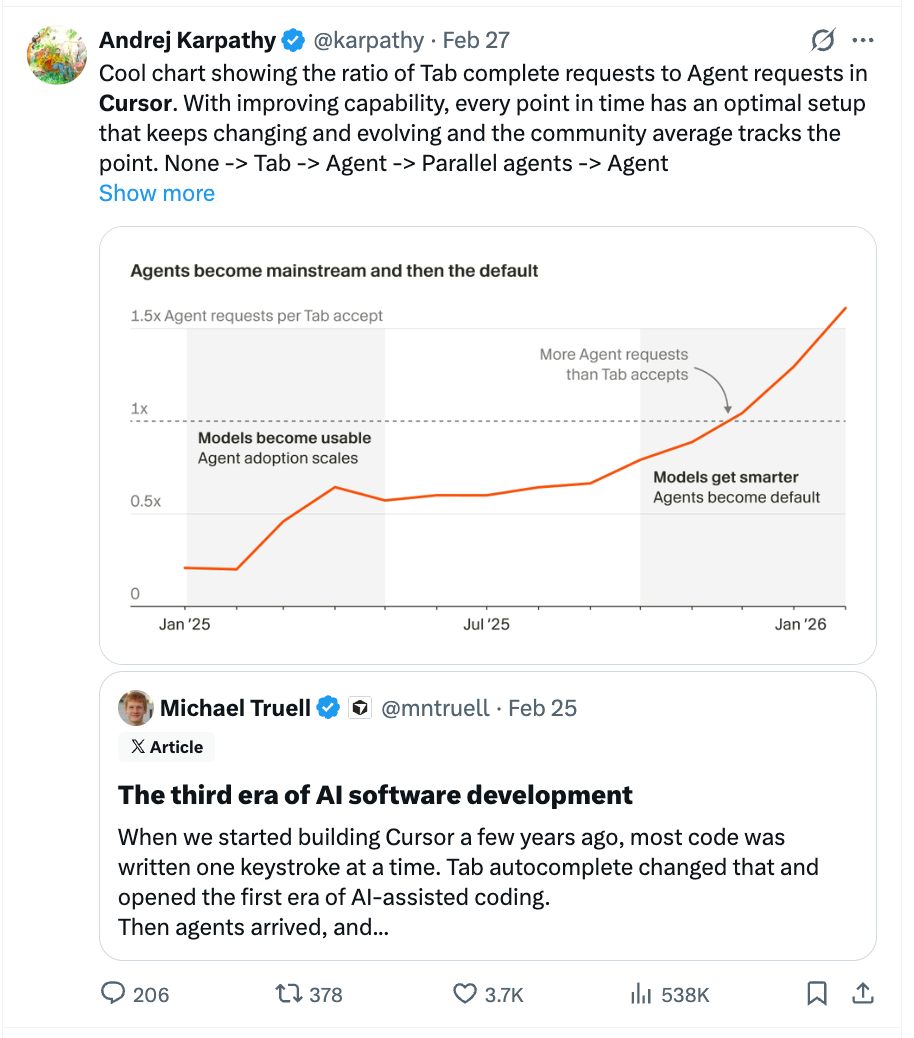
Simply deploying AI to write code faster doesn't increase end-to-end velocity. It creates a new bottleneck where human engineers are overwhelmed with reviewing a flood of AI-generated code. To truly benefit, companies must also automate verification and validation processes.

In the AI era, technical debt isn't 'ugly' code but anything that slows an AI agent's feedback loop. This includes slow tests, messy system boundaries that the AI will replicate, and poor runtime performance. The focus shifts from human readability to machine-drivable efficiency and safety.

AI agents can generate code far faster than humans can meaningfully review it. The primary challenge is no longer creation but comprehension. Developers spend most of their time trying to understand and validate AI output, a task for which current tools like standard PR interfaces are inadequate.