Get your free personalized podcast brief
We scan new podcasts and send you the top 5 insights daily.
You can't just deploy a probabilistic model like an LLM in a high-stakes field like healthcare. The key is to build a deterministic infrastructure (e.g., a rules engine with clinical guidelines) that governs the AI's operation, ensuring it operates safely within predefined constraints.

Related Insights
Don't give LLMs full control. Use deterministic code for core logic, validation, and enforcing rules. Delegate only tasks requiring flexibility or understanding of unstructured input to the LLM, treating it as a specialized component, not the entire system.
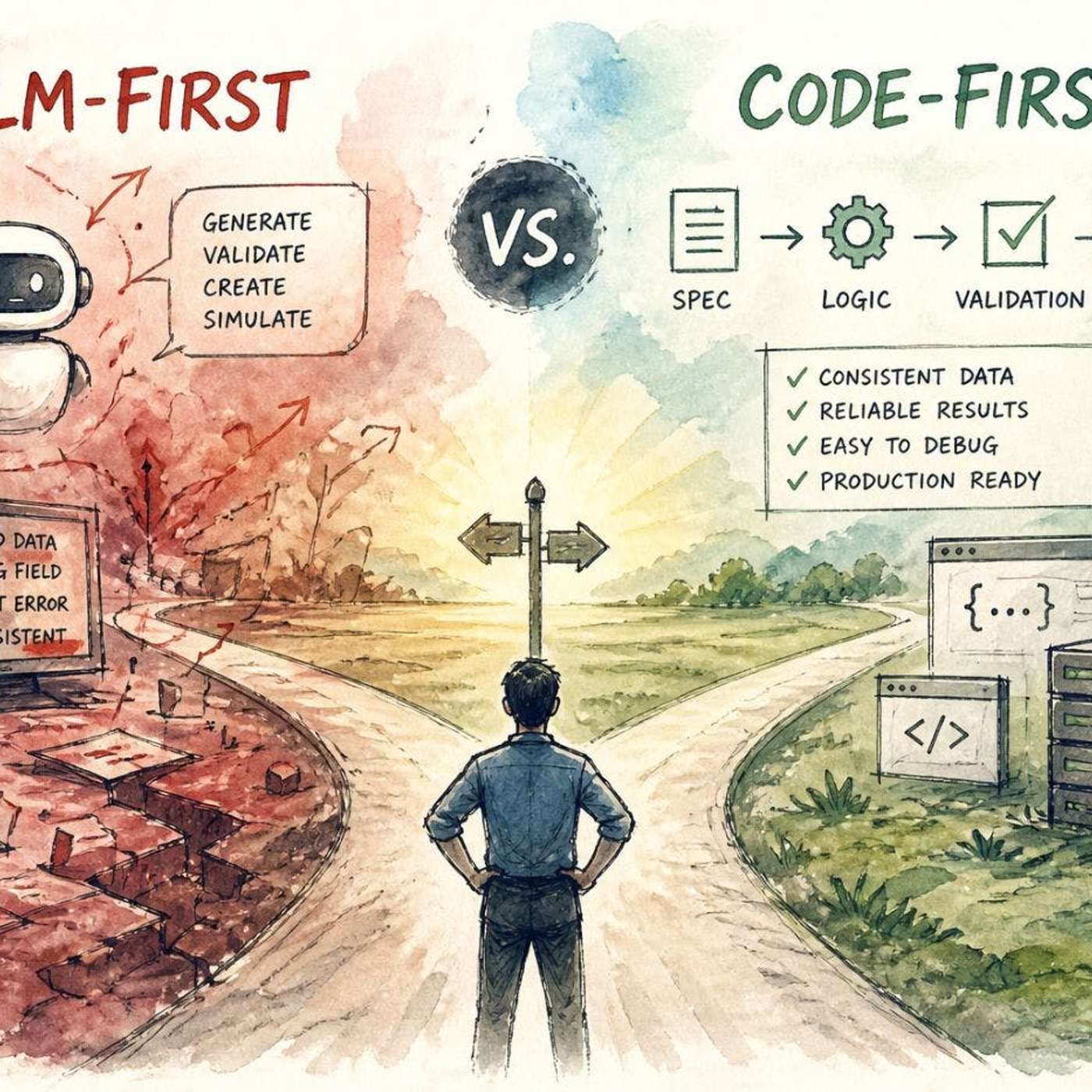
A new academic framework, ArbiterK, challenges the standard model of an LLM acting as the central controller. It inverts the paradigm by embedding the LLM within a deterministic execution system, demoting it to a suggestion engine. This ensures the system, not the probabilistic LLM, retains final control and enforces rules.

To ensure reliability in healthcare, ZocDoc doesn't give LLMs free rein. It wraps them in a hybrid system where traditional, deterministic code orchestrates the AI's tasks, sets firm boundaries, and knows when to hand off to a human, preventing the 'praying for the best' approach common with direct LLM use.

In high-stakes industries like finance and healthcare, the ability to deploy autonomous AI is directly tied to the ability to prove it operates within safe, predefined boundaries. Rather than slowing innovation, robust governance is the prerequisite for safely activating autonomous systems in regulated environments.

Instead of relying solely on 'black box' LLMs, a more robust approach is neurosymbolic computation. This method combines three estimators: a traditional symbolic/rule-based model (e.g., a medical checklist), a neural network prediction, and an LLM's assessment. By comparing these diverse outputs, experts can make more informed and reliable judgments.

For critical enterprise functions like financial modeling, 99.9% accuracy from a probabilistic LLM is unacceptable. Platforms like Salesforce's Agent Force 360 solve this by layering deterministic logic and guardrails on top of the AI, ensuring compliance and preventing costly errors where even a 0.1% failure rate is too high.

To deploy LLMs in high-stakes environments like finance, combine them with deterministic checks. For example, use a traditional algorithm to calculate cash flow and only surface the LLM's answer if it falls within an acceptable range. This prevents hallucinations and ensures reliability.

To solve for LLM non-determinism, a hybrid approach first uses an LLM to evaluate new agent behaviors. It then analyzes these interactions to auto-generate specific, deterministic rules. Over time, this shifts most traffic to a fast, reliable rules engine, reserving the LLM only for true novelties.

In high-stakes fields like healthcare, the cost of an AI error is immense. Product leaders must prioritize safety, reliability, and the reproducibility of outcomes. A complete audit trail is non-negotiable, as it enables the reversal of incorrect decisions and ensures accountability.

Dr. Jordan Schlain frames AI in healthcare as fundamentally different from typical tech development. The guiding principle must shift from Silicon Valley's "move fast and break things" to "move fast and not harm people." This is because healthcare is a "land of small errors and big consequences," requiring robust failure plans and accountability.
