Get your free personalized podcast brief
We scan new podcasts and send you the top 5 insights daily.
Instead of providing a 'seed' for deterministic outputs, Jev prioritizes robustness: ensuring similar inputs produce similar outputs. This is more critical for real-world software, which must handle slight variations gracefully. Strict determinism is a less important property that can be traded off for better cost and performance.

Related Insights
Traditional software relies on predictable, deterministic functions. AI agents introduce a new paradigm of "stochastic subroutines," where correctness and logic are abdicated. This means developers must design systems that can achieve reliable outcomes despite the non-deterministic paths the AI might take to get there.

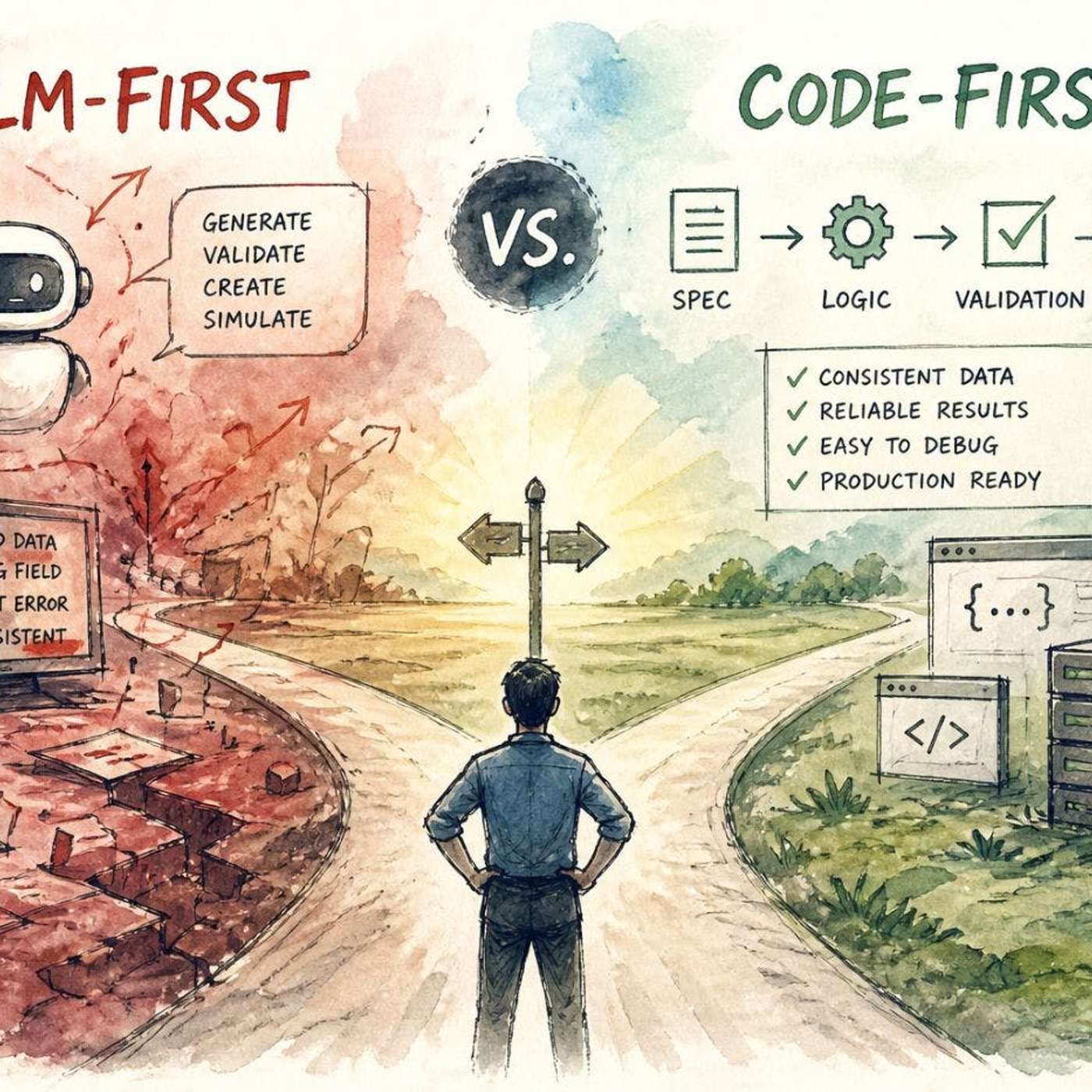
Don't give LLMs full control. Use deterministic code for core logic, validation, and enforcing rules. Delegate only tasks requiring flexibility or understanding of unstructured input to the LLM, treating it as a specialized component, not the entire system.
Leaders often misunderstand AI's probabilistic nature, thinking it's a flaw that will be "fixed." Drawing parallels to chaos theory, the slight non-determinism is an intentional feature that enables creativity and requires building systems with guardrails and human oversight, not seeking perfect predictability.

Customers often expect AI to behave like traditional, deterministic software, wanting the exact same output every time. Product Fruits' founder argues that trying to force this rigidity prevents scaling and misses the point of AI. The key is to educate customers that they must accept the stochastic nature of AI to truly leverage its power.

A significant hurdle for using large vision models in production is their non-deterministic nature. The same model can produce different results for the same query at different times, making it difficult to build reliable, consistent downstream systems. This unpredictability is a key challenge alongside speed and cost.

To ensure model robustness, OpenAI uses a "worst at N" evaluation metric. They sample a model's output multiple times (e.g., 20) on a given problem and measure the performance of the single worst response. This focuses development on eliminating low-quality outliers and ensuring a high floor for safety and consistency, rather than just optimizing for average performance.
When selecting foundational models, engineering teams often prioritize "taste" and predictable failure patterns over raw performance. A model that fails slightly more often but in a consistent, understandable way is more valuable and easier to build robust systems around than a top-performer with erratic, hard-to-debug errors.

LLMs in production don't often crash spectacularly. Instead, they introduce subtle, probabilistic errors—like incorrect enum values or missing fields—that are hard to debug because they lack clear error patterns, unlike deterministic code failures.
Setting an LLM's temperature to zero should make its output deterministic, but it doesn't in practice. This is because floating-point number additions, when parallelized across GPUs, are non-associative. The order in which batched operations complete creates tiny variations, preventing true determinism.

Simply adapting the Infrastructure-as-Code (IAC) model for AI is insufficient. Because AI systems are probabilistic—producing varied outputs from the same input—effective governance requires a multi-level strategy covering pre-deployment validation, runtime enforcement, and continuous monitoring, rather than a single configuration policy.