Get your free personalized podcast brief
We scan new podcasts and send you the top 5 insights daily.
The main barrier to using patient-derived organoids (mini-tumor avatars) for personalized treatment isn't the science of growing them. It's the standard NHS practice of immediately fixing biopsy tissue in paraffin, which kills the cells. A system-wide shift to fresh tissue sampling is the critical prerequisite for scale.

Related Insights
Dr. Deb Schrag suggests the main challenge for new molecular cancer screening technologies is not invention, but implementation. The critical task will be deploying these tools at a population scale and effectively managing the logistical challenge of distinguishing true positives from false alarms.
With support from the FDA and NIH, the industry is moving to standardize organoid systems. This shift transforms them from niche research tools into reliable, quality-controlled preclinical models that can be used for personalized medicine and to generate more predictable drug discovery data.

The primary challenge holding back precision medicine is not a lack of data or innovation. Instead, it's the operational difficulty of integrating and interpreting complex, siloed information quickly enough to make it clinically actionable for individual patients. The focus must shift from accumulation to execution.
Only 5% of investigational cancer drugs reach the market due to the gap between lab models and human biology. Dr. Saav Solanki highlights organoids, which use real patient tissue, as a key translational model to improve the predictive accuracy of preclinical research and increase the low success rate.
By converting his blood cells into pluripotent stem cells and growing them into 'organoids' (mini versions of his heart, liver, etc.), Bryan Johnson can test the effects and side effects of new molecules on his own tissues in a petri dish, accelerating and de-risking his longevity experiments.

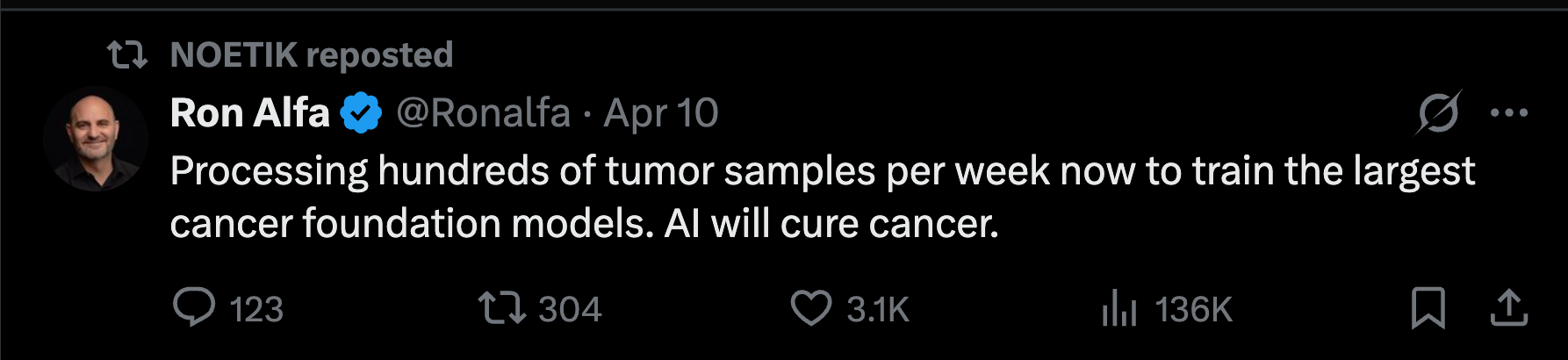
A major cause of clinical trial failure is that preclinical testing uses immortalized cancer cell lines cultured for decades. These cells have abnormal genomes and gene expressions that don't represent actual tumors, creating a massive translational gap that Noetik's patient-derived data aims to solve.
The technology behind new cell cryopreservatives also enables short-term (3-5 days), ice-free cold storage of complex structures like organoids and organs. This overcomes a major hurdle in their transportation and use, as they traditionally cannot be frozen or held for long periods.

The challenge of scaling 3D cell cultures isn't just about building larger systems. A more fundamental problem is the inability to measure and characterize the complex 3D environment in real-time. Without effective in-process analytics to ensure quality control and process optimization, true industrial scalability remains unachievable.
The ideal future for personalized cell therapies involves decentralized manufacturing using mobile units at the point of care, like a hospital. This model, which Cellino is pioneering with Mass General Hospital, eliminates complex logistics, reduces costs, and broadens patient access beyond major urban centers to rural areas.
To prevent exhausting small tissue samples, a pathology lab physically splits incoming biopsies into two cassettes. A small portion is used for initial diagnostic workups like immunohistochemical stains, while the bulk of the specimen is reserved in a separate cassette specifically for molecular testing, guaranteeing tissue adequacy.
