Get your free personalized podcast brief
We scan new podcasts and send you the top 5 insights daily.
Traditional models like rodents, non-human primates, iPSCs, and brain organoids fail to replicate complex human brain architecture, vasculature, and disease biology. Reperfusing intact donor human brains preserves native blood-brain barriers, endogenous CSF production, and human-specific targets to directly generate human pharmacology preclinically.

Related Insights
Current drug development heavily relies on animal testing. However, significant biological differences mean we may be filtering out effective human medicines that fail in animal models, creating a hidden opportunity cost for medical breakthroughs.

Yale spin-out Bexorg uses donated, post-mortem human brains kept molecularly active to test CNS drugs. This novel platform's key advantage is its ability to directly measure pharmacokinetics and blood-brain barrier penetration in a complex human organ, addressing a primary reason for clinical trial failure that animal and cell models cannot adequately predict.

The push away from animal models is a technical necessity, not just an ethical one. Advanced therapeutics like T-cell engagers and multispecific antibodies depend on human-specific biological pathways. These mechanisms are not accurately reproduced in animal models, rendering them ineffective for testing these new drug classes.

For CNS diseases, where animal models are notoriously unreliable predictors of efficacy, the most pragmatic R&D model is to quickly move promising new chemical entities into human trials. The focus shifts from extensive preclinical validation to early biological experimentation in humans for proof-of-concept.

19 of 20 drugs fail because diseases like cancer and Alzheimer's require complex solutions, not a simple "turn one screw" fix. Massively scaled human tissue testing allows for exploring the vast search space needed to find these multi-target cures, which traditional methods cannot handle.

Advanced cell therapy isn't just about replacing lost cells. Transplanted, genetically engineered cells can be programmed to produce and secrete therapeutics locally. This turns them into a delivery platform that solves the critical challenge of the blood-brain barrier for large molecules.
Only 5% of investigational cancer drugs reach the market due to the gap between lab models and human biology. Dr. Saav Solanki highlights organoids, which use real patient tissue, as a key translational model to improve the predictive accuracy of preclinical research and increase the low success rate.

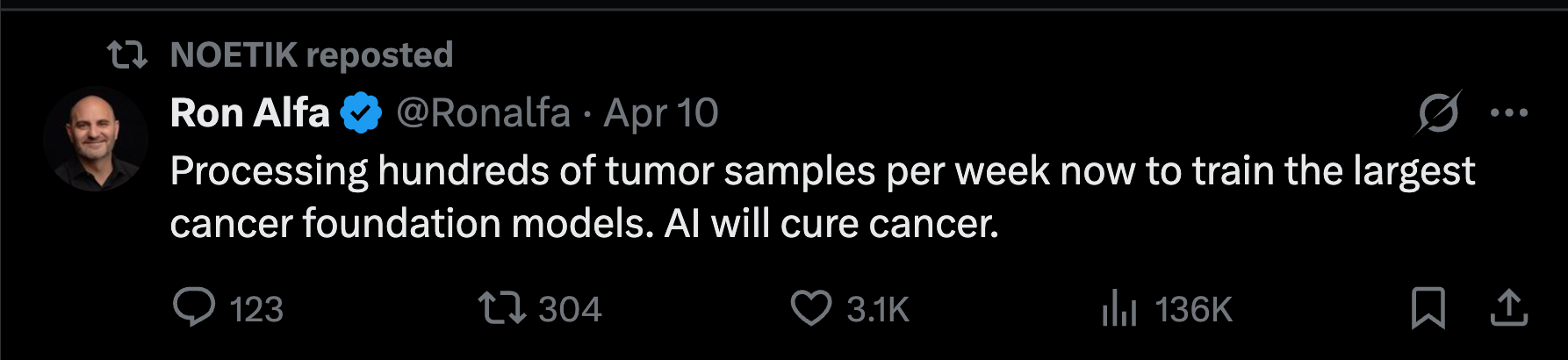
To bridge the gap between animal models and human trials, Noetik trains models on its human data and then runs inference on mouse histology (H&E) images. This allows them to predict human-relevant biology and gene expression directly from the mouse model, overcoming a key translational hurdle in drug development.
The NIH will no longer award funding to new grant proposals that rely exclusively on animal models. This policy forces a shift towards New Approach Methodologies (NAMs), such as organoids and organ-on-chips, serving as a major catalyst for innovation and adoption in the preclinical testing space.
The CNS biotech ecosystem has incredible momentum from new tools like advanced imaging, genetics, and AI. However, progress is stalled because the industry still uses outdated development frameworks, such as decades-old clinical trial designs and over-reliance on flawed animal models that fail to recapitulate human disease.