Get your free personalized podcast brief
We scan new podcasts and send you the top 5 insights daily.
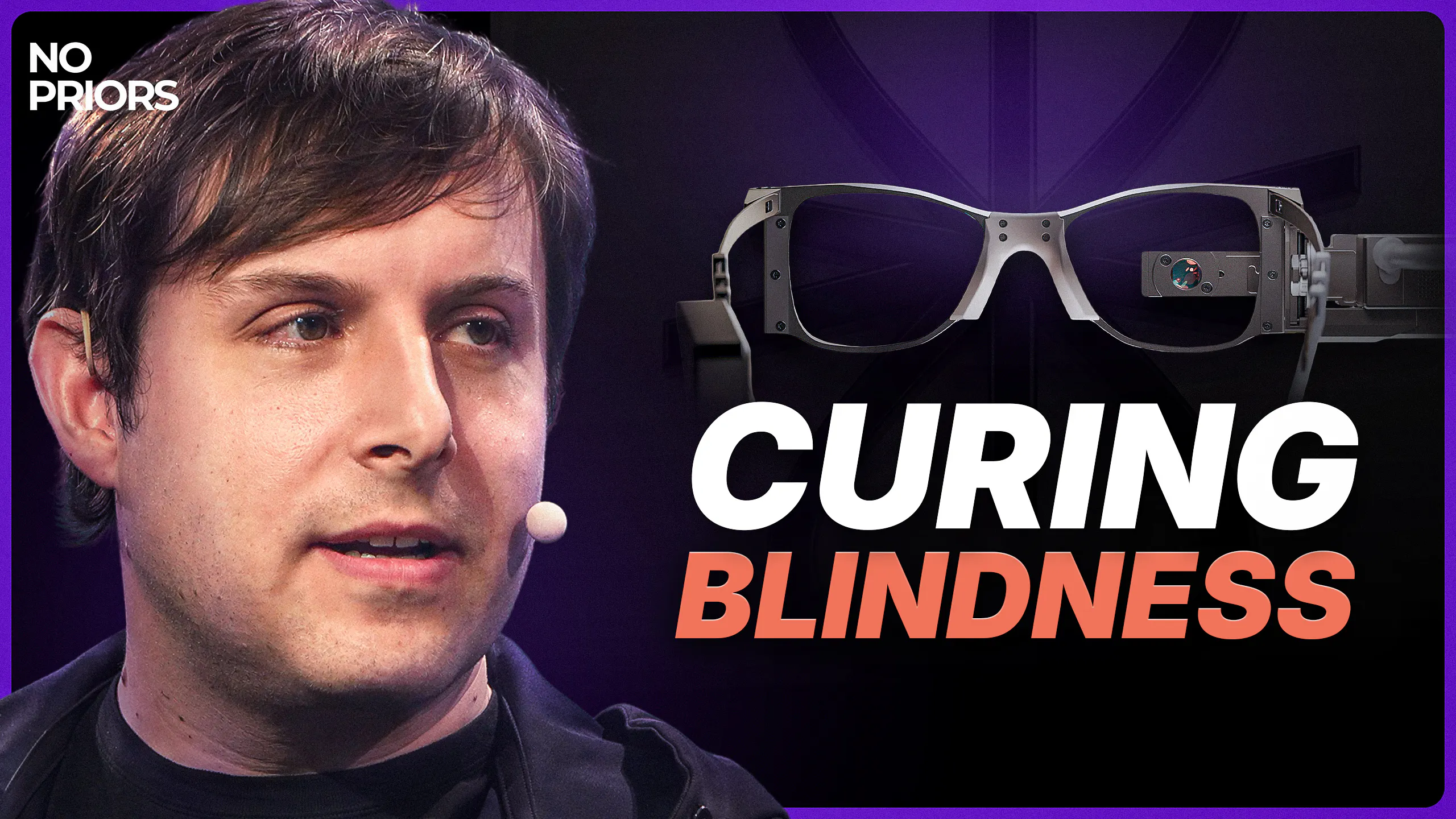
There's a spectrum of BCI applications. One end offers "hand substitutes," like silent speech for app control, which may offer only marginal utility. The more transformative end focuses on restoring core sensory channels like vision and hearing, which fundamentally augments the human experience.
Related Insights
The performance ceiling for non-invasive Brain-Computer Interfaces (BCIs) is rising dramatically, not from better sensors, but from advanced AI. New models can extract high-fidelity signals from noisy data collected outside the skull, potentially making surgical implants like Neuralink unnecessary for sophisticated use cases.

The next frontier of brain-computer interfaces (BCIs) moves beyond implanting electrodes. Researchers are developing interfaces where a user's own neural stem cells are grown onto a silicon chip. This biological hybrid then integrates with the brain, creating a seamless connection to cloud-based AI.

The next frontier for Neuralink is "blindsight," restoring vision by stimulating the brain. The primary design challenge isn't just technical; it's creating a useful visual representation with very few "pixels" of neural stimulation. The problem is akin to designing a legible, life-like image using Atari-level graphics.

While current brain-computer interfaces (BCIs) are for medical patients, the timeline for healthy individuals to augment their brains is rapidly approaching. A child who is five years old today might see the first healthy human augmentations before they graduate high school, signaling a near-term, transformative shift for society.

Designing for users with motor disabilities who control interfaces with their minds presents a unique challenge. Unlike typical design scenarios, it's impossible for designers to truly imagine or simulate the sensory experience, making direct empathy an unreliable tool for closed-loop interactions.
While companies like Neuralink popularize assistive BCIs for controlling external devices, a different segment is focused on therapeutic applications. Companies like InBrain aim not to control computers but to use high-resolution interfaces to directly heal or modulate neural circuits for treating diseases.

While many focus on BCI for high-bandwidth communication with AI, the more profound goal is "substrate independence." This means separating the human experience from its fragile biological hardware, allowing us to repair, replace, and upgrade parts of ourselves, fundamentally reducing human fragility.
A "frontier interface" is one where the interaction model is completely unknown. Historically, from light pens to cursors to multi-touch, the physical input mechanism has dictated the entire scope of what a computer can do. Brain-computer interfaces represent the next fundamental shift, moving beyond physical manipulation.
The company first targets patients with disabilities, a clear medical need. By restoring functions like speech, they create platforms for enhanced abilities (e.g., prompting AI with thoughts), paving the way for a wider consumer market where the risk-benefit calculation shifts over time.

Huberman argues that the most practical near-term path to 'writing' to the brain for focus or sleep isn't through complex implants but through the eyes and surrounding nerves. Technologies like smart glasses or sleep masks can leverage this direct neural pathway to powerfully and safely modify brain states.
