Get your free personalized podcast brief
We scan new podcasts and send you the top 5 insights daily.
Modern design tools like Figma and Vercel can generate workable demos, allowing product managers to get prototypes in front of customers for validation early in the process. This decouples product validation from engineering resource constraints, speeds up the feedback loop, and ensures engineering only builds features customers have already agreed to buy.

Related Insights
Instead of guarding prototypes, build a library of high-fidelity, interactive demos and give sales and customer success teams free reign to show them to customers. This democratizes the feedback process, accelerates validation, and eliminates the engineering burden of creating one-off sales demos.

Vercel's Pranati Perry explains that tools like V0 occupy a new space between static design (Figma) and development. They enable designers and PMs to create interactive prototypes that better communicate intent, supplement PRDs, and explore dynamic states without requiring full engineering resources.

Many product teams lack dedicated UX designers, creating a 'design gap' that blocks pre-development prototyping. Vibe coding tools empower PMs to quickly generate interactive, testable prototypes, ensuring ideas are validated with users before engineering begins.
The primary beneficiaries of AI prototyping are not developers, but Product Managers. These tools give PMs a 'get-out-of-no-developers' card, allowing them to independently create functional prototypes for user testing and ideation without waiting for engineering resources.

AI development tools have radically compressed the product design cycle. Instead of presenting wireframes or mockups, teams can now arrive at initial stakeholder meetings with fully functional, data-connected demos, dramatically accelerating the feedback loop and decision-making process.
Before writing code, you can string together hyperlinked screenshots in a design tool like Figma. This creates a 'hacky' prototype that feels like a fully built app to potential customers, allowing for rapid, low-cost user testing and validation.

AI tools like Vibe Coding remove the traditional dependency on design and engineering for prototyping. Product managers without coding expertise can now build and test functional prototypes with customers in hours, drastically accelerating problem-solution fit validation before committing development resources.

Historically, resource-intensive prototyping (requiring designers and tools like Figma) was reserved for major features. AI tools reduce prototype creation time to minutes, allowing PMs to de-risk even minor features with user testing and solution discovery, improving the entire product's success rate.
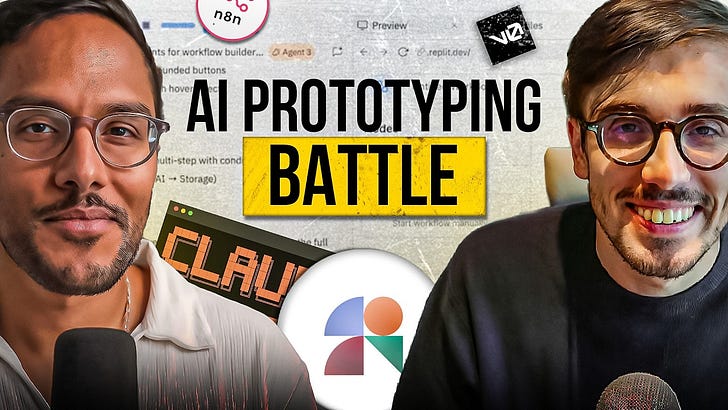
The product management workflow is evolving from documentation to creation. With AI tools lowering the barrier to build, PMs can now develop and share functional prototypes to communicate ideas and test assumptions, a much higher-fidelity approach than traditional written documents.
Instead of asking designers to create mockups from a verbal brief, PMs can use AI tools to generate multiple visual explorations themselves. This allows them to bring more concrete, refined ideas to the table, leading to a richer and more effective collaboration with the design team.